


Formosat-5, the nation’s first domestically developed satellite, was successfully launched yesterday at 2:51am Taiwan time from Vandenberg Air Force Base in California.
The satellite first communicated with a ground station in Svalbard, Norway, 83 minutes after its launch. At about 11:10am Taiwan time, it established contact with a ground station in Taoyuan’s Jhongli District (中壢).
The National Space Organization (NSPO) spent six years and about NT$5.65 billion (US$186.8 million at the current exchange rate) developing Formosat-5, which is to replace the decommissioned Formosat-2 in collecting data for disaster evaluation, national security and scientific research during its five-year mission.
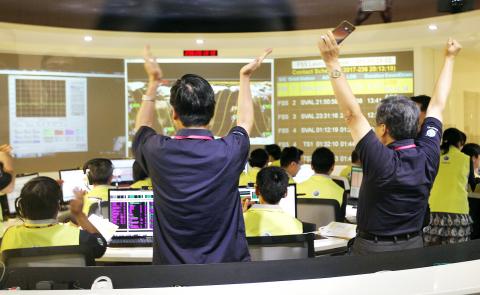
Photo: CNA
Through a Taiwan Television Enterprise broadcast at the agency’s control center in Hsinchu, officials, researchers and online viewers yesterday watched a US-made Space Exploration Technologies Corp (SpaceX) Falcon 9 rocket propel Formosat-5 into space.
As the satellite reached an altitude of 720km, audiences in Hsinchu and California simultaneously burst out in cheers and applause.
“The nation’s last launch of a satellite was in 2006. The launch [yesterday] could be said to be ‘sharpening a sword in 10 years,’” National Applied Research Laboratories (NARL) president Wang Yeong-her (王永和) said.
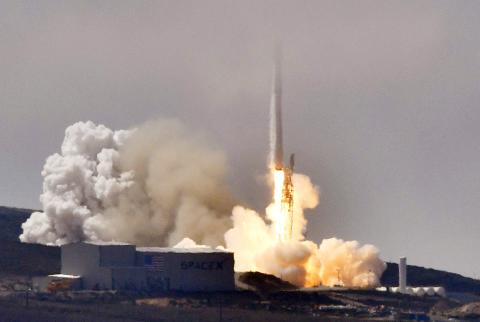
Photo: AP
The interpreter for the televised broadcast, National Museum of Natural Science director-general Sun Wei-hsin (孫維新), said the satellite’s first images would be available in about two weeks, once its solar panels and other equipment are operational.
The decommissioned Formosat-2 contributed greatly to disaster prevention and relief, providing images of Hurricane Katrina in the US in 2005, the 2008 Sichuan earthquake in China and Typhoon Morakot in Taiwan in 2009, Sun said, adding that he believes Formosat-5 will do even better.
However, in an op-ed published by the Chinese-language Apple Daily on Friday last week, former NSPO director-general Lance Wu (吳作樂) said that Formosat-5 was no better than its predecessor, questioning the agency’s “innovation.”

Photo: CNA
NSPO Deputy Director-General Yu Shiann-jen (余憲政) on Monday defended the satellite’s development, saying: “Formosat-5 is capable of delivering color imagery and a resolution down to 4m, better than the 8m of Formosat-2. It can also adjust the angle of photographs due to its smart agility.”
“More importantly, the images taken by Formosat-5 belong to Taiwan. We do not have to pay a foreign contractor like we did for Formosat-2,” he added.
The nation’s next space project, Formosat-7, which is to be a constellation of 12 small satellites, is being inspected by NSPO members, who are confident about its launch next year, Minister of Science and Technology Chen Liang-gee (陳良基) told a news conference in Taipei yesterday before toasting with champagne.
“We want to encourage young people to develop space technology, which is a promising industry,” Chen said.
In Los Angeles, Deputy Minister of Science and Technology Su Fong-chin (蘇芳慶) addressed a party celebrating the launch, saying that success does not come easy in space.
“It takes careful planning, execution and, more importantly, dedicated team effort,” Su said.
He extended his congratulations and appreciation to the NSPO’s Formosat-5 team and the SpaceX launch team for their efforts.
Su also expressed Taiwan’s appreciation to the US for its “long-term collaboration and partnership on many space programs over past decades.”
American Institute in Taiwan Chairman James Moriarty, Representative to the US Stanley Kao (高碩泰) and NARL chairman Yang Hung-duen (楊弘敦) were among the guests at the party.
President Tsai Ing-wen (蔡英文) extended her congratulations soon after the launch.
Formosat-5’s successful journey into orbit is an indication that Taiwan has taken another giant step in its technological advancement, Tsai said, adding that it would create a new momentum in the development of the nation’s space-related industries.

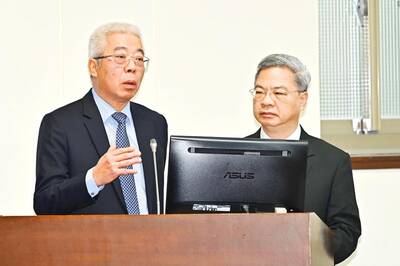
Taiwan has arranged for about 8 million barrels of crude oil, or about one-third of its monthly needs, to be shipped from the Red Sea this month to bypass the Strait of Hormuz and ease domestic supply pressures, CPC Corp, Taiwan (CPC, 台灣中油) said yesterday. The state-run oil company has worked with Middle Eastern suppliers to secure routes other than the Strait of Hormuz, through which about 20 percent of the world’s oil and liquefied natural gas typically passes, CPC chairman Fang Jeng-zen (方振仁) said at a meeting of the legislature’s Economics Committee in Taipei. Suppliers in Saudi Arabia have indicated they
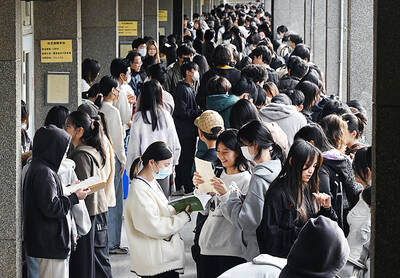
A global survey showed that 60 percent of Taiwanese had attained higher education, second only to Canada, the Ministry of the Interior said. Taiwan easily surpassed the global average of 43 percent and ranked ahead of major economies, including Japan, South Korea and the US, data from the Organisation for Economic Co-operation and Development (OECD) for 2024 showed. Taiwan has a high literacy rate, data released by the ministry showed. As of the end of last year, Taiwan had 20.617 million people aged 15 or older, accounting for 88.5 percent of the total population, with a literacy rate of 99.4 percent, the data

CCP ‘PAWN’? Beijing could use the KMT chairwoman’s visit to signal to the world that many people in Taiwan support the ‘one China’ principle, an academic said Chinese Nationalist Party (KMT) Chairwoman Cheng Li-wun (鄭麗文) yesterday arrived in China for a “peace” mission and potential meeting with Chinese President Xi Jinping (習近平), while a Taiwanese minister detailed the number of Chinese warships currently deployed around the nation. Cheng is visiting at a time of increased Chinese military pressure on Taiwan, as the opposition-dominated Legislative Yuan stalls a government plan for US$40 billion in extra defense spending. Speaking to reporters before going to the airport, Cheng said she was going on a “historic journey for peace,” but added that some people felt uneasy about her trip. “If you truly love Taiwan,

NEW LOW: The council in 2024 based predictions on a pessimistic estimate for the nation’s total fertility rate of 0.84, but last year that rate was 0.69, 17 percent lower An expected National Development Council (NDC) report expects the nation’s population to drop below 12 million by 2065, with the old-age dependency ratio to top 100 percent sooner than 2070, sources said yesterday. The council is slated to release its latest population projections in August, using an ultra-low fertility model, the sources said. The previous report projected that Taiwan’s population would fall to 14.37 million by 2070, but based on a new estimate of the total fertility rate (TFR) — the average number of children born to a woman over her lifetime — the population is expected to reach 12 million by


 RSS
RSS