


A coalition of labor and civic groups yesterday rallied in front of the Democratic Progressive Party’s (DPP) headquarters in Taipei to protest against what they called the DPP administration’s pro-business shift in labor policies and its failure to follow through on campaign promises.
This year’s Autumn Struggle march was directed against “fake transitional justice,” as protesters said the DPP administration promised but failed to carry out necessary reforms.
The DPP pledged support for minority groups, but the party, following its ascension to power, made a sharp turn in labor policies and other key issues and aligned itself with business groups instead of workers and underprivileged groups, protesters said.
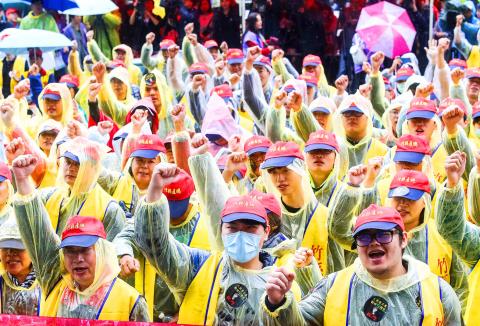
Photo: CNA
The DPP promised to carry out comprehensive, progressive reforms in the name of transitional justice, but it did little to address the structural exploitation permitted by government policies, while the only “transition” the DPP administration implemented was to cement its political advantage against the Chinese Nationalist Party (KMT), protesters said.
“Transitional justice cannot bring happiness to the public if it is solely conducted against the KMT for political gain. That is why we ask [the DPP administration] to listen to the public and orient its policies toward public welfare and especially the welfare of disadvantaged people,” march director Lin Tzu-wen (林子文) said.
Protesters sent a plaque to the DPP describing the party as a “fraud ring,” as they said the party flip-flopped on labor rights and public issues and continued the former administration’s policies that contributed to the exploitation of workers.
“A hunger strike in protest of a planned cancelation of seven national holidays by the DPP administration will not be stopped until the plan is scrapped,” Hsinchu Confederation of Trade Unions director Chan Su-chen (詹素貞) said.
Protesters also took issue with policies on migrant workers, education, property seizure, gender equality, energy and food safety.
The Green Citizens’ Action Alliance said the government should communicate with the public and respond to doubts about a plan to lift a ban on food imports from four Japanese prefectures that was implemented after the Fukushima Dai-ichi nuclear power plant disaster in 2011, instead of just scrapping the proposed lifting of the ban.
Education rights advocates criticized the Ministry of Education’s proposed university transition measures, which would allow more flexibility in school administration and facilitate school closures and mergers.
“The measures would be a continuation of the higher education policies of the 1990s that gave rise to tuition hikes and deregulation and privatization of the education sector,” Taiwan Higher Education Union member Su Tzu-hsuan (蘇子軒) said.
The DPP said that projects to reform the social welfare system are under way, and the party would help facilitate communication between the government and the public to speed up reforms in labor policies, childcare, education, housing, long-term care services and pension systems.
“We fully understand the public’s expectation for reforms and it is certain that the government will shape its policies in consideration of the opinions voiced today,” DPP spokesman Yang Chia-liang (楊家俍) said.

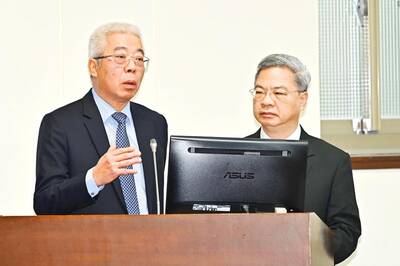
Taiwan has arranged for about 8 million barrels of crude oil, or about one-third of its monthly needs, to be shipped from the Red Sea this month to bypass the Strait of Hormuz and ease domestic supply pressures, CPC Corp, Taiwan (CPC, 台灣中油) said yesterday. The state-run oil company has worked with Middle Eastern suppliers to secure routes other than the Strait of Hormuz, through which about 20 percent of the world’s oil and liquefied natural gas typically passes, CPC chairman Fang Jeng-zen (方振仁) said at a meeting of the legislature’s Economics Committee in Taipei. Suppliers in Saudi Arabia have indicated they
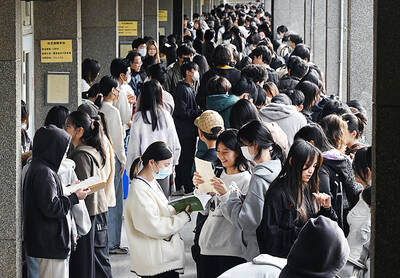
A global survey showed that 60 percent of Taiwanese had attained higher education, second only to Canada, the Ministry of the Interior said. Taiwan easily surpassed the global average of 43 percent and ranked ahead of major economies, including Japan, South Korea and the US, data from the Organisation for Economic Co-operation and Development (OECD) for 2024 showed. Taiwan has a high literacy rate, data released by the ministry showed. As of the end of last year, Taiwan had 20.617 million people aged 15 or older, accounting for 88.5 percent of the total population, with a literacy rate of 99.4 percent, the data

CCP ‘PAWN’? Beijing could use the KMT chairwoman’s visit to signal to the world that many people in Taiwan support the ‘one China’ principle, an academic said Chinese Nationalist Party (KMT) Chairwoman Cheng Li-wun (鄭麗文) yesterday arrived in China for a “peace” mission and potential meeting with Chinese President Xi Jinping (習近平), while a Taiwanese minister detailed the number of Chinese warships currently deployed around the nation. Cheng is visiting at a time of increased Chinese military pressure on Taiwan, as the opposition-dominated Legislative Yuan stalls a government plan for US$40 billion in extra defense spending. Speaking to reporters before going to the airport, Cheng said she was going on a “historic journey for peace,” but added that some people felt uneasy about her trip. “If you truly love Taiwan,

NEW LOW: The council in 2024 based predictions on a pessimistic estimate for the nation’s total fertility rate of 0.84, but last year that rate was 0.69, 17 percent lower An expected National Development Council (NDC) report expects the nation’s population to drop below 12 million by 2065, with the old-age dependency ratio to top 100 percent sooner than 2070, sources said yesterday. The council is slated to release its latest population projections in August, using an ultra-low fertility model, the sources said. The previous report projected that Taiwan’s population would fall to 14.37 million by 2070, but based on a new estimate of the total fertility rate (TFR) — the average number of children born to a woman over her lifetime — the population is expected to reach 12 million by


 RSS
RSS