


Members of the Chinese Nationalist Party (KMT) caucus have been calling for a party-wide consensus on “one China, different interpretations,” as preparations are under way for a meeting between the KMT chairwoman and Chinese authorities in Beijing next month to discuss cross-strait ties.
In a bid to prevent a repeat of recent conflict over the matter, the caucus yesterday again said that KMT Chairwoman Hung Hsiu-chu (洪秀柱) must adhere to the so-called “1992 consensus” of “one China, different interpretations.”
Conflicts within the party emerged when Hung pushed for “one China, same interpretation” to be adopted.
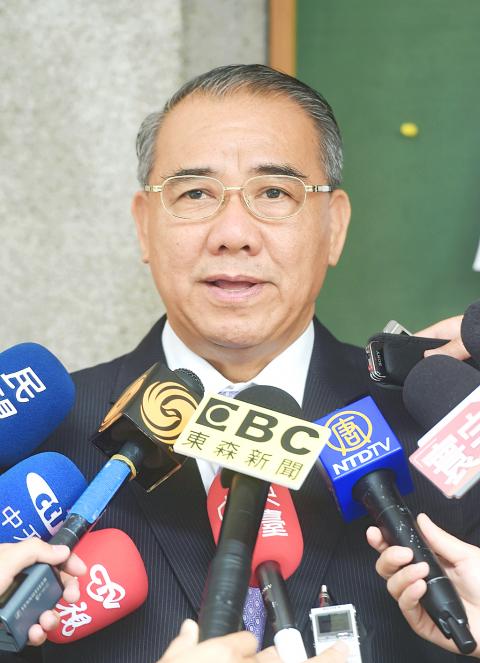
Photo: Fang Pin-chao, Taipei Times
The “1992 consensus” is a term former KMT lawmaker Su Chi (蘇起) admitted making up in 2000 when he was head of the Mainland Affairs Council. It refers to a tacit understanding between the KMT and the Chinese government that both sides of the Taiwan Strait acknowledge that there is “one China,” with each side having its own interpretation of what “China” means.
Hung is to meet Chinese President Xi Jinping (習近平) next month at a forum on “peaceful cross-strait development.”
The KMT says “one China, different interpretations” gives Taiwan an advantage in cross-strait relations.
A statement issued by the KMT caucus yesterday said that Taiwan and China have entered a period of “cold peace,” which it said must be overcome through normal communications.
The KMT hopes for more opportunities to engage with China and has suggested an exchange of ideas on peaceful development, the statement said.
The statement said that prior to exchanges or implementation of important cross-strait policies, the party headquarters should comprehensively brief the caucus, adding that it would get input from the public to “signify the importance placed on public opinion within the party’s central leadership and improve the effectiveness of promoting exchange activities.”
KMT caucus convener Sufin Siluko (廖國棟) said cross-strait peace is a huge topic, adding that he supports Hung’s attendance at the Beijing forum.
He said the forum would allow “Taiwan’s voice to be heard in Beijing,” adding that he hopes Hung can express the caucus’ stance on the “1992 consensus” at an opportune time.
He said that five legislators are to attend the forum and that the caucus would not stand in the way of anyone who sought to attend, adding that it would be best if all 35 KMT lawmakers were in their legislative seats next month with the next session expected be a tug-of-war.
KMT Legislator Lin Te-fu (林德福) said that while legislators are talking about whether to attend the forum in Beijing, there is still no consensus within the party itself.
He said that the caucus and the party’s central leadership must work together to ensure good communication.
Lin said that Hung should look at what was said at past meetings between KMT heads and Xi, adding that he believes Hung should “be smart enough to say one China, different interpretations, just as former president Ma Ying-jeou (馬英九) did.”
“I am sure the Chinese authorities will understand our position. The ideas brought up by the caucus should be valued by them,” Lin said.
KMT Culture and Communications Committee director Chow Chi-wai (周志偉) said that the caucus’ position on cross-strait interaction is in agreement with the party’s central leadership.
He said that the KMT would continue building on the established foundation of promoting cross-strait interaction, peaceful policies and economic development.
Chow said the caucus is the division of the party most capable of participating in and supervising the central government, adding that he hopes the party would work in unity to put the KMT back in power.

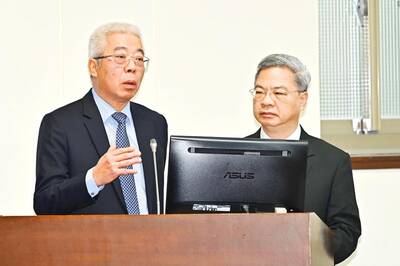
Taiwan has arranged for about 8 million barrels of crude oil, or about one-third of its monthly needs, to be shipped from the Red Sea this month to bypass the Strait of Hormuz and ease domestic supply pressures, CPC Corp, Taiwan (CPC, 台灣中油) said yesterday. The state-run oil company has worked with Middle Eastern suppliers to secure routes other than the Strait of Hormuz, through which about 20 percent of the world’s oil and liquefied natural gas typically passes, CPC chairman Fang Jeng-zen (方振仁) said at a meeting of the legislature’s Economics Committee in Taipei. Suppliers in Saudi Arabia have indicated they
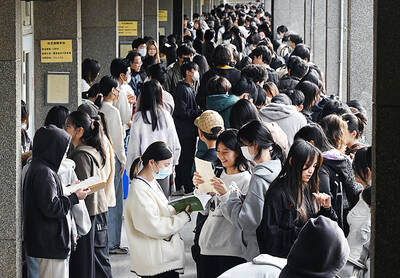
A global survey showed that 60 percent of Taiwanese had attained higher education, second only to Canada, the Ministry of the Interior said. Taiwan easily surpassed the global average of 43 percent and ranked ahead of major economies, including Japan, South Korea and the US, data from the Organisation for Economic Co-operation and Development (OECD) for 2024 showed. Taiwan has a high literacy rate, data released by the ministry showed. As of the end of last year, Taiwan had 20.617 million people aged 15 or older, accounting for 88.5 percent of the total population, with a literacy rate of 99.4 percent, the data
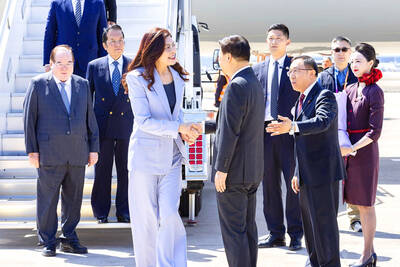
CCP ‘PAWN’? Beijing could use the KMT chairwoman’s visit to signal to the world that many people in Taiwan support the ‘one China’ principle, an academic said Chinese Nationalist Party (KMT) Chairwoman Cheng Li-wun (鄭麗文) yesterday arrived in China for a “peace” mission and potential meeting with Chinese President Xi Jinping (習近平), while a Taiwanese minister detailed the number of Chinese warships currently deployed around the nation. Cheng is visiting at a time of increased Chinese military pressure on Taiwan, as the opposition-dominated Legislative Yuan stalls a government plan for US$40 billion in extra defense spending. Speaking to reporters before going to the airport, Cheng said she was going on a “historic journey for peace,” but added that some people felt uneasy about her trip. “If you truly love Taiwan,

NEW LOW: The council in 2024 based predictions on a pessimistic estimate for the nation’s total fertility rate of 0.84, but last year that rate was 0.69, 17 percent lower An expected National Development Council (NDC) report expects the nation’s population to drop below 12 million by 2065, with the old-age dependency ratio to top 100 percent sooner than 2070, sources said yesterday. The council is slated to release its latest population projections in August, using an ultra-low fertility model, the sources said. The previous report projected that Taiwan’s population would fall to 14.37 million by 2070, but based on a new estimate of the total fertility rate (TFR) — the average number of children born to a woman over her lifetime — the population is expected to reach 12 million by


 RSS
RSS