


The legislature’s Foreign Affairs and National Defense Committee yesterday approved a proposal to eliminate a controversial addendum to the Enforcement Rules of the Passport Act (護照條例施行細則) that bans any modifications to the nation’s passports, which has been criticized as targeting a pro-independence sticker movement.
At a morning meeting at the legislature, the committee conducted an item-by-item examination of a package of amendments to the Enforcement Rules, which was proposed by the Ministry of Foreign Affairs in November last year and took effect on Jan. 1.
At the center of the controversy is Article 3 of the Enforcement Rules — an addendum included in the amendment package with an expanded definition of a ban already in Item 2, Article 5 of the Passport Statute (護照條例) on modification, alteration or stamps to the passport, stipulating that the ban applies to both the cover and inner pages.
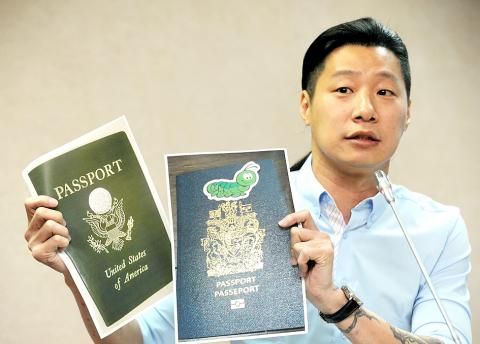
Photo: CNA
Presenting a picture of a Canadian passport embellished with a caterpillar sticker, New Power Party Legislator Freddy Lim (林昶佐) asked ministry officials whether they would deny the holder of such a passport entry to Taiwan or bring them in for questioning.
“No,” Deputy Minister of Foreign Affairs Javier Hou (侯清山) replied.
“So, only Taiwanese with sticker-adorned passports would be given a hard time at the nation’s borders? Is it not extremely contradictory?” Lim said.
Democratic Progressive Party (DPP) Legislator Chen Ting-fei (陳亭妃) pointed to a sticker with her name on it that was put on the cover of her passport by a travel agency as proof that Article 3 of the Enforcement Rules was tailor-made for the “Taiwan Passport Sticker Movement.”
Launched in July last year, the movement encourages Taiwanese to cover the “Republic of China” seal on their passport cover with a “Republic of Taiwan” (台灣國) sticker. It has attracted more than 30,000 followers on Facebook.
After reaching a consensus, participating legislators agreed to delete the addendum in question, which has sparked an outcry among supporters of the sticker movement, who accuse the ministry of infringing on their freedom of expression.
The committee meeting came two weeks after the DPP caucus decided to refer the whole package of amendments to the legislative committee for review. Under the law, it should have only be sent to the legislature and put on record for future reference.
However, due to the ministry’s opposition, legislators did not remove another related addendum — Article 22 of the Enforcement Rules — which allows government authorities to revoke the passports of people who violate the ban and refuse to “return their travel document to its original appearance.”
Bureau of Consular Affairs Director-General Kung Chung-chen (龔中誠) said that while he respected the new legislature’s opinions, the ministry would continue to advise the public to refrain from attaching stickers to their passports to avoid being denied entry to other countries.
Meanwhile, following the joint efforts of Lim and DPP Legislator Wellington Koo (顧立雄), a revision was made to Article 14 of the Enforcement Rules allowing first-time passport applicants to transliterate their names based on their pronunciation either in their mother tongue or Mandarin.
At present, people are only permitted to do so on their alternate names in the passport.
The revised amendment package is to be sent to a legislative plenary session for approval.

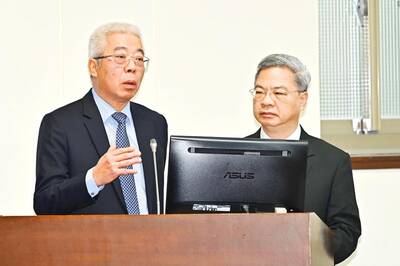
Taiwan has arranged for about 8 million barrels of crude oil, or about one-third of its monthly needs, to be shipped from the Red Sea this month to bypass the Strait of Hormuz and ease domestic supply pressures, CPC Corp, Taiwan (CPC, 台灣中油) said yesterday. The state-run oil company has worked with Middle Eastern suppliers to secure routes other than the Strait of Hormuz, through which about 20 percent of the world’s oil and liquefied natural gas typically passes, CPC chairman Fang Jeng-zen (方振仁) said at a meeting of the legislature’s Economics Committee in Taipei. Suppliers in Saudi Arabia have indicated they
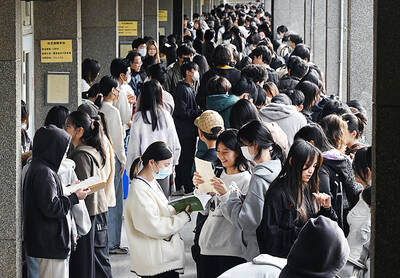
A global survey showed that 60 percent of Taiwanese had attained higher education, second only to Canada, the Ministry of the Interior said. Taiwan easily surpassed the global average of 43 percent and ranked ahead of major economies, including Japan, South Korea and the US, data from the Organisation for Economic Co-operation and Development (OECD) for 2024 showed. Taiwan has a high literacy rate, data released by the ministry showed. As of the end of last year, Taiwan had 20.617 million people aged 15 or older, accounting for 88.5 percent of the total population, with a literacy rate of 99.4 percent, the data

CCP ‘PAWN’? Beijing could use the KMT chairwoman’s visit to signal to the world that many people in Taiwan support the ‘one China’ principle, an academic said Chinese Nationalist Party (KMT) Chairwoman Cheng Li-wun (鄭麗文) yesterday arrived in China for a “peace” mission and potential meeting with Chinese President Xi Jinping (習近平), while a Taiwanese minister detailed the number of Chinese warships currently deployed around the nation. Cheng is visiting at a time of increased Chinese military pressure on Taiwan, as the opposition-dominated Legislative Yuan stalls a government plan for US$40 billion in extra defense spending. Speaking to reporters before going to the airport, Cheng said she was going on a “historic journey for peace,” but added that some people felt uneasy about her trip. “If you truly love Taiwan,

NEW LOW: The council in 2024 based predictions on a pessimistic estimate for the nation’s total fertility rate of 0.84, but last year that rate was 0.69, 17 percent lower An expected National Development Council (NDC) report expects the nation’s population to drop below 12 million by 2065, with the old-age dependency ratio to top 100 percent sooner than 2070, sources said yesterday. The council is slated to release its latest population projections in August, using an ultra-low fertility model, the sources said. The previous report projected that Taiwan’s population would fall to 14.37 million by 2070, but based on a new estimate of the total fertility rate (TFR) — the average number of children born to a woman over her lifetime — the population is expected to reach 12 million by


 RSS
RSS