


The scandal over the military police’s alleged violations of civilians’ rights with an illegal detention and search of a private residence took a surprising turn when a man surnamed Hu (胡) said he has a collection of more than 1,000 White Terror-era documents, and asked the Ministry of National Defense (MND) to contact him.
“It was meaningless for the military police to search Wei’s house. There are more of these documents in my hands,” said Hu, who is a consultant for the Taiwanese Web site “Rebirth.com” (再生.com) which specializes in the sale of antiques, valuable cultural items and historical materials.
The military police detained and questioned Wei last month, then went to his home, seizing three documents, which Wei had put up for sale on the Web site.
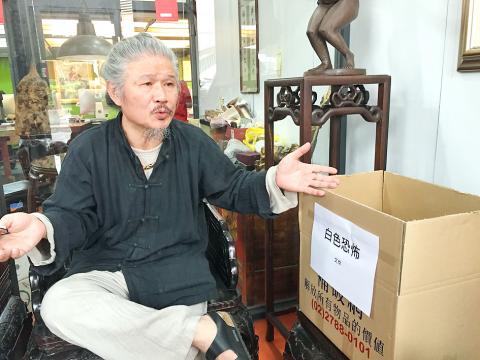
Photo: CNA
Among Hu’s collection were documents relating to the then-Chinese Nationalist Party (KMT) government’s conspiracy case against General Sun Li-jen (孫立人) and persecution of prominent KMT politician Lei Chen (雷震), Hu said.
Besides the files on Sun and Lei from the 1950s, Hu said he has more than 1,000 documents from the White Terror era, mostly once-classified material from the KMT’s military and intelligence apparatus, whose investigations led to the arrest, torture, imprisonment and death of dissidents, political activists and suspected communist spies during the four decades of martial law under the authoritarian rule of Chiang Kai-shek (蔣介石) and his son, former president Chiang Ching-kuo (蔣經國).
Among his collection were photographs of prisoners in their final hours, with their names, taken just before their execution, which researchers said is valuable historical material and should be put in a protected depository at the National Archives or at Academia Sinica.
“People from Academia Sinica and other institutions have bought materials from me in the past. I am a law-abiding businessman and I will not make problems for the military. If MND officials contact me, I am willing to reveal in public all the material in my collection,” Hu said, adding that he was not sure why the MND and the military police took such an avid interest in tracking down the three documents offered for sale by Wei.
Hu said that he obtained all the documents legally, some from private collectors and others at auctions, paying more than NT$100,000 for some, while others were offered to him.
“We always try to authenticate the materials, as some turn out to be fakes, while some are stolen goods,” Hu said.
MND spokesman Major General David Lo (羅紹和) said the seller should get in touch with the defense ministry on his own, because it would not be appropriate for the ministry to contact Hu, as the public might suspect harassment and White Terror-era tactics against a private citizen.
“It is best to hand the materials to judicial agencies or the police for their handling, then they can be examined by experts for their authenticity. The MND would also provide assistance in this work, because we are not certain if these documents have been declassified, and to determine which agencies they had came from, and others might involved personal privacy issues for the affected individuals,” Lo said.
However, political commentator Chung Nien-huang (鍾年晃) urged Hu not to hand the documents over to the ministry or its related agencies, because they would most likely be destroyed, as the KMT and military officials have a vested interest in destroying all evidence of its killing of tens of thousands of Taiwanese during the White Terror era and the 228 Massacre.
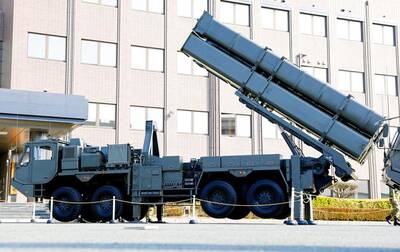
Japan has deployed long-range missiles in a southwestern region near China, the Japanese defense minister said yesterday, at a time when ties with Beijing are at their lowest in recent years. The missiles were installed in Kumamoto in the southern region of Kyushu, as Japan is attempting to shore up its military capacity as China steps up naval activity in the East China Sea. “Standoff defense capabilities enable us to counter the threat of enemy forces attempting to invade our country ... while ensuring the safety of our personnel,” Japanese Minister of Defense Shinjiro Koizumi said. “This is an extremely important initiative for

The nation’s fastest supercomputer, Nano 4 (晶創26), is scheduled to be launched in the third quarter, and would be used to train large language models in finance and national defense sectors, the National Center for High-Performance Computing (NCHC) said. The supercomputer, which would operate at about 86.05 petaflops, is being tested at a new cloud computing center in the Southern Taiwan Science Park in Tainan. The exterior of the server cabinet features chip circuitry patterns overlaid with a map of Taiwan, highlighting the nation’s central position in the semiconductor industry. The center also houses Taiwania 2, Taiwania 3, Forerunner 1 and
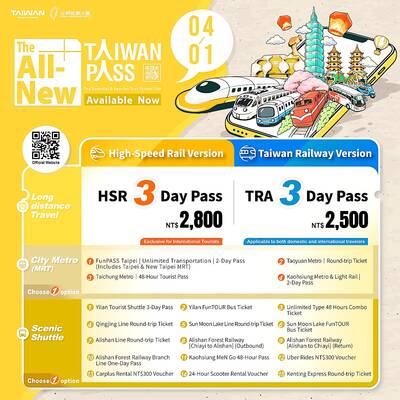
MORE POPULAR: Taiwan Pass sales increased by 59 percent during the first quarter compared with the same period last year, the Tourism Administration said The Tourism Administration yesterday said that it has streamlined the Taiwan Pass, with two versions available for purchase beginning today. The tourism agency has made the pass available to international tourists since 2024, allowing them to access the high-speed rail, Taiwan Railway Corp services, four MRT systems and four Taiwan Tourist Shuttles. Previously, five types of Taiwan Pass were available, but some tourists have said that the offerings were too complicated. The agency said only two types of Taiwan Pass would be available, starting from a three-day pass with the high-speed rail and a three-day pass with Taiwan Railway Corp. The former costs NT$2,800
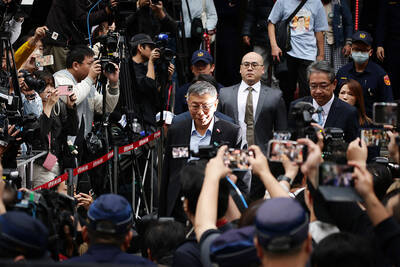
FIRST TRIAL: Ko’s lawyers sought reduced bail and other concessions, as did other defendants, but the bail judge denied their requests, citing the severity of the sentences Former Taipei mayor Ko Wen-je (柯文哲) was yesterday sentenced to 17 years in prison and had his civil rights suspended for six years over corruption, embezzlement and other charges. Taipei prosecutors in December last year asked the Taipei District Court for a combined 28-year, six-month sentence for the four cases against Ko, who founded the Taiwan People’s Party (TPP). The cases were linked to the Core Pacific City (京華城購物中心) redevelopment project and the mismanagement of political donations. Other defendants convicted on separate charges included Chinese Nationalist Party (KMT) Taipei City Councilor Angela Ying (應曉薇), who was handed a 15-year, six-month sentence; Core Pacific


 RSS
RSS