


Democratic Progressive Party (DPP) legislator-elect Su Jia-chyuan (蘇嘉全) is likely to become the nation’s first non-Chinese Nationalist Party (KMT) legislative speaker on Monday, as the DPP caucus yesterday nominated him for the post.
DPP caucus whip Ker Chien-ming (柯建銘), Legislator Chen Ming-wen (陳明文) and Su had all been interested in running for the speakership, and a vote within the caucus was planned to select a candidate during yesterday morning’s meeting.
However, before the meeting was to begin at 9am, Ker appeared outside the meeting room, along with Chen and Su, all three smiling.
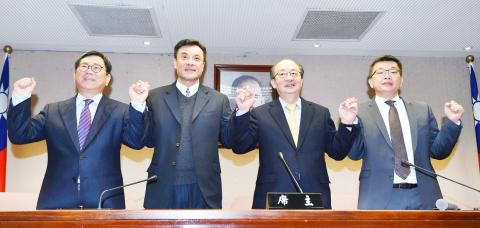
Photo: Fang Pin-chao, Taipei Times
“I think it is easiest [to solve the issue] if we three talk among ourselves,” Ker said. “We have reached a simple conclusion: to support Su as the party’s candidate for legislative speaker.”
Ker said he is confident that when Su is elected speaker, he will be able to keep the legislature running smoothly, leaving president-elect Tsai Ing-wen (蔡英文) worry-free.
When asked about rumors that he had said he would rather die than withdraw from the speaker election, Ker denied ever making such a remark.
Ker declined to discuss whether he would continue to serve as caucus whip.
The caucus unanimously passed nomination of Su as the DPP’s speaker candidate and the nomination of DPP Legislator Tsai Chi-chang (蔡其昌) as deputy speaker candidate.
With an absolute majority of 68 seats, accounting for 60.1 percent of the legislature, the DPP’s candidates are almost certain to win the speakership and deputy speakership.
Ker said he had a sleepless night as negotiations between himself, Su and Chen Ming-wen hosted by Kaohsiung Mayor Chen Chu (陳菊) at DPP headquarters in Taipei on Thursday failed to generate any concrete results.
“So I called Chen and Su at 7am and asked them to come to my office to discuss the issue,” Ker said.
“We started our meeting at 8am and, after some discussion, we felt we should try to maintain harmony within the party, and should not disappoint the people, nor force the party’s central leadership to intervene in the speaker election, and reached our decision,” Ker added.
On a trip to thank her supporters in Yunlin and Chiayi counties, Tsai Ing-wen welcomed the decision, while denying she had talked Ker out of the race.
“I am happy our caucus members were able to negotiate among themselves to smoothly work out candidates for legislative speaker and deputy speaker,” she said.
“I hope that in the future, we can integrate different opinions within the party on important issues to start the reform agenda as soon as possible, based on the values of solidarity and reform,” she added.
Tsai Ing-wen denied that she had overridden the will of the caucus, as there had been speculation that she preferred Su to serve as speaker.
She said she had merely “reminded” the caucus about the public’s expectations.

‘NO SECURITY RISK’: The Railway Bureau reassured the public that the technicians’ activities were limited to technical guidance and did not involve sensitive systems The Railway Bureau yesterday said it had invited eight Chinese technicians to assist with an airport MRT construction project. The bureau issued the confirmation after an Internet user said Chinese nationals had entered the construction zone of Taiwan Taoyuan International Airport’s Terminal 3 project. They asked why “individuals from an enemy state” were allowed access to such a major national infrastructure project, which raised serious concerns over Taiwan’s industrial safety, sensitive systems and information security. The bureau’s Northern Region Engineering Branch Office said subcontractor Taiwan Handle Industrial Co (台灣手把工業) of the Taoyuan airport MRT’s “Contract No. CU05 Project A14 Station Civil, MEP &

The National Chungshan Institute of Science and Technology yesterday showcased its locally developed variants of the Vision 60 robotic patrol dog, which it plans to deploy on the nation’s outlying territories in the South China Sea. The variants were produced under the Joint Lab project — created by the institute and domestic companies — and assembled with domestically produced motors, lenses and artificial intelligence (AI) systems alongside licensed tech from the US, Missile and Rocket Systems Research Division deputy director Jen Kuo-kang (任國光) told the media event at a military base in Taipei’s Dazhi (大直) area. Taiwan has built up its strengths

NOT IMMEDIATE: Taiwan has a chance to appeal the proposed 10 percent tariff before it starts, while other countries face a 12.5 percent tariff from the trade office Taiwan is among 60 economies determined by the US to have failed to impose or enforce a ban on the importation of goods produced with forced labor, according to a notice released on Tuesday by the Office of the US Trade Representative (USTR), which proposed imposing an additional 10 percent or more tariff on them. The USTR in a statement said that following an investigation, it had determined under Section 301 of the Trade Act of 1974 that the failure of the 60 economies to impose and effectively enforce a prohibition on the importation of goods produced with forced labor is

TIT-FOR-TAT: The US allegedly revoked the visa of a Chinese national working at Xinhua News Agency in the US in response to Beijing’s expulsion of Vivian Wang The Presidential Office yesterday condemned China for expelling a New York Times correspondent from Beijing following the newspaper’s interview with President William Lai (賴清德), saying the move highlighted Beijing’s suppression of press freedom and its threat to international news media. Taiwan has noted a series of recent incidents in which Beijing used similar tactics to “threaten and pressure international media outlets and journalists,” Presidential Office spokeswoman Karen Kuo (郭雅慧) said in a statement. “This concerns not only press freedom and freedom of expression, but also the safety of journalists, and Taiwan and relevant partners are paying close attention to the situation,” she


 RSS
RSS