


Amid rumors that President Ma Ying-jeou (馬英九) is considering handing over his right to form the Cabinet to the new legislature chosen by voters in the elections on Saturday next week, Chinese Nationalist Party (KMT) presidential candidate Eric Chu (朱立倫) yesterday said that he supports the idea of letting the party that holds the legislative majority form the Cabinet.
“I have always agreed with the concept of a majority-formed Cabinet. We appreciate such an idea because allowing the party with a legislative majority to form the Cabinet can help put Taiwan’s democracy on the right track,” Chu said while campaigning in Hsinchu in the morning.
It is an idea similar to one that he has repeatedly proposed, Chu said, adding that he would respect such a “constitutional convention” if elected president.
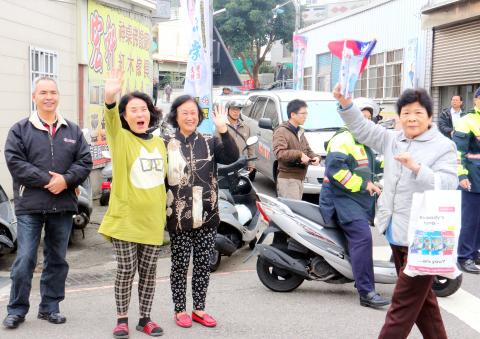
Photo: CNA
“That is why we must go all out and not give up [fighting for] any of our legislative seats,” Chu said.
However, he did not give a direct response when asked if he would still back Ma’s idea if the Democratic Progressive Party (DPP) wins a legislative majority, and when asked if the proposal was just an election ploy by the KMT to help it in the legislative polls.
The Chinese-language newspaper Apple Daily on Wednesday — , citing an unidentified KMT member — reported that Ma was inclined to give up the right to form a new Cabinet if the KMT lose both the presidency and its legislative majority in the elections.
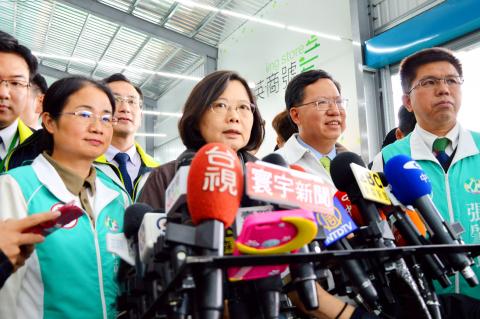
Photo: Hsieh Wu-hsiung, Taipei Times
The anonymous source was quoted as saying that since Ma had brought up the idea of majority-formed Cabinet many times, he might not rule it out if it was raised again after the elections.
In June 2007, as he began his first run for the presidency, Ma said he would honor the spirit of a semi-presidential system and allow the majority party in the legislature to form the Cabinet.
In Taiwan’s semi-presidential system, the president names the premier without having to seek approval from the legislature.
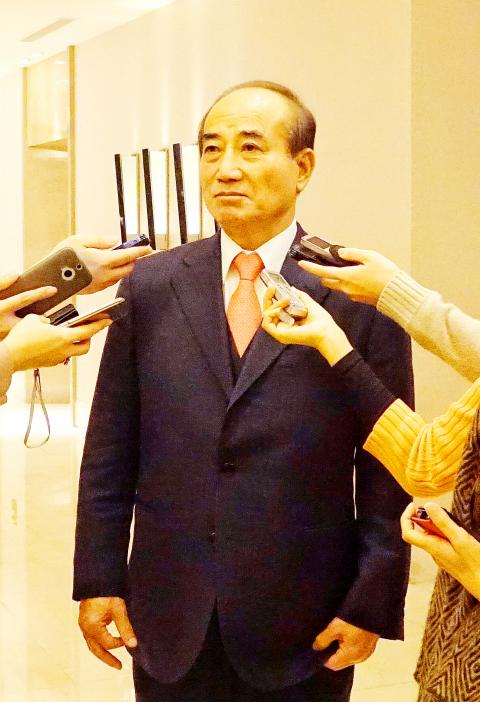
Photo: Liu Hsin-de, Taipei Times
This has led to criticism that the president enjoys all the power, but does not have to answer to the legislature, while the premier has no real power, but must bear the brunt of opposition to major administration policies.
Asked to confirm that Ma was mulling such an idea, Presidential Office spokesman Charles Chen (陳以信) yesterday declined to comment on hypothetical situations, saying only that Ma would handle relevant matters in accordance with constitutional procedures.
Legislative Speaker Wang Jin-pyng (王金平) also refused to comment on the speculation, saying such a matter should only be decided by the president.
“[The question of] who should enjoy the power and who should shoulder the responsibility requires some rethinking,” Wang said.
Deputy Legislative Speaker Hung Hsiu-chu (洪秀柱) said she agrees with the idea of a majority-formed Cabinet because she thinks it conforms to the spirit of a parliamentary system.
Pressed by reporters, DPP presidential candidate Tsai Ing-wen (蔡英文) said that the Constitution gives the president the power to appoint a premier and that it is not something that should be given away under the table.
“Allowing arbitrary changes is not only detrimental to our constitutional system, but could also lead to confusion about authority and the division of responsibility, and unsettle the political arena,” Tsai said.
That such rumors were spreading in the run-up to the elections showed that they were being used to manipulate the elections, rather than ensuring the stability of the country, she said.

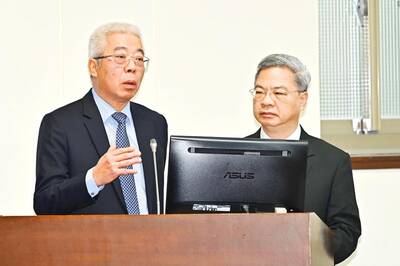
Taiwan has arranged for about 8 million barrels of crude oil, or about one-third of its monthly needs, to be shipped from the Red Sea this month to bypass the Strait of Hormuz and ease domestic supply pressures, CPC Corp, Taiwan (CPC, 台灣中油) said yesterday. The state-run oil company has worked with Middle Eastern suppliers to secure routes other than the Strait of Hormuz, through which about 20 percent of the world’s oil and liquefied natural gas typically passes, CPC chairman Fang Jeng-zen (方振仁) said at a meeting of the legislature’s Economics Committee in Taipei. Suppliers in Saudi Arabia have indicated they
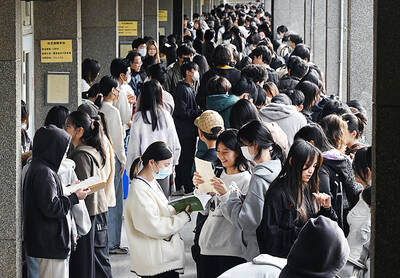
A global survey showed that 60 percent of Taiwanese had attained higher education, second only to Canada, the Ministry of the Interior said. Taiwan easily surpassed the global average of 43 percent and ranked ahead of major economies, including Japan, South Korea and the US, data from the Organisation for Economic Co-operation and Development (OECD) for 2024 showed. Taiwan has a high literacy rate, data released by the ministry showed. As of the end of last year, Taiwan had 20.617 million people aged 15 or older, accounting for 88.5 percent of the total population, with a literacy rate of 99.4 percent, the data
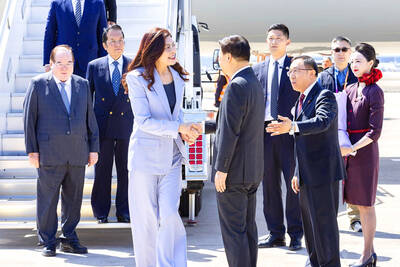
CCP ‘PAWN’? Beijing could use the KMT chairwoman’s visit to signal to the world that many people in Taiwan support the ‘one China’ principle, an academic said Chinese Nationalist Party (KMT) Chairwoman Cheng Li-wun (鄭麗文) yesterday arrived in China for a “peace” mission and potential meeting with Chinese President Xi Jinping (習近平), while a Taiwanese minister detailed the number of Chinese warships currently deployed around the nation. Cheng is visiting at a time of increased Chinese military pressure on Taiwan, as the opposition-dominated Legislative Yuan stalls a government plan for US$40 billion in extra defense spending. Speaking to reporters before going to the airport, Cheng said she was going on a “historic journey for peace,” but added that some people felt uneasy about her trip. “If you truly love Taiwan,

NEW LOW: The council in 2024 based predictions on a pessimistic estimate for the nation’s total fertility rate of 0.84, but last year that rate was 0.69, 17 percent lower An expected National Development Council (NDC) report expects the nation’s population to drop below 12 million by 2065, with the old-age dependency ratio to top 100 percent sooner than 2070, sources said yesterday. The council is slated to release its latest population projections in August, using an ultra-low fertility model, the sources said. The previous report projected that Taiwan’s population would fall to 14.37 million by 2070, but based on a new estimate of the total fertility rate (TFR) — the average number of children born to a woman over her lifetime — the population is expected to reach 12 million by


 RSS
RSS