


China has unveiled changes to the structure of its military, adding three new units, described by Chinese President Xi Jinping (習近平) as “a major policy decision to realize the Chinese dream of a strong army,” state media reported.
The formation of the new units, which follows Beijing’s announcement that it was building a second aircraft carrier, comes with China acting more aggressively in territorial disputes in the South China Sea and East China Sea, drawing the ire of its neighbors and the US.
Beijing in November last year said it planned sweeping changes in a move intended to enhance the ruling Chinese Communist Party’s control over the People’s Liberation Army (PLA).
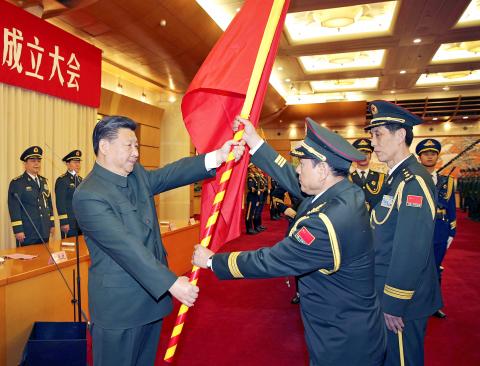
Photo: AP
The latest reforms announced late on Friday are to see a new army unit set up to oversee China’s arsenal of strategic missiles.
Besides the “Rocket Force,” the PLA also unveiled an army general command to serve as the headquarters for land forces and a support unit to assist combat troops, the official Xinhua news agency said.
Xi, who is chief of the Chinese Communist Party and also serves as head of the military, has previously announced plans to slash China’s number of troops by 300,000 to about 2 million to craft a more efficient fighting force.
The Central Military Commission, which Xi chairs, on Friday also released guidelines to help build the country’s vision of a modern military before 2020 by cutting troops and improving the quality of combat personnel, Xinhua said.
The announcements come with China also expanding its naval capacity by building a second aircraft carrier.
The nation’s first such vessel, the Liaoning, is a secondhand Soviet ship built more than 25 years ago that was commissioned by China in 2012 after extensive refits.
The Global Times newspaper, known for its nationalistic editorial stance, said new conditions required a strong army and cited the US as a reason.
“If China has a big gap with the US in terms of military prowess, this will affect its international position and other countries’ attitude toward China,” it said in an editorial posted on its Web site yesterday. “With a strong army, China can be more politically appealing, influential and persuasive.”
Beijing’s armed forces have been involved in sometimes tense confrontations with Japanese and Philippine units over maritime disputes in the East China Sea and South China Sea respectively, prompting fears that the disputes could result in armed clashes.
Meanwhile, the new PLA Rocket Force is tasked with maintaining conventional and nuclear weaponry with the ability to both deter and to strike, Xi told a ceremony for the founding of the three new organizations, according to Xinhua.
However, a spokesman for the Chinese Ministry of National Defense denied any shift in the country’s nuclear weapons policy.
“China’s nuclear policy and nuclear strategy are consistent, there has been no change whatsoever,” ministry spokesman Yang Yujun (楊宇軍) said on Friday, according to a transcript posted on the ministry’s Web site.
The new unit would take over from the Second Artillery Force, he said.
At a military parade in September last year, China showed off “carrier-killer” missiles, including the land-based DF-21 Mod-4 intermediate-range type, which is thought to be equipped with onboard terminal guidance systems that give it the unprecedented ability to attack a moving target.
A Chinese analyst said the latest moves were aimed at modernizing the military.
“For a long time, China had no overseas interests. The navy, air force and guided-missile units were relatively weak compared with the army,” Shanghai University of Political Science and Law professor Ni Lexiong (倪樂雄) told reporters.
“To catch up with European and American powers ... China must raise the modernization level and combat strength of the army,” he added.

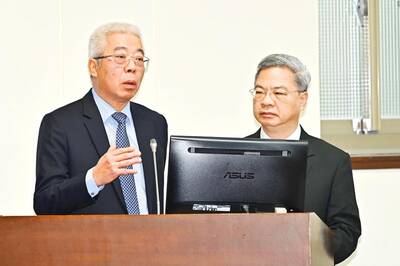
Taiwan has arranged for about 8 million barrels of crude oil, or about one-third of its monthly needs, to be shipped from the Red Sea this month to bypass the Strait of Hormuz and ease domestic supply pressures, CPC Corp, Taiwan (CPC, 台灣中油) said yesterday. The state-run oil company has worked with Middle Eastern suppliers to secure routes other than the Strait of Hormuz, through which about 20 percent of the world’s oil and liquefied natural gas typically passes, CPC chairman Fang Jeng-zen (方振仁) said at a meeting of the legislature’s Economics Committee in Taipei. Suppliers in Saudi Arabia have indicated they
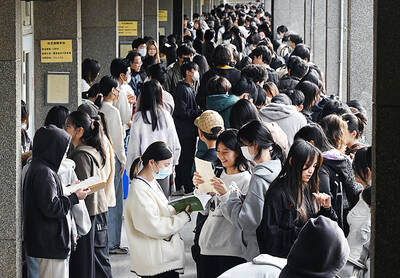
A global survey showed that 60 percent of Taiwanese had attained higher education, second only to Canada, the Ministry of the Interior said. Taiwan easily surpassed the global average of 43 percent and ranked ahead of major economies, including Japan, South Korea and the US, data from the Organisation for Economic Co-operation and Development (OECD) for 2024 showed. Taiwan has a high literacy rate, data released by the ministry showed. As of the end of last year, Taiwan had 20.617 million people aged 15 or older, accounting for 88.5 percent of the total population, with a literacy rate of 99.4 percent, the data
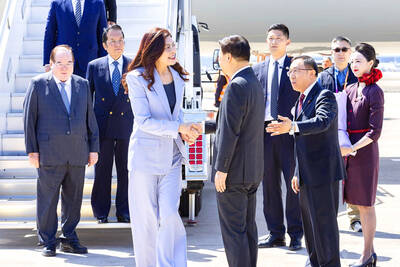
CCP ‘PAWN’? Beijing could use the KMT chairwoman’s visit to signal to the world that many people in Taiwan support the ‘one China’ principle, an academic said Chinese Nationalist Party (KMT) Chairwoman Cheng Li-wun (鄭麗文) yesterday arrived in China for a “peace” mission and potential meeting with Chinese President Xi Jinping (習近平), while a Taiwanese minister detailed the number of Chinese warships currently deployed around the nation. Cheng is visiting at a time of increased Chinese military pressure on Taiwan, as the opposition-dominated Legislative Yuan stalls a government plan for US$40 billion in extra defense spending. Speaking to reporters before going to the airport, Cheng said she was going on a “historic journey for peace,” but added that some people felt uneasy about her trip. “If you truly love Taiwan,

NEW LOW: The council in 2024 based predictions on a pessimistic estimate for the nation’s total fertility rate of 0.84, but last year that rate was 0.69, 17 percent lower An expected National Development Council (NDC) report expects the nation’s population to drop below 12 million by 2065, with the old-age dependency ratio to top 100 percent sooner than 2070, sources said yesterday. The council is slated to release its latest population projections in August, using an ultra-low fertility model, the sources said. The previous report projected that Taiwan’s population would fall to 14.37 million by 2070, but based on a new estimate of the total fertility rate (TFR) — the average number of children born to a woman over her lifetime — the population is expected to reach 12 million by


 RSS
RSS