


Lawmakers and academics yesterday criticized the Southern Branch of the National Palace Museum (NPM) for exhibiting replicas of art works donated by Hong Kong actor Jackie Chan (成龍), saying the display is an insult to the public and an example of China’s “united front” strategy.
Chan — a member of the Chinese People’s Political Consultative Conference (CPPCC) — donated replicas of a set of bronze zodiac sculptures looted from China’s Old Summer Palace by British and French forces in 1860.
The artworks were on display in the courtyard of the museum in Chiayi County on Monday during its soft opening.

Photo: Tsai Tsung-hsun, Taipei Times
Chan bicycled to the ceremony with President Ma Ying-jeou (馬英九) and attended as an honored guest.
Sources said that Chan had attempted to avoid the association of his CPPCC membership with the donation by contacting the NPM through his wife, Taiwanese actress Joan Lin (林鳳嬌), and that he had originally wanted the replicas to be displayed at the main branch in Taipei.
He did not ask for a certificate of donation or a tax deductible allowance from the museum, the sources said.
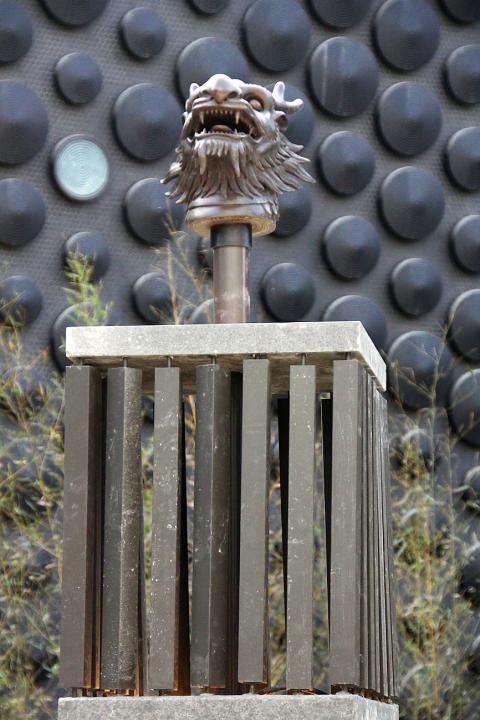
Photo: Lin Yi-chang, Taipei Times
“Replicas are not worth a lot of money in the art market and in this case the symbolism of the donation is greater than its substantive value,” an unnamed art expert said.
“The NPM cannot call itself a world-class museum and stoop to accepting replicas. This is tantamount to abandoning all professional standards, and the decision will be mocked by the international community of museums as an amateur-hour folly,” former National Museum of Taiwan History director Wu Mi-cha (吳密察) said.
The Chinese government has spent vast sums to recover the original zodiac sculptures, which “incite extreme nationalist passions,” he said.
“It is unthinkable that the NPM has overlooked the value of the zodiac sculptures as tools in China’s ‘united front’ strategy,” he added.
“The NPM should not proceed under the assumption that inside every unattended shopping basket is edible food,” Democratic Progressive Party (DPP) Legislator Hsu Chih-chieh (許智傑) said.
Chan has “ulterior motives,” and the donation is “an insult to Taiwanese,” Soochow University professor and former Cabinet spokesman Shieh Jhy-wey (謝志偉) said.
China is guilty of the same kind of “bullying imperialism” epitomized by the British and French forces in 1860, he added.
“Does the NPM expect Taiwanese to surrender their heads to China in exchange for a dozen sculpted zodiac animal heads?” Shieh said.
The display contradicts the museum’s stated intention for establishing the southern branch, which was to promote Taiwanese identity by establishing a museum that focuses on the arts and cultures of Asia — rather than exclusively Chinese artifacts, he added.
DPP Legislator Lee Chun-yi (李俊俋), who was present at the soft opening, said the event’s pageants and speeches were “chock full of Greater China ideology.”
Chan has previously mocked Taiwanese democracy as “the biggest joke in the world,” DPP Legislator Huang Wei-cher (黃偉哲) said. “How dare Chan show his face here in Taiwan, 18 days before the presidential election?”
NPM Director Fung Ming-chu (馮明珠) yesterday said that the replicas “have nothing to do with any ‘united front’ tactics,” and the architect of the southern branch complex, Kris Yao (姚仁喜), had assured her the replicas are examples of “excellent modern craftsmanship.”
“The public need to cherish and protect the replicas, and should not harbor any thoughts of vandalism,” Fung added.
Additional reporting by Chang Hsiao-ti

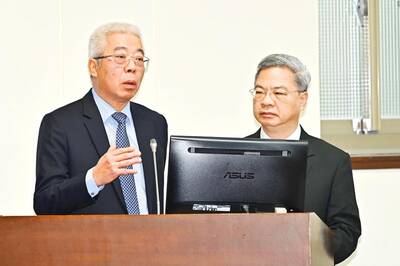
Taiwan has arranged for about 8 million barrels of crude oil, or about one-third of its monthly needs, to be shipped from the Red Sea this month to bypass the Strait of Hormuz and ease domestic supply pressures, CPC Corp, Taiwan (CPC, 台灣中油) said yesterday. The state-run oil company has worked with Middle Eastern suppliers to secure routes other than the Strait of Hormuz, through which about 20 percent of the world’s oil and liquefied natural gas typically passes, CPC chairman Fang Jeng-zen (方振仁) said at a meeting of the legislature’s Economics Committee in Taipei. Suppliers in Saudi Arabia have indicated they
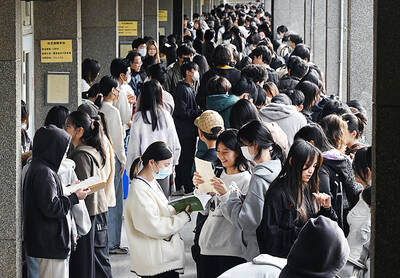
A global survey showed that 60 percent of Taiwanese had attained higher education, second only to Canada, the Ministry of the Interior said. Taiwan easily surpassed the global average of 43 percent and ranked ahead of major economies, including Japan, South Korea and the US, data from the Organisation for Economic Co-operation and Development (OECD) for 2024 showed. Taiwan has a high literacy rate, data released by the ministry showed. As of the end of last year, Taiwan had 20.617 million people aged 15 or older, accounting for 88.5 percent of the total population, with a literacy rate of 99.4 percent, the data
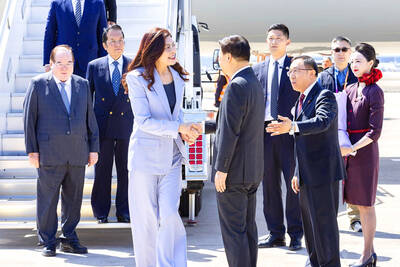
CCP ‘PAWN’? Beijing could use the KMT chairwoman’s visit to signal to the world that many people in Taiwan support the ‘one China’ principle, an academic said Chinese Nationalist Party (KMT) Chairwoman Cheng Li-wun (鄭麗文) yesterday arrived in China for a “peace” mission and potential meeting with Chinese President Xi Jinping (習近平), while a Taiwanese minister detailed the number of Chinese warships currently deployed around the nation. Cheng is visiting at a time of increased Chinese military pressure on Taiwan, as the opposition-dominated Legislative Yuan stalls a government plan for US$40 billion in extra defense spending. Speaking to reporters before going to the airport, Cheng said she was going on a “historic journey for peace,” but added that some people felt uneasy about her trip. “If you truly love Taiwan,

NEW LOW: The council in 2024 based predictions on a pessimistic estimate for the nation’s total fertility rate of 0.84, but last year that rate was 0.69, 17 percent lower An expected National Development Council (NDC) report expects the nation’s population to drop below 12 million by 2065, with the old-age dependency ratio to top 100 percent sooner than 2070, sources said yesterday. The council is slated to release its latest population projections in August, using an ultra-low fertility model, the sources said. The previous report projected that Taiwan’s population would fall to 14.37 million by 2070, but based on a new estimate of the total fertility rate (TFR) — the average number of children born to a woman over her lifetime — the population is expected to reach 12 million by


 RSS
RSS