


The Chinese Nationalist Party (KMT) headquarters yesterday scheduled the extempore party congress aimed at removing Deputy Legislative Speaker Hung Hsiu-chu (洪秀柱) as the party’s presidential candidate. It is to take place on Saturday.
The congress, which has as its objectives “forging consensuses and securing victory through party solidarity,” is scheduled to begin at 2pm on Saturday at the National Sun Yat-sen Memorial Hall, KMT Culture and Communications Committee director-general Lin Yi-hua (林奕華) said after the conclusion of a party affairs meeting in Taipei yesterday morning.
When asked about whether such short notice would make it impossible for overseas KMT representatives to return for the congress, Lin said the Civil Associations Act (人民團體法) only requires one day advance notice for such a meeting, adding that she believes the selection of the date conforms with the law.
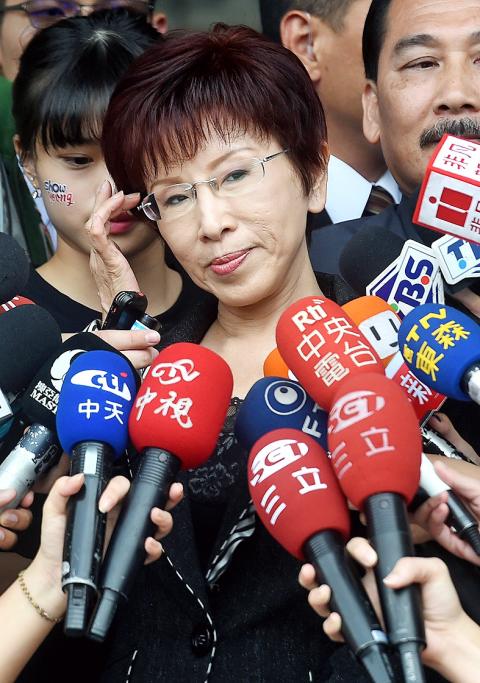
Photo: Chien Jung-fong, Taipei Times
Regarding calls from some KMT lawmakers that the proposal to rescind Hung’s nomination be put to a secret ballot, Lin said the issue was not discussed at the meeting.
“The agenda and procedures for the congress will be made public after they are finalized. On Wednesday [tomorrow], we are scheduled to first brief members of the KMT Central Standing Committee on the matter,” Lin said.
The announcement came after the committee passed a motion on Wednesday last week, backed by nearly three-fourths of its 39 members, to hold a provisional congress to replace Hung as presidential candidate.
Hung, who was officially nominated by the KMT on July 19 as the only hopeful to have met all of the party’s presidential primary requirements, has been facing mounting pressure from other members to exit the race for the Jan. 16 election, as her support ratings have dropped by more than 20 percentage points in the past few months.
KMT Chairman Eric Chu (朱立倫) last week weighed in on the matter, saying that Hung’s pro-unification cross-strait policies run counter to both the party’s stance and mainstream public opinion, and urged her to look at the bigger picture.
Chu added that he was willing to “assume the responsibility” of being the party’s candidate should Hung decide to quit the race.
However, Hung has refused to quit and vowed to continue campaigning until the last minute.
Rejecting Hung’s comments on Sunday that putting her nomination to a vote — whether by applause, a show of hands, or a ballot — at the congress would be detrimental to the KMT’s primary mechanism, KMT Legislator Lo Shu-lei (羅淑蕾) said that changing the polling method only for Hung could impair the congress’ procedures.
“Given that a KMT congress approved Hung’s nomination with a round of applause, adopting a different voting method now could be disruptive,” Lo said.
Lo said that applause is also an effective manner of voting, because it is easy to determine whether a proposal has passed by the proportion of attendees standing up and applauding.
When asked who would be the most suitable substitute for Hung, Lo said that she believes Chu would be the party’s best hope.
“Factoring in political geography, provincialism and gender, KMT Vice Chairperson Huang Min-hui (黃敏惠), who once served as Chiayi mayor, would also be an ideal choice,” Lo added.
In related news, at a question-and-answer session in the legislature, Control Yuan Secretary-General Fu Meng-jung (傅孟融) said that Hung would be required to transfer the remainder of contributions to her campaign to the government’s coffers should she be forced out of the race.
“According to the Political Donations Act (政治獻金法), Hung will no longer be allowed to tap the political donations she has received once she exits the race. She will be required to submit a list of all expenditures to the Control Yuan within three months and give the remainder to the government,” Fu said.
Hung would be required to set up a new campaign account should she plan to run for a different post, Fu said.

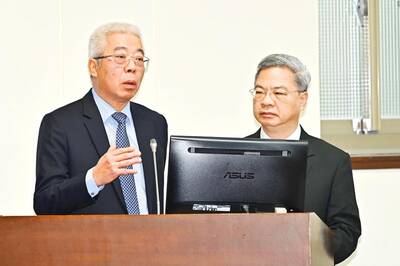
Taiwan has arranged for about 8 million barrels of crude oil, or about one-third of its monthly needs, to be shipped from the Red Sea this month to bypass the Strait of Hormuz and ease domestic supply pressures, CPC Corp, Taiwan (CPC, 台灣中油) said yesterday. The state-run oil company has worked with Middle Eastern suppliers to secure routes other than the Strait of Hormuz, through which about 20 percent of the world’s oil and liquefied natural gas typically passes, CPC chairman Fang Jeng-zen (方振仁) said at a meeting of the legislature’s Economics Committee in Taipei. Suppliers in Saudi Arabia have indicated they
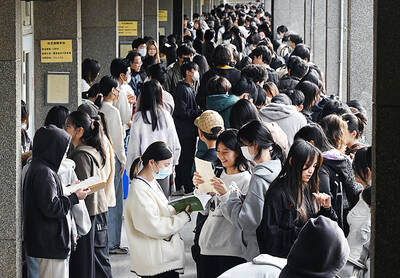
A global survey showed that 60 percent of Taiwanese had attained higher education, second only to Canada, the Ministry of the Interior said. Taiwan easily surpassed the global average of 43 percent and ranked ahead of major economies, including Japan, South Korea and the US, data from the Organisation for Economic Co-operation and Development (OECD) for 2024 showed. Taiwan has a high literacy rate, data released by the ministry showed. As of the end of last year, Taiwan had 20.617 million people aged 15 or older, accounting for 88.5 percent of the total population, with a literacy rate of 99.4 percent, the data

CCP ‘PAWN’? Beijing could use the KMT chairwoman’s visit to signal to the world that many people in Taiwan support the ‘one China’ principle, an academic said Chinese Nationalist Party (KMT) Chairwoman Cheng Li-wun (鄭麗文) yesterday arrived in China for a “peace” mission and potential meeting with Chinese President Xi Jinping (習近平), while a Taiwanese minister detailed the number of Chinese warships currently deployed around the nation. Cheng is visiting at a time of increased Chinese military pressure on Taiwan, as the opposition-dominated Legislative Yuan stalls a government plan for US$40 billion in extra defense spending. Speaking to reporters before going to the airport, Cheng said she was going on a “historic journey for peace,” but added that some people felt uneasy about her trip. “If you truly love Taiwan,

NEW LOW: The council in 2024 based predictions on a pessimistic estimate for the nation’s total fertility rate of 0.84, but last year that rate was 0.69, 17 percent lower An expected National Development Council (NDC) report expects the nation’s population to drop below 12 million by 2065, with the old-age dependency ratio to top 100 percent sooner than 2070, sources said yesterday. The council is slated to release its latest population projections in August, using an ultra-low fertility model, the sources said. The previous report projected that Taiwan’s population would fall to 14.37 million by 2070, but based on a new estimate of the total fertility rate (TFR) — the average number of children born to a woman over her lifetime — the population is expected to reach 12 million by


 RSS
RSS