


A student who had campaigned against the Ministry of Education’s controversial adjustments to high-school curriculum guidelines was found dead yesterday in an apparent suicide at his family’s residence in New Taipei City.
Dai Lin (林冠華), a member of the Northern Taiwan Anti-Curriculum Changes Alliance, was found dead by emergency workers who were summoned by his mother after her son failed to respond to calls outside his bedroom, the New Taipei City Fire Department said. After police arrived and broke down the door, they saw Lin lying in bed with a pan of charcoal lighted on a nearby desk, in an apparent suicide.
Yesterday was his 20th birthday.
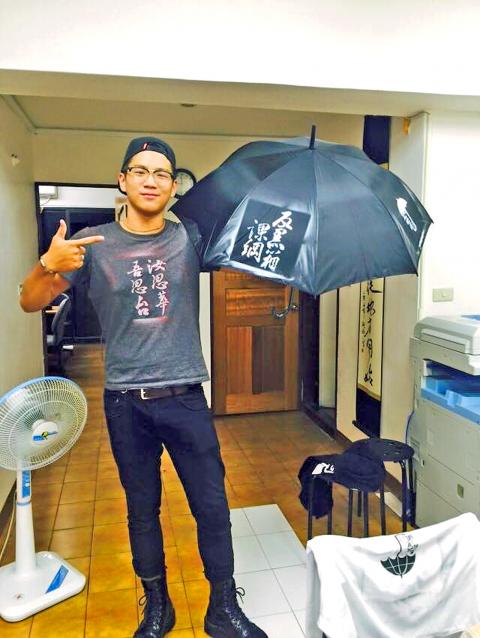
Photo taken from Lin Kuan-hua’s Facebook account
Lin was a second-year student at the continuing studies division of the New Taipei Municipal Juang Jing Vocational High School. He applied for a leave of absence last month so he could devote more time to the anti-curriculum changes campaign.
Lin had been a prominent activist within the Northern Taiwan Anti-Curriculum Changes Alliance. While alliance members refused requests to confirm his exact role, Lin periodically served as one of the group’s spokespeople, with alliance convener Chu Chen (朱震) and other members deferring to him throughout a press conference earlier this month at the Legislative Yuan.
He was among the students who were arrested on Thursday night last week for breaking into the ministry’s compound to protest changes to the curriculum guidelines. Protesters have urged the ministry to withdraw the changes — which are to take effect tomorrow — because of their “China-centric” focus and questionable approval process.
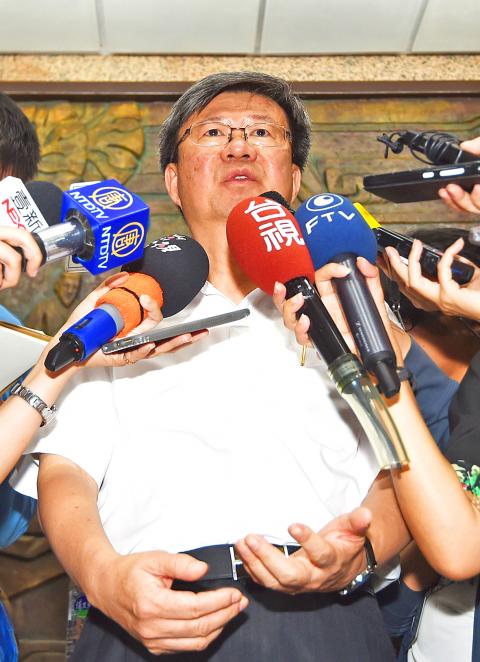
Photo: Fang Pin-chao, Taipei Times
In a final Facebook post, Lin wrote: “Wish me happy birthday. 8 5 12 16. I have only one wish: Minister [of Education Wu Se-hwa (吳思華)] withdraw the curriculum guidelines.”
Lin’s friends later “decoded” the numbers 8-5-12-16 as corresponding to the letters for “h-e-l-p” in the English alphabet.
New Taipei City Department of Education Commissioner Lin Teng-chiao (林騰蛟) said that Dai Lin had suffered from long-term “emotional problems.”
His mother had stayed with him until 2am yesterday, while his school’s military instructor waited nearby, the commissioner said, adding that it was “unfortunate” that Dai Lin had chosen to end his life in the early morning while his family was sleeping.
Juang Jing Vocational High School principal Lin Shu-kuei (林淑貴) was quoted in the Chinese-language United Daily News as saying that Dai Lin had been emotionally unstable since the start of last semester and had received counseling from teachers.
His mother, according to the Chinese-language Apple Daily, said that Dai Lin had been “depressed” since being released on bail last week for entering the ministry building.
“I very much regret that I was not able to stop this,” she said in a statement, denying that her son had been pressured or threatened by ministry officials.
Separately yesterday, a tearful Democratic Progressive Party Legislator Chen Chi-mai (陳其邁) made public screenshots of a conversation on the messaging app Line, which suggested that Dai Lin had planned his suicide as a way to stop the implementation of the curriculum guidelines.
In the conversation between Dai Lin and a friend on June 1, which Chen displayed at a political commentary show yesterday afternoon, Dai Lin told his friend he had an idea that could “very possibly stop the curriculum guideline adjustments,” adding that he would exercise his plan on July 30.
“When I do it, the media and the public opinion would go crazy about it,” Dai Lin said in the Line conversation.
When his friend asked what he planned to do, he replied: “I cannot say it, there are just some things that you can only do, but not say.”
“Don’t worry. What I am going to do will give you some force to stop the curriculum guideline adjustments,” he added.
The friend replied: “I know what you are going to do,” and “Please don’t die.”
“You think too much,” Dai Lin said.
“Mistakes committed by the government should not be shouldered by students,” Chen, in tears, said after showing the screenshots. “If the Ministry of Education was sincere about communicating with the students, why would this happen?”
Additional reporting by Weng Yu-huang

PROVOCATIVE: Chinese Deputy Ambassador to the UN Sun Lei accused Japan of sending military vessels to deliberately provoke tensions in the Taiwan Strait China denounced remarks by Japan and the EU about the South China Sea at a UN Security Council meeting on Monday, and accused Tokyo of provocative behavior in the Taiwan Strait and planning military expansion. Ayano Kunimitsu, a Japanese vice foreign minister, told the Council meeting on maritime security that Tokyo was seriously concerned about the situation in the East China and South China seas, and reiterated Japan’s opposition to any attempt to change the “status quo” by force, and obstruction of freedom of navigation and overflight. Stavros Lambrinidis, head of the EU delegation to the UN, also highlighted South China Sea

SILENCING CRITICS: In addition to blocking Taiwan, China aimed to prevent rights activists from speaking out against authoritarian states, a Cabinet department said The Ministry of Foreign Affairs (MOFA) yesterday condemned transnational repression by Beijing after RightsCon, a major digital human rights conference scheduled to be held in Zambia this week, was abruptly canceled due to Chinese pressure over Taiwanese participation. This year’s RightsCon, the world’s largest conference discussing issues “at the intersection of human rights and technology,” was scheduled to take place from tomorrow to Friday in Lusaka, and expected to draw 2,600 in-person attendees from 150 countries, along with 1,100 online participants. However, organizers were forced to cancel the event due to behind-the-scenes pressure from China, the ministry said, expressing its “strongest condemnation”
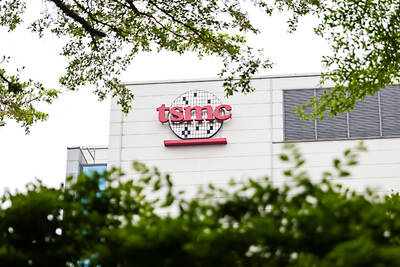
Taiwan Semiconductor Manufacturing Co (TSMC, 台積電), the world’s largest contract chipmaker, said it expects its 2-nanometer (2nm) chip capacity to grow at a compound annual rate of 70 percent from this year to 2028. The projection comes as five fabs begin volume production of 2-nanometer chips this year — two in Hsinchu and three in Kaohsiung — TSMC senior vice president and deputy cochief operating officer Cliff Hou (侯永清) said at the company’s annual technology symposium in Silicon Valley, California, last week. Output in the first year of 2-nanometer production, which began in the fourth quarter of last year, is expected to
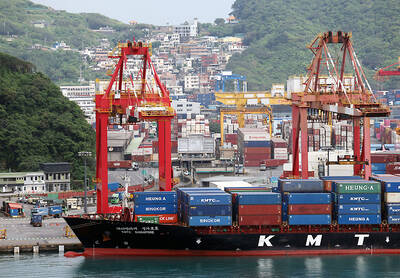
Taiwan’s economy grew far faster than expected in the first quarter, as booming demand for artificial intelligence (AI) applications drove a surge in exports, spilling over into investment and consumption, the Directorate-General of Budget, Accounting and Statistics (DGBAS) said yesterday. GDP growth was 13.69 percent year-on-year during the January-to-March period, beating the DGBAS’ February forecast by 2.23 percentage points and marking the most robust growth in nearly four decades, DGBAS senior official Chiang Hsin-yi (江心怡) told a news conference in Taipei. The result was powered by exports, which remain the backbone of Taiwan’s economy, Chiang said. Outbound shipments jumped 51.12 percent year-on-year to


 RSS
RSS