


The Democratic Progressive Party (DPP) yesterday condemned Chinese Ambassador to the US Cui Tiankai (崔天凱) for calling DPP Chairperson Tsai Ing-wen’s (蔡英文) visit to the US a “job interview,” adding that his call for Tsai to be interviewed by China was rude and would not help to improve cross-strait relations.
“Chairperson Tsai has made it very clear in her commentary piece in the Wall Street Journal yesterday that maintaining stable and sustainable developments in cross-strait relations are important objectives,” DPP Department of China Affairs director Chao Tien-lin (趙天麟) told a news conference at DPP headquarters in Taipei. “We hope to create transparent channels of communication between the DPP and Beijing, as well as between the party and the public to strengthen mutual trust and cooperation across the Taiwan Strait, and to maintain peace and stability through exchanges, cooperation and dialogue in accordance with our principles.”
Chao said DPP presidential candidate Tsai has stressed that the visit is not a “job interview,” but to deliver the message that Taiwan and the US both believe in the universal values of democracy, freedom and human rights.
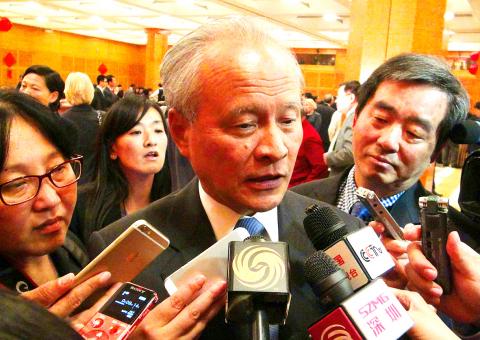
Photo: CNA
“Cui has not only intentionally twisted [Tsai’s intentions], but he arrogantly considers China as some sort of ‘heavenly court,’ asking Tsai to be tested by all Chinese,” Chao said. “This rude language is shocking and it does not help to improve mutual understanding and communication across the Taiwan Strait.”
Chao urged direct dialogue, adding that Beijing should refrain from making deals behind closed doors, while refusing any goodwill from the DPP.
Noting that some people have said Tsai’s visit to the US is aimed at soliciting Washington’s support ahead of January’s presidential election, Cui had said he wondered why she would talk to foreigners, but not directly to her compatriots on the other side of the Taiwan Strait.
“She first has to pass the test of the 1.3 billion Chinese,” Cui said.
Tsai should also state clearly whether she accepts the “one China” principle and should leave no ambiguity about that point, he said.
Cui said that China has been vigilant against activities to push for Taiwanese independence and there is no room for ambiguity when it comes to the “one China” principle.
“We have made it clear to the US that China is opposed to any activities related to Taiwan independence staged in the US and oppose the US giving a stage to such activities,” he said.
Additional reporting by CNA

‘NO SECURITY RISK’: The Railway Bureau reassured the public that the technicians’ activities were limited to technical guidance and did not involve sensitive systems The Railway Bureau yesterday said it had invited eight Chinese technicians to assist with an airport MRT construction project. The bureau issued the confirmation after an Internet user said Chinese nationals had entered the construction zone of Taiwan Taoyuan International Airport’s Terminal 3 project. They asked why “individuals from an enemy state” were allowed access to such a major national infrastructure project, which raised serious concerns over Taiwan’s industrial safety, sensitive systems and information security. The bureau’s Northern Region Engineering Branch Office said subcontractor Taiwan Handle Industrial Co (台灣手把工業) of the Taoyuan airport MRT’s “Contract No. CU05 Project A14 Station Civil, MEP &

The National Chungshan Institute of Science and Technology yesterday showcased its locally developed variants of the Vision 60 robotic patrol dog, which it plans to deploy on the nation’s outlying territories in the South China Sea. The variants were produced under the Joint Lab project — created by the institute and domestic companies — and assembled with domestically produced motors, lenses and artificial intelligence (AI) systems alongside licensed tech from the US, Missile and Rocket Systems Research Division deputy director Jen Kuo-kang (任國光) told the media event at a military base in Taipei’s Dazhi (大直) area. Taiwan has built up its strengths

NOT IMMEDIATE: Taiwan has a chance to appeal the proposed 10 percent tariff before it starts, while other countries face a 12.5 percent tariff from the trade office Taiwan is among 60 economies determined by the US to have failed to impose or enforce a ban on the importation of goods produced with forced labor, according to a notice released on Tuesday by the Office of the US Trade Representative (USTR), which proposed imposing an additional 10 percent or more tariff on them. The USTR in a statement said that following an investigation, it had determined under Section 301 of the Trade Act of 1974 that the failure of the 60 economies to impose and effectively enforce a prohibition on the importation of goods produced with forced labor is

TIT-FOR-TAT: The US allegedly revoked the visa of a Chinese national working at Xinhua News Agency in the US in response to Beijing’s expulsion of Vivian Wang The Presidential Office yesterday condemned China for expelling a New York Times correspondent from Beijing following the newspaper’s interview with President William Lai (賴清德), saying the move highlighted Beijing’s suppression of press freedom and its threat to international news media. Taiwan has noted a series of recent incidents in which Beijing used similar tactics to “threaten and pressure international media outlets and journalists,” Presidential Office spokeswoman Karen Kuo (郭雅慧) said in a statement. “This concerns not only press freedom and freedom of expression, but also the safety of journalists, and Taiwan and relevant partners are paying close attention to the situation,” she


 RSS
RSS