


Tainan prosecutors yesterday requested the detention of Tainan City Council Speaker Lee Chuan-chiao (李全教), of the Chinese Nationalist Party (KMT), and three others, as prosecutors said there was solid evidence of their involvement in vote-buying in last year’s speaker election.
Tainan Chief Prosecutor Chen Chien-hung (陳建弘) yesterday morning said that three or four months ahead of the election, Lee had promised several city councilor candidates that he would pay for their votes in the speakership election on Dec. 25 last year. Chen added that the amount Lee offered was between NT$300,000 and NT$10 million (US$9,506 and US$316,857).
The detention hearing began at 6pm. The hearing was ongoing as of press time last night.
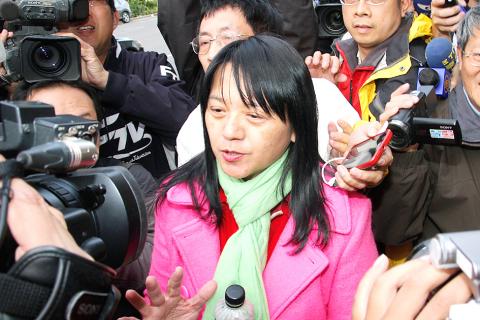
Photo: CNA
Following a long investigation, a total of 19 people, including suspected accomplices and witnesses, were on Sunday summoned for questioning that lasted until midnight. Prosecutors conducted raids at 47 sites earlier that day, the Tainan District Prosecutors’ Office said.
Lee was intercepted on Sunday afternoon at Tainan Airport, where he was about to fly to Xiamen, China, via Kinmen and was taken to the speaker’s office, where a search was being carried out and then to the prosecutors’ office for questioning, the office said.
Among the 19 people questioned were five city councilors, including Tsai Chiu-lan (蔡秋蘭), Chuang Yu-chu (莊玉珠), Tseng Wang Ya-yun (曾王雅雲) and Liang Shun-fa (梁順發) — who were expelled from the Democratic Progressive Party (DPP) on suspicion of voting for Lee in the speakership election in return for money — as well as independent Chao Kun-yuan (趙昆原).
Tsai, Liang and Chao were released without bail early yesterday morning, while bail of NT$300,000 and NT$500,000 was set for Chuang and Tseng Wang respectively, the prosecutors’ office said.
Two other suspects, Pan Hsin-chuan (潘新傳), a Tainan DPP official, and Sung Wei-ju (宋偉儒), the head of the Rende District (仁德) Farmers’ Association, were both released on NT$200,000 bail, the prosecutors’ office said.
The prosecutors also requested the detention of Chuang’s husband, Tsai Chi-hsin (蔡啟新); Lin Tsung-pin (林聰彬), a vote broker affiliated with the KMT; and Yang Ming-ta (楊明達), a former city councilor.
Chen said the evidence the office had collected suggested that Lee, Tsai Chi-hsin, Lin and Yang were “highly involved” in violations of Article 100 of the Civil Servants Election and Recall Act (公職人員選舉罷免法), which bans offering payoffs and delivery of bribes or other undue benefits in elections.
Prosecutors sought the group’s detention to prevent them from absconding, colluding or destroying evidence, Chen said.
Earlier yesterday, KMT Chairman Eric Chu (朱立倫) said in response to the latest developments in the case that he respected the judicial process.
Chu said he believed the judiciary would not do wrong by Lee, nor would it be too lenient, because it is a mature system.
However, an association of Lee’s supporters later yesterday said in a statement that the prosecutors’ probe into the case was “tinged with politics.”
The purpose of Lee’s trip to China was to serve as a witness at a friend’s wedding, and he had booked a return flight on Uni Air (立榮航空) from Kinmen to Tainan for this afternoon, the statement said, dismissing reports suggesting he planned to flee to China.
Allegations of vote-buying against Lee emerged after he was elected as council speaker by a vote of 29 to 26, defeating the DPP’s Lai Mei-hui (賴美惠) in the 57-seat city council where the DPP holds a majority of 28 seats, the KMT 16 and the Taiwan Solidarity Union one, with the remaining 12 held by independents.
Tainan prosecutors indicted Lee and four others on suspicion of involvement in vote-buying after his election in last year’s Nov. 29 elections, seeking to nullify his victory.

‘NO SECURITY RISK’: The Railway Bureau reassured the public that the technicians’ activities were limited to technical guidance and did not involve sensitive systems The Railway Bureau yesterday said it had invited eight Chinese technicians to assist with an airport MRT construction project. The bureau issued the confirmation after an Internet user said Chinese nationals had entered the construction zone of Taiwan Taoyuan International Airport’s Terminal 3 project. They asked why “individuals from an enemy state” were allowed access to such a major national infrastructure project, which raised serious concerns over Taiwan’s industrial safety, sensitive systems and information security. The bureau’s Northern Region Engineering Branch Office said subcontractor Taiwan Handle Industrial Co (台灣手把工業) of the Taoyuan airport MRT’s “Contract No. CU05 Project A14 Station Civil, MEP &

The National Chungshan Institute of Science and Technology yesterday showcased its locally developed variants of the Vision 60 robotic patrol dog, which it plans to deploy on the nation’s outlying territories in the South China Sea. The variants were produced under the Joint Lab project — created by the institute and domestic companies — and assembled with domestically produced motors, lenses and artificial intelligence (AI) systems alongside licensed tech from the US, Missile and Rocket Systems Research Division deputy director Jen Kuo-kang (任國光) told the media event at a military base in Taipei’s Dazhi (大直) area. Taiwan has built up its strengths

NOT IMMEDIATE: Taiwan has a chance to appeal the proposed 10 percent tariff before it starts, while other countries face a 12.5 percent tariff from the trade office Taiwan is among 60 economies determined by the US to have failed to impose or enforce a ban on the importation of goods produced with forced labor, according to a notice released on Tuesday by the Office of the US Trade Representative (USTR), which proposed imposing an additional 10 percent or more tariff on them. The USTR in a statement said that following an investigation, it had determined under Section 301 of the Trade Act of 1974 that the failure of the 60 economies to impose and effectively enforce a prohibition on the importation of goods produced with forced labor is

TIT-FOR-TAT: The US allegedly revoked the visa of a Chinese national working at Xinhua News Agency in the US in response to Beijing’s expulsion of Vivian Wang The Presidential Office yesterday condemned China for expelling a New York Times correspondent from Beijing following the newspaper’s interview with President William Lai (賴清德), saying the move highlighted Beijing’s suppression of press freedom and its threat to international news media. Taiwan has noted a series of recent incidents in which Beijing used similar tactics to “threaten and pressure international media outlets and journalists,” Presidential Office spokeswoman Karen Kuo (郭雅慧) said in a statement. “This concerns not only press freedom and freedom of expression, but also the safety of journalists, and Taiwan and relevant partners are paying close attention to the situation,” she


 RSS
RSS