


Tainan prosecutors yesterday indicted five people on suspicion of involvement in an alleged vote-buying scheme centered on Tainan City Council Speaker Lee Chuan-chiao (李全教), of the Chinese Nationalist Party (KMT), after they sought to nullify his election victory last month.
In a separate case, Tainan City Council Deputy Speaker Kuo Hsin-liang (郭信良), of the Democratic Progressive Party (DPP), was also indicted yesterday. Kuo was charged with using his position as deputy speaker in 2012 to extort bribes from a steel firm.
In the case of Lee, Huang Cheng-ching (黃澄清), the head of the Farmers’ Association in Yuching District (玉井), who campaigned for Lee as his chief executive; Lee Li-hua (李麗華), who was elected as borough warden; and Kang Ching-liang (康清良) were charged with involvement in the vote-buying scheme, while two others were also accused of accepting money from Kang for their vote.
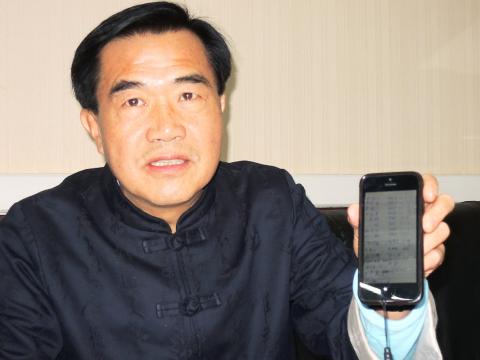
Photo: Tsai Wen-chu, Taipei Times
Lee Li-hua was allegedly given NT$300,000 (US$9,573) in August last year by Huang after she was promised NT$5,000 per household in her borough as bribes for votes. Huang then commissioned Kang to give out the money, Prosecutor Huang Hsin-yung (黃信勇) said.
Nine other voters investigated in the case did not face charges, or were put on probation because they either refused financial offers or admitted accepting money in return for their vote, according to Tainan District Prosecutors’ Office.
In the case of Kuo, prosecutors said that Kuo had demanded NT$12 million from Quintain Steel Co (官田鋼鐵) when the firm’s plan to expand its plant met with opposition from residents and was undergoing an environmental impact assessment review at the city’s Environmental Protection Bureau in 2012.
Kuo advised Quintain Steel to withdraw its application and file for a retrial, as he said that he could peddle his influence among the anti-Quintain Steel groups and officials at the Environmental Protection Bureau to help it secure approval of the environmental impact assessment for the expansion project, prosecutors said.
Quintain Steel paid Kuo NT$7 million before its environmental impact assessment report was disapproved, prosecutors said, adding that the prosecutors’ office dismissed as false Kuo’s statement that the money was a loan.
Prosecutors said they found that Kuo was involved in another fraud case in 2007 in which he swindled Tungsheng Construction Co (東昇營造) out of NT$2 million.
In response to the indictments, Lee Chuan-chiao issued a statement claiming his innocence, saying that he was elected without having to resort to vote-buying tactics because his constituency was a pan-blue stronghold.
Lee Chuan-chiao accused the Tainan District Prosecutors’ Office of dancing to the tune of Greater Tainan Mayor William Lai (賴清德). Lai said that Lee Chuan-chiao provided five DPP city councilors with money to secure his speakership in the speaker election on Dec. 25 last year, when the DPP controlled 29 of 57 seats.
Kuo also claimed his innocence, saying that the prosecutors’ office indicted him on “trumped-up charges” under pressure from the KMT, which has launched countermeasures against prosecutors in the legislature by its lawmakers threatening to freeze the office’s funding and refer prosecutors to the Control Yuan for investigation.
Meanwhile, DPP spokesperson Cheng Yun-peng (鄭運鵬) yesterday urged the judiciary to be fair.
Cheng said that in light of the indictment, Kuo will be referred to the party’s Disciplinary Committee, which is scheduled to meet tomorrow, and which will launch its own investigation.
If the allegations are proven to be true, under party regulations, Kuo could see his party rights suspended or be expelled from the DPP.
Additional reporting by Loa Iok-sin

‘NO SECURITY RISK’: The Railway Bureau reassured the public that the technicians’ activities were limited to technical guidance and did not involve sensitive systems The Railway Bureau yesterday said it had invited eight Chinese technicians to assist with an airport MRT construction project. The bureau issued the confirmation after an Internet user said Chinese nationals had entered the construction zone of Taiwan Taoyuan International Airport’s Terminal 3 project. They asked why “individuals from an enemy state” were allowed access to such a major national infrastructure project, which raised serious concerns over Taiwan’s industrial safety, sensitive systems and information security. The bureau’s Northern Region Engineering Branch Office said subcontractor Taiwan Handle Industrial Co (台灣手把工業) of the Taoyuan airport MRT’s “Contract No. CU05 Project A14 Station Civil, MEP &

The National Chungshan Institute of Science and Technology yesterday showcased its locally developed variants of the Vision 60 robotic patrol dog, which it plans to deploy on the nation’s outlying territories in the South China Sea. The variants were produced under the Joint Lab project — created by the institute and domestic companies — and assembled with domestically produced motors, lenses and artificial intelligence (AI) systems alongside licensed tech from the US, Missile and Rocket Systems Research Division deputy director Jen Kuo-kang (任國光) told the media event at a military base in Taipei’s Dazhi (大直) area. Taiwan has built up its strengths
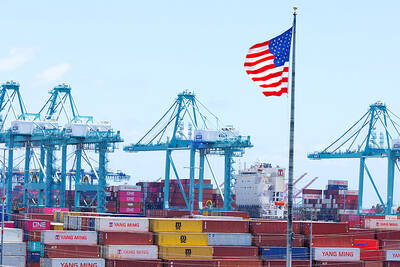
NOT IMMEDIATE: Taiwan has a chance to appeal the proposed 10 percent tariff before it starts, while other countries face a 12.5 percent tariff from the trade office Taiwan is among 60 economies determined by the US to have failed to impose or enforce a ban on the importation of goods produced with forced labor, according to a notice released on Tuesday by the Office of the US Trade Representative (USTR), which proposed imposing an additional 10 percent or more tariff on them. The USTR in a statement said that following an investigation, it had determined under Section 301 of the Trade Act of 1974 that the failure of the 60 economies to impose and effectively enforce a prohibition on the importation of goods produced with forced labor is
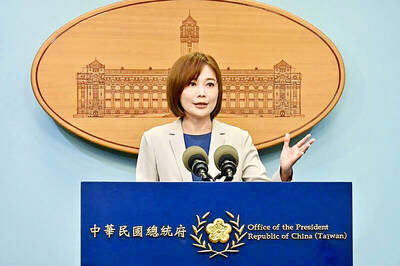
TIT-FOR-TAT: The US allegedly revoked the visa of a Chinese national working at Xinhua News Agency in the US in response to Beijing’s expulsion of Vivian Wang The Presidential Office yesterday condemned China for expelling a New York Times correspondent from Beijing following the newspaper’s interview with President William Lai (賴清德), saying the move highlighted Beijing’s suppression of press freedom and its threat to international news media. Taiwan has noted a series of recent incidents in which Beijing used similar tactics to “threaten and pressure international media outlets and journalists,” Presidential Office spokeswoman Karen Kuo (郭雅慧) said in a statement. “This concerns not only press freedom and freedom of expression, but also the safety of journalists, and Taiwan and relevant partners are paying close attention to the situation,” she


 RSS
RSS