


The Ministry of Justice’s Investigation Bureau yesterday said allegations brought by the Mainland Affairs Council against former deputy council minister Chang Hsien-yao (張顯耀) involved leaks of classified information to China, as other sources said that Chang could face trial for treason.
Sources said that Chang might have divulged information classified as “confidential” under the National Security Information Protection Act (國家機密保護法) in two separate instances.
The act classifies information under three designations: top secret, secret and confidential.
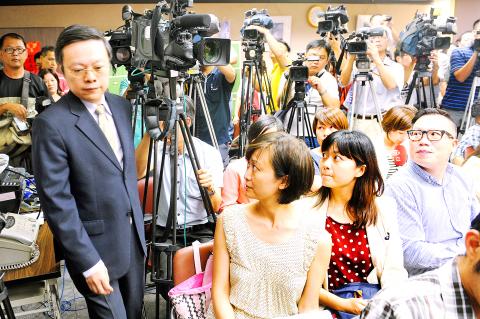
Photo: George Tsorng, Taipei Times
“Confidential” applies to information that would cause identifiable damage to national security.
Sources said the bureau would send a request today to the Taiwan High Prosecutors’ Office that prosecutors open an investigation of Chang on suspicion of treason.
Meanwhile, the controversy over Chang’s resignation last week showed no sign of dying.
The council and the Presidential Office yesterday disputed Chang’s allegation that National Security Council (NSC) Secretary-General King Pu-tsung (金溥聰) had ordered his removal and that President Ma Ying-jeou (馬英九) did not know about King’s move in advance.
In an interview with the Chinese-language United Daily News published yesterday, Chang said that Mainland Affairs Council Minister Wang Yu-chi (王郁琦) had told him on Thursday last week that “a superior” wanted him to leave his post.
“When I asked who the superior was, Wang said it was King,” Chang told the paper.
Chang said he asked Wang if Ma knew about the request and Wang said no, but assured him that arrangements would be made for Chang to become chairman of a company.
Chang said he had no idea what “national secrets” he was supposed to have leaked, although he did have some suspicions.
“I think I might know what it is about. But I cannot reveal it now, since if I did, it would constitute a leak of confidential information,” he told the paper.
He said he felt that he had been “sold out by his superiors.”
However, Wang told a news conference that he had not told Chang who the “superior” was when he ordered his deputy to step down.
He said he had reported to Premier Jiang Yi-huah (江宜樺) and King before talking with Chang and had obtained their consent.
He did not report to Ma directly because he “believed the premier and the NSC secretary-general would do so,” Wang said.
Separately, Presidential Office spokesperson Ma Wei-kuo (馬瑋國) said the president had been informed by the premier and King of the decision to ask Chang to resign.
The president had also asked Wang about the matter after being informed, and supported Chang’s removal and an investigation, Ma Wei-kuo said.
As for why Chang has been offered a corporate position when he was being asked to step down and was suspected of leaking information, Wang said it was to allow some “leeway” and “to protect Chang’s rights and reputation because there was no confirmation yet that he had leaked secrets.”
Wang said he could not provide any details about the alleged national security leaks.
He also declined to answer questions about a tip-off from “the outside” about Chang’s actions that the council reportedly received in the second half of last month.
When asked who would be held accountable if the allegations of national security leaks by Chang proved to be true or if the allegations were false, Wang said that as his job as minister was directly tied to the results of the investigation, he would report to the public once the case is closed.
Lai Chung-chiang (賴中強), an attorney and the convener of the Democratic Front Against the Cross-strait Trade in Services Agreement, said King had violated the Constitution if he was the one who ordered Chang to step down.
“Even if the president knew about the decision, it would still be a violation if it was King who made the move,” Lai said.
The Constitution stipulates that ministers and commission chairs “shall be appointed by the president of the republic upon the recommendation of the president of the Executive Yuan,” Lai said.
Decommissioning should follow the same process, Lai said.
While Wang has denied it was King who had issued the order, he did not clarify who had done so either, referring to the person simply as “the superior.”
Chang and Wang’s remarks clearly contradict each other, so “obviously someone is lying, and I would expect the Legislative Yuan and the Control Yuan to probe the matter and King’s suspected overreaching,” Lai said.
King issued a statement late last night saying he might take legal action against anyone who defames his reputation.
Additional reporting by Shih Hsiu-chuan

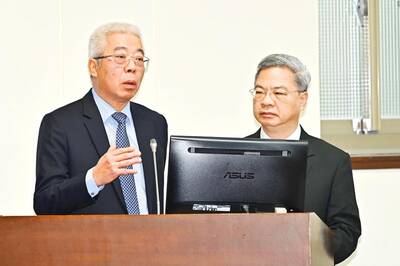
Taiwan has arranged for about 8 million barrels of crude oil, or about one-third of its monthly needs, to be shipped from the Red Sea this month to bypass the Strait of Hormuz and ease domestic supply pressures, CPC Corp, Taiwan (CPC, 台灣中油) said yesterday. The state-run oil company has worked with Middle Eastern suppliers to secure routes other than the Strait of Hormuz, through which about 20 percent of the world’s oil and liquefied natural gas typically passes, CPC chairman Fang Jeng-zen (方振仁) said at a meeting of the legislature’s Economics Committee in Taipei. Suppliers in Saudi Arabia have indicated they
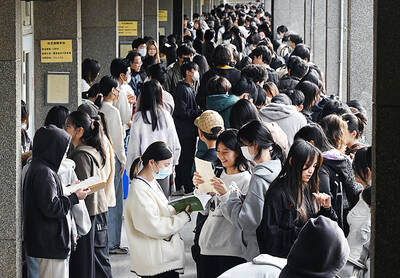
A global survey showed that 60 percent of Taiwanese had attained higher education, second only to Canada, the Ministry of the Interior said. Taiwan easily surpassed the global average of 43 percent and ranked ahead of major economies, including Japan, South Korea and the US, data from the Organisation for Economic Co-operation and Development (OECD) for 2024 showed. Taiwan has a high literacy rate, data released by the ministry showed. As of the end of last year, Taiwan had 20.617 million people aged 15 or older, accounting for 88.5 percent of the total population, with a literacy rate of 99.4 percent, the data
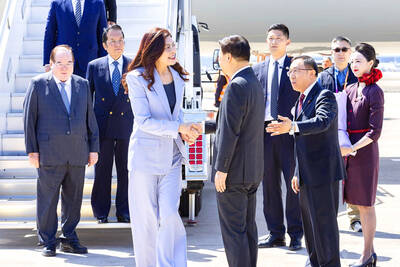
CCP ‘PAWN’? Beijing could use the KMT chairwoman’s visit to signal to the world that many people in Taiwan support the ‘one China’ principle, an academic said Chinese Nationalist Party (KMT) Chairwoman Cheng Li-wun (鄭麗文) yesterday arrived in China for a “peace” mission and potential meeting with Chinese President Xi Jinping (習近平), while a Taiwanese minister detailed the number of Chinese warships currently deployed around the nation. Cheng is visiting at a time of increased Chinese military pressure on Taiwan, as the opposition-dominated Legislative Yuan stalls a government plan for US$40 billion in extra defense spending. Speaking to reporters before going to the airport, Cheng said she was going on a “historic journey for peace,” but added that some people felt uneasy about her trip. “If you truly love Taiwan,

NEW LOW: The council in 2024 based predictions on a pessimistic estimate for the nation’s total fertility rate of 0.84, but last year that rate was 0.69, 17 percent lower An expected National Development Council (NDC) report expects the nation’s population to drop below 12 million by 2065, with the old-age dependency ratio to top 100 percent sooner than 2070, sources said yesterday. The council is slated to release its latest population projections in August, using an ultra-low fertility model, the sources said. The previous report projected that Taiwan’s population would fall to 14.37 million by 2070, but based on a new estimate of the total fertility rate (TFR) — the average number of children born to a woman over her lifetime — the population is expected to reach 12 million by


 RSS
RSS