


President Ma Ying-jeou (馬英九) yesterday again said he would like to sit down with the students leading the massive protest against the cross-strait service trade agreement because he does not understand the rationale behind their opposition to the pact, which he said is vital to Taiwan’s development.
Ma called a press conference at 6pm, ahead of an expected mass demonstration today against the pact, which the government signed with China in June last year and is pending ratification by the legislature.
Hundreds of students have occupied the legislative chamber since March 18 over concerns about negative impacts the pact might have on Taiwan, with an average of thousands of students, members of the public and civil groups joining sit-in protests within and outside the Legislative Yuan compound every day in support of the siege.
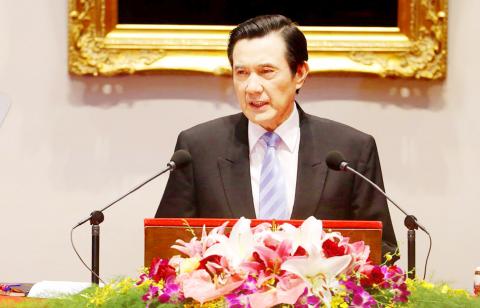
Photo: CNA
Ma yesterday offered the government’s latest response to the four demands that would be highlighted in today’s demonstration on Ketagalan Boulevard.
The government rejected the demand that the Executive Yuan withdraw the pact, as Ma said that revoking the pact would deeply harm the nation’s interests.
Ma said the government supports a mechanism to monitor cross-strait negotiations being brought into the legal system, but added that whether it is necessary for a specific bill to regulate cross-strait negotiations being enacted, as the students have demanded, was “open to discussion.”
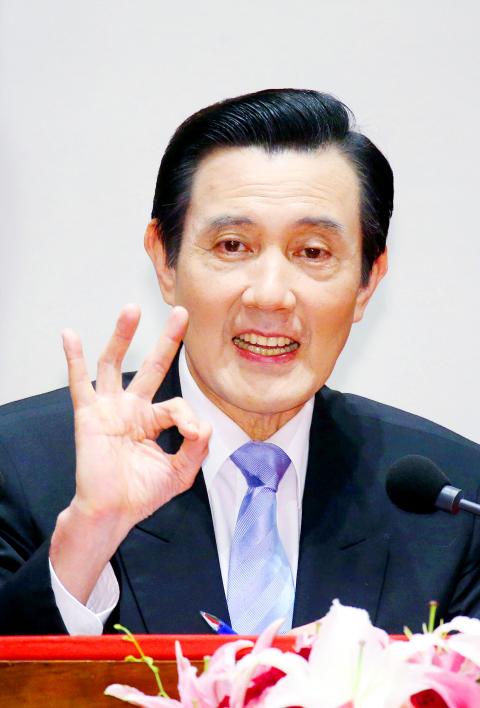
Photo: CNA
The demand that a review of the cross-strait service trade agreement in the legislature be delayed until the specific bill is passed was “unnecessary,” Ma said, adding that the legislature can handle the two issues “in parallel.”
Ma said he has instructed the Executive Yuan to assess the possibility of holding a citizens’ constitutional conference, as the students have demanded, but he declined to give an estimated timeline for completing the assessment.
As for the possibility that Ma, who doubles as chairman of the Chinese Nationalist Party (KMT), could loosen party discipline so that KMT lawmakers would not be coerced to toe the party line and instead make decisions of their own free will, Ma said that he “holds no sway over the KMT caucus’ decisions.”
“People think I can have anyone punished any time for breach of party discipline. In fact, it is the party caucus’ decision, not mine,” Ma told a press conference, which was rescheduled from 10:30am yesterday to 3pm, and then to 6pm.
Yesterday’s press conference was only the second time that Ma responded to the students’ demands in the past 12 days.
His first press conference on Sunday last week disappointed the students, with some protesters forcing their way into the Executive Yuan that night, followed by an occupation of the compound by thousands of students.
Premier Jiang Yi-huah (江宜樺) then ordered National Police Agency (NPA) Director-General Wang Cho-chiun (王卓鈞) to forcibly evict the protesters from the Executive Yuan compound by dawn, resulting in scores of protesters being injured in what has been termed a bloody crackdown.
The crackdown had prompted calls for Jiang and Wang to resign, but Ma yesterday dismissed the calls, saying that was not necessary.
Ma reiterated that he would like to discuss with students whatever concerns they have about the cross-strait service trade agreement.
“I hope I can explain to the students the contents of the agreement in detail, but we have not been given a chance. I want to invite them for a talk and hope that they can tell me why they are opposed to the agreement,” Ma said.
Ma said he “failed utterly to see” why some people have criticized the cross-strait service trade agreement as being in China’s favor and that it would sell out the interests of Taiwan if it is ratified by the legislature.

‘NO SECURITY RISK’: The Railway Bureau reassured the public that the technicians’ activities were limited to technical guidance and did not involve sensitive systems The Railway Bureau yesterday said it had invited eight Chinese technicians to assist with an airport MRT construction project. The bureau issued the confirmation after an Internet user said Chinese nationals had entered the construction zone of Taiwan Taoyuan International Airport’s Terminal 3 project. They asked why “individuals from an enemy state” were allowed access to such a major national infrastructure project, which raised serious concerns over Taiwan’s industrial safety, sensitive systems and information security. The bureau’s Northern Region Engineering Branch Office said subcontractor Taiwan Handle Industrial Co (台灣手把工業) of the Taoyuan airport MRT’s “Contract No. CU05 Project A14 Station Civil, MEP &

The National Chungshan Institute of Science and Technology yesterday showcased its locally developed variants of the Vision 60 robotic patrol dog, which it plans to deploy on the nation’s outlying territories in the South China Sea. The variants were produced under the Joint Lab project — created by the institute and domestic companies — and assembled with domestically produced motors, lenses and artificial intelligence (AI) systems alongside licensed tech from the US, Missile and Rocket Systems Research Division deputy director Jen Kuo-kang (任國光) told the media event at a military base in Taipei’s Dazhi (大直) area. Taiwan has built up its strengths

NOT IMMEDIATE: Taiwan has a chance to appeal the proposed 10 percent tariff before it starts, while other countries face a 12.5 percent tariff from the trade office Taiwan is among 60 economies determined by the US to have failed to impose or enforce a ban on the importation of goods produced with forced labor, according to a notice released on Tuesday by the Office of the US Trade Representative (USTR), which proposed imposing an additional 10 percent or more tariff on them. The USTR in a statement said that following an investigation, it had determined under Section 301 of the Trade Act of 1974 that the failure of the 60 economies to impose and effectively enforce a prohibition on the importation of goods produced with forced labor is
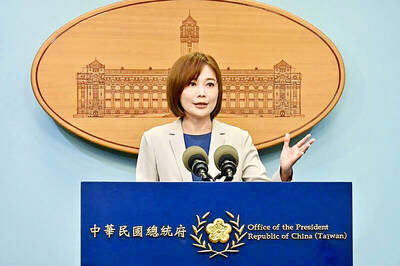
TIT-FOR-TAT: The US allegedly revoked the visa of a Chinese national working at Xinhua News Agency in the US in response to Beijing’s expulsion of Vivian Wang The Presidential Office yesterday condemned China for expelling a New York Times correspondent from Beijing following the newspaper’s interview with President William Lai (賴清德), saying the move highlighted Beijing’s suppression of press freedom and its threat to international news media. Taiwan has noted a series of recent incidents in which Beijing used similar tactics to “threaten and pressure international media outlets and journalists,” Presidential Office spokeswoman Karen Kuo (郭雅慧) said in a statement. “This concerns not only press freedom and freedom of expression, but also the safety of journalists, and Taiwan and relevant partners are paying close attention to the situation,” she


 RSS
RSS