


The Democratic Progressive Party (DPP) yesterday issued an ultimatum demanding that President Ma Ying-jeou (馬英九) apologize to the public about the controversial cross-strait service trade agreement and renegotiate the deal.
“If it were not for Ma’s grave mistakes in his handling of the agreement, the students would not be here,” DPP Chairman Su Tseng-chang (蘇貞昌) told an international press conference, referring to the hundreds of protesters — mostly students — occupying the legislative chamber since Tuesday evening.
“The ball is now in Ma’s court. A solution to the ongoing mass protest is still possible if he is willing to apologize, send the deal back for substantive deliberation and renegotiate it with China,” Su said, warning the Ma administration against using police force to remove the students.
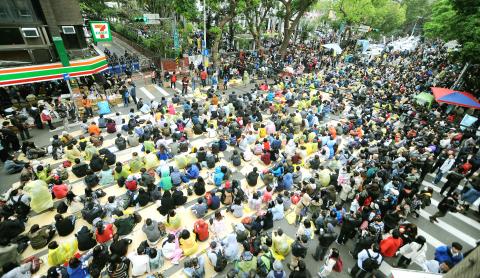
Photo: Liu Hsin-de, Taipei Times
The Chinese Nationalist Party (KMT) has always resorted to smear campaigns to discredit the opposition and hide its true motives, Su said.
Since the occupation of the legislative chamber began, the KMT and several media outlets have branded the students “rioters” and accused them of “lawless behavior,” he said.
Premier Jiang Yi-huah (江宜樺) and KMT caucus whip Lin Hung-chih (林鴻池) yesterday accused “certain political parties” of being behind the student protest.
The DPP has nothing to do with the protest, Su said, adding that the students “had no choice but to stage it” because Ma had refused to listen to the public.
Su blasted KMT claims that the DPP had violated the consensus and tried to undermine the ratification of the deal.
Nothing could be further from the truth, he said, as the DPP had submitted a counterproposal and convened a joint committee meeting to review the pact.
“The KMT could have attended the meeting and taken advantage of its majority during the review process, but it refused to do so,” he said.
Pledging his full support to the students, Su said the DPP has begun mobilizing people across the country for a mass rally today in and around the Legislative Yuan compound.
With the DPP and the Taiwan Solidarity Union both mobilizing support, the crowd of protesters could swell to more than 15,000, he said.
At press time, the number of protesters outside had surpassed 10,000, police estimates show.
In a prepared statement, the DPP condemned the KMT for disregarding a previous consensus on the trade agreement, overriding legislative proceedings and undermining Taiwanese democracy.
The party said it could not take the pact lightly because it would impact thousands of industries and millions of jobs in the nation.
The DPP said it would support and protect the students, who have set a deadline of noon today for Ma to meet their demands, as long as the protest persists.
Meanwhile, the Formosan Association for Public Affairs (FAPA) is urging US President Barack Obama and the US Congress to express their “strong concern” to Taipei about the government’s efforts to force the cross-strait service trade agreement through the legislature.
“The present heavy-handed approach is harmful to the country’s democracy,” a statement issued by the Washington-based Taiwanese-American organization said.
“The KMT government and the Legislative Yuan urgently need to have an orderly clause-by-clause process to review the agreement,” it said. “As this trade agreement is an international legal instrument, it should be treated as such and receive formal approval by the legislature.”
“FAPA will raise this issue with its contacts in the US Congress and the US Government and urge both to convey their strong concerns to the Taiwan authorities about these undemocratic procedures,” it said.
Additional reporting by William Lowther

‘NO SECURITY RISK’: The Railway Bureau reassured the public that the technicians’ activities were limited to technical guidance and did not involve sensitive systems The Railway Bureau yesterday said it had invited eight Chinese technicians to assist with an airport MRT construction project. The bureau issued the confirmation after an Internet user said Chinese nationals had entered the construction zone of Taiwan Taoyuan International Airport’s Terminal 3 project. They asked why “individuals from an enemy state” were allowed access to such a major national infrastructure project, which raised serious concerns over Taiwan’s industrial safety, sensitive systems and information security. The bureau’s Northern Region Engineering Branch Office said subcontractor Taiwan Handle Industrial Co (台灣手把工業) of the Taoyuan airport MRT’s “Contract No. CU05 Project A14 Station Civil, MEP &

The National Chungshan Institute of Science and Technology yesterday showcased its locally developed variants of the Vision 60 robotic patrol dog, which it plans to deploy on the nation’s outlying territories in the South China Sea. The variants were produced under the Joint Lab project — created by the institute and domestic companies — and assembled with domestically produced motors, lenses and artificial intelligence (AI) systems alongside licensed tech from the US, Missile and Rocket Systems Research Division deputy director Jen Kuo-kang (任國光) told the media event at a military base in Taipei’s Dazhi (大直) area. Taiwan has built up its strengths

NOT IMMEDIATE: Taiwan has a chance to appeal the proposed 10 percent tariff before it starts, while other countries face a 12.5 percent tariff from the trade office Taiwan is among 60 economies determined by the US to have failed to impose or enforce a ban on the importation of goods produced with forced labor, according to a notice released on Tuesday by the Office of the US Trade Representative (USTR), which proposed imposing an additional 10 percent or more tariff on them. The USTR in a statement said that following an investigation, it had determined under Section 301 of the Trade Act of 1974 that the failure of the 60 economies to impose and effectively enforce a prohibition on the importation of goods produced with forced labor is

TIT-FOR-TAT: The US allegedly revoked the visa of a Chinese national working at Xinhua News Agency in the US in response to Beijing’s expulsion of Vivian Wang The Presidential Office yesterday condemned China for expelling a New York Times correspondent from Beijing following the newspaper’s interview with President William Lai (賴清德), saying the move highlighted Beijing’s suppression of press freedom and its threat to international news media. Taiwan has noted a series of recent incidents in which Beijing used similar tactics to “threaten and pressure international media outlets and journalists,” Presidential Office spokeswoman Karen Kuo (郭雅慧) said in a statement. “This concerns not only press freedom and freedom of expression, but also the safety of journalists, and Taiwan and relevant partners are paying close attention to the situation,” she


 RSS
RSS