


Amid the latest political storm over the alleged illegal lobbying for a lawsuit involving Democratic Progressive Party Legislator Ker Chien-ming (柯建銘), President Ma Ying-jeou (馬英九) yesterday urged Legislative Speaker Wang Jin-pyng (王金平) to return to Taiwan immediately and explain his alleged involvement in the incident.
“[The incident] will damage the credibility of the judicial system and at the same time hurt the Chinese Nationalist Party’s (KMT) image … I hope Speaker Wang can return to Taiwan and explain the issue to the public as soon as possible,” Ma, who doubles as KMT chairman, said after casting his vote for the KMT’s Central Standing Committee election at the Taipei City Council.
Accompanied by a group of KMT Taipei City councilors, Ma said he has instructed KMT Secretary-General Tseng Yung-chuan (曾永權) to contact Wang and ask him to clarify the issue as soon as possible.
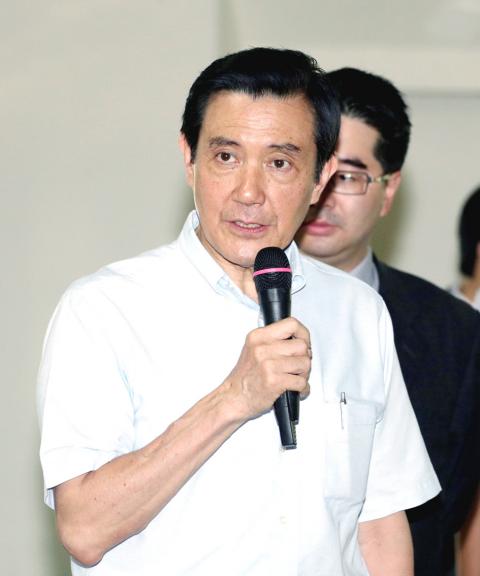
Photo: CNA
Wang is in Malaysia on a family vacation. According to his assistant, Wang will not return to Taiwan any time soon because he is hosting his second daughter’s wedding today.
The assistant added that Wang has already heard the news about the alleged Ker-case lobbying from his office, but decided to refrain from commenting on the case.
Wang is scheduled to return on Tuesday, the assistant added.
Meanwhile, Ma yesterday also defended his decision to accept the resignation of former Minister of Justice Tseng Yung-fu (曾勇夫) on Friday night over accusations that he had abused his power to stop a prosecutor from appealing Ker’s case with the Supreme Court.
“As the general public has questions about the case, Tseng can no longer carry out his duty as the justice minister under such circumstances,” Ma said.
Tseng, who had originally refused to step down, while insisting on his innocence, announced his resignation late on Friday night after meeting with Premier Jiang Yi-huah (江宜樺) twice earlier in the day.
Jiang yesterday dismissed the idea that Ma had forced Tseng’s resignation and said Tseng was defending his innocence during their private meetings.
“We both agree that he, as the top official in the judicial system, should hold his own performance to higher standards,” Jiang said.
Jiang said Tseng agreed to take “political responsibility” for the allegations and that his resignation did not mean that he admitted any involvement in illegal lobbying.
“We had a peaceful and rational discussion yesterday, and he was not forced to step down,” Jiang said.
Politicians in the pan-blue camp yesterday expressed concern about the incident and urged the Ma administration to handle it carefully.
Taipei Mayor Hau Lung-bin (郝龍斌) said the incident involves administrative, legislative and judicial issues, and such a constitutional matter should be addressed carefully.
Former Taipei EasyCard Corp (悠遊卡公司) chairman Sean Lien (連勝文) expressed concern about the Special Investigation Division’s (SID) eavesdropping on Ker and Wang, but refrained from commenting further on the case.
Lien’s father, former KMT chairman Lien Chan (連戰), also showed up at the Taipei City Council to cast his vote, but declined to comment on the incident.
Meanwhile, conspiracy theories have been fueling the rumor mill, with KMT Legislator Liao Cheng-ching (廖正井) saying that he saw the incident as “sheer infighting” in the government’s judiciary system between Tseng and Prosecutor-General Huang Shih-ming (黃世銘), who led the SID, while others said it was an internal struggle in the Ma administration — infighting between Ma and Wang.
Wang does not have a position within the KMT, but as legislative speaker and a key figure in the party’s localization factions, he has great influence in the party.
Wang also represents the KMT’s old power bloc, along with party heavyweights including Lien Chan and former KMT chairman Wu Poh-hsiung (吳伯雄), and has had problematic relations with Ma in the wake of fierce competition over the KMT chairmanship in 2005.
Additional reporting by Shih Hsiu-chuan and staff writer

The National Chungshan Institute of Science and Technology yesterday showcased its locally developed variants of the Vision 60 robotic patrol dog, which it plans to deploy on the nation’s outlying territories in the South China Sea. The variants were produced under the Joint Lab project — created by the institute and domestic companies — and assembled with domestically produced motors, lenses and artificial intelligence (AI) systems alongside licensed tech from the US, Missile and Rocket Systems Research Division deputy director Jen Kuo-kang (任國光) told the media event at a military base in Taipei’s Dazhi (大直) area. Taiwan has built up its strengths

RIGHT DIRECTION: Taiwan’s efforts to prevent forced labor include a proposal to ‘fully prohibit’ employers from withholding workers’ documents, an official said Taiwan is to establish a mechanism to restrict imports of goods linked to forced labor, the Executive Yuan said yesterday, after the US proposed imposing additional tariffs on Taiwanese goods over labor concerns. “The Ministry of Labor and the Ministry of Economic Affairs are to establish an interministerial review procedure,” Executive Yuan spokesperson Michelle Lee (李慧芝) said at a news briefing in Taipei. “The government is to use the Foreign Trade Act [貿易法] as the legal basis to restrict imports of goods produced with forced labor” and bring its supply chain governance more in line with international standards on human rights, resilience

NOT IMMEDIATE: Taiwan has a chance to appeal the proposed 10 percent tariff before it starts, while other countries face a 12.5 percent tariff from the trade office Taiwan is among 60 economies determined by the US to have failed to impose or enforce a ban on the importation of goods produced with forced labor, according to a notice released on Tuesday by the Office of the US Trade Representative (USTR), which proposed imposing an additional 10 percent or more tariff on them. The USTR in a statement said that following an investigation, it had determined under Section 301 of the Trade Act of 1974 that the failure of the 60 economies to impose and effectively enforce a prohibition on the importation of goods produced with forced labor is

TIT-FOR-TAT: The US allegedly revoked the visa of a Chinese national working at Xinhua News Agency in the US in response to Beijing’s expulsion of Vivian Wang The Presidential Office yesterday condemned China for expelling a New York Times correspondent from Beijing following the newspaper’s interview with President William Lai (賴清德), saying the move highlighted Beijing’s suppression of press freedom and its threat to international news media. Taiwan has noted a series of recent incidents in which Beijing used similar tactics to “threaten and pressure international media outlets and journalists,” Presidential Office spokeswoman Karen Kuo (郭雅慧) said in a statement. “This concerns not only press freedom and freedom of expression, but also the safety of journalists, and Taiwan and relevant partners are paying close attention to the situation,” she


 RSS
RSS