


Democratic Progressive Party (DPP) lawmakers yesterday maintained that students have every right to attend meetings of legislative committees and expressed concern over one media outlet’s criticism of students’ behavior toward the education minister on Monday.
The Chinese-language United Daily News yesterday dedicated its front page and another full page to criticism of a group of university students — who, on a visit to a legislative committee meeting, had told Minister of Education Chiang Wei-ling (蔣偉寧) to his face that he was not qualified for the job — and DPP Legislator Cheng Li-chiun (鄭麗君) for turning the committee meeting into a “private courtroom” for the students to “grill” Chiang.
The Ministry of Education sent an e-mail to university authorities after student-led protests last week against a controversial Next Media Group deal. The e-mail asked universities to investigate protesters out of “concern” for their health, prompting accusations of a re-emergence of the tactics of the White Terror era.
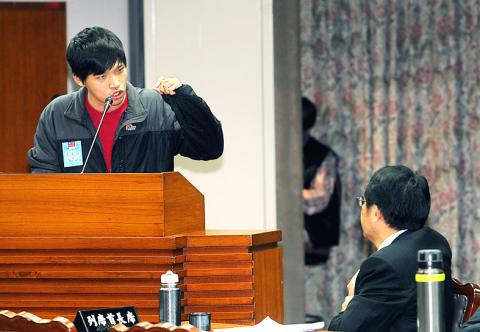
Photo: Taipei Times
Cheng, the convener of the legislature’s Education and Culture Committee, invited student representatives and professors who participated in the protests to attend a special session of the committee on Monday.
In response to the United Daily News coverage, Cheng yesterday said the newspaper had infringed on the students’ freedom of expression and had tried to shift the focus away from inappropriate practices at the ministry.
The students’ explanation of the chilling effect of the e-mail was the main reason why Chiang offered an apology and a four-point pledge to correct the ministry’s mistakes and ensure students’ rights to participate in protests at the meeting, Cheng said.
Cheng also expressed disappointment at a U-turn by Chinese Nationalist Party (KMT) lawmakers, saying they disagreed with the ministry’s move and supported her decision to call the special session on Monday.
“These students are citizens and adults, and we should treat them accordingly. Citizens have the freedom to express their views on public affairs, and to challenge unfairness and injustice. That is what the student movement is all about,” Cheng said, adding that if anyone oppressed the students’ freedom of expression, they were making the same mistake as the ministry.
The students’ attendance at the meeting was legal, DPP Legislator Yeh Yi-jin (葉宜津) said, noting that Article 67 of the Constitution stipulates that “the legislature may set up various committees and such committees may invite government officials and private persons concerned to be present at their meetings to answer questions.”
The public should appreciate the students’ courage in stepping forward and challenging authority, and the students’ comments certainly did not amount to “contempt of the legislature” as has been claimed, she said.
DPP Legislator Chen Ting-fei (陳亭妃) said the students and professors stood on the same podium as Chiang, who returned to his seat when the students were speaking, and answered legislators’ questions, rather than “grilling” the minister.
Chen Wei-ting (陳為廷), a National Tsing Hua University (NTHU) student who accused Chiang of incompetence, being hypocritical and lying about his support for the student movement, issued a statement on his Facebook page yesterday, saying that while he could have worded his responses better, he stood by the context of his comments and that the United Daily News’ claim that he had been impolite was “outrageous” and incorrect.
NTHU issued a press release yesterday, in which the school said it was disappointed at Chen’s comments and behavior. The school pulled the release from its Facebook page hours later after it was criticized.
Wang Dan (王丹), a Chinese dissident who was part of the student movement during China’s Tiananmen Square Massacre in 1989 and who now teaches at NTHU, offered his support to the student protesters on his Facebook page.
Wang said he was astonished at the newspaper’s two-page coverage and its criticism of the students rather than the ministry’s misconduct.
“I’m wondering why society is so tolerant of authority, yet so critical of young people who participate in public affairs,” he said.
When reached for comment, the United Daily News said its coverage reflected the truth and that it would continue to publish stories in line with professional journalistic practices.
Additional reporting by Chao Ching-yu

‘NO SECURITY RISK’: The Railway Bureau reassured the public that the technicians’ activities were limited to technical guidance and did not involve sensitive systems The Railway Bureau yesterday said it had invited eight Chinese technicians to assist with an airport MRT construction project. The bureau issued the confirmation after an Internet user said Chinese nationals had entered the construction zone of Taiwan Taoyuan International Airport’s Terminal 3 project. They asked why “individuals from an enemy state” were allowed access to such a major national infrastructure project, which raised serious concerns over Taiwan’s industrial safety, sensitive systems and information security. The bureau’s Northern Region Engineering Branch Office said subcontractor Taiwan Handle Industrial Co (台灣手把工業) of the Taoyuan airport MRT’s “Contract No. CU05 Project A14 Station Civil, MEP &

The National Chungshan Institute of Science and Technology yesterday showcased its locally developed variants of the Vision 60 robotic patrol dog, which it plans to deploy on the nation’s outlying territories in the South China Sea. The variants were produced under the Joint Lab project — created by the institute and domestic companies — and assembled with domestically produced motors, lenses and artificial intelligence (AI) systems alongside licensed tech from the US, Missile and Rocket Systems Research Division deputy director Jen Kuo-kang (任國光) told the media event at a military base in Taipei’s Dazhi (大直) area. Taiwan has built up its strengths

NOT IMMEDIATE: Taiwan has a chance to appeal the proposed 10 percent tariff before it starts, while other countries face a 12.5 percent tariff from the trade office Taiwan is among 60 economies determined by the US to have failed to impose or enforce a ban on the importation of goods produced with forced labor, according to a notice released on Tuesday by the Office of the US Trade Representative (USTR), which proposed imposing an additional 10 percent or more tariff on them. The USTR in a statement said that following an investigation, it had determined under Section 301 of the Trade Act of 1974 that the failure of the 60 economies to impose and effectively enforce a prohibition on the importation of goods produced with forced labor is

TIT-FOR-TAT: The US allegedly revoked the visa of a Chinese national working at Xinhua News Agency in the US in response to Beijing’s expulsion of Vivian Wang The Presidential Office yesterday condemned China for expelling a New York Times correspondent from Beijing following the newspaper’s interview with President William Lai (賴清德), saying the move highlighted Beijing’s suppression of press freedom and its threat to international news media. Taiwan has noted a series of recent incidents in which Beijing used similar tactics to “threaten and pressure international media outlets and journalists,” Presidential Office spokeswoman Karen Kuo (郭雅慧) said in a statement. “This concerns not only press freedom and freedom of expression, but also the safety of journalists, and Taiwan and relevant partners are paying close attention to the situation,” she


 RSS
RSS