


Thousands of workers, students and social activists yesterday threw eggs toward the Presidential Office in Taipei during a protest about various economic and social issues, after launching five parades across the city.
“Fuck the government. It’s garbage,” thousands of demonstrators assembled on Ketagalan Boulevard chanted in unison as they moved toward the Presidential Office.
As they reached police barricades that stopped them about 300m away from the Presidential Office building itself, they began to throw eggs.
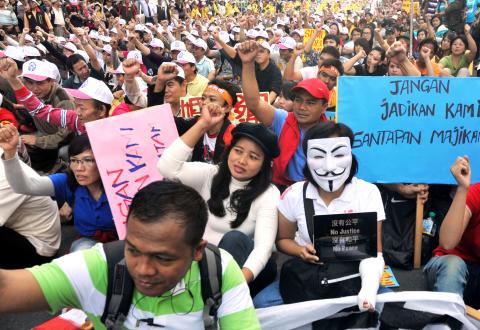
Photo: AFP, Mandy CHENG
Thousands of eggs were thrown over the barricades, accompanied by angry shouts, cheers and whistles.
Zhongzheng First Precinct Police Chief Fang Yang-ning (方仰寧), the commander of the police force at the scene, immediately declared that egg-throwing violated the Assembly and Parade Act (集會遊行法) and asked the crowd to stop or to disband.
However, the protesters continued and soon the ground was covered with egg yolk and cracked eggshells.
Prior to the rally in front of the Presidential Office, the demonstrators had marched across the city in five parades, each representing a social dilemma — including “merchandization” of education, racial discrimination, forced land seizures, a development-oriented economy and deteriorating social insurance systems.
“The demonstration today is a demonstration for all members of the working class and incorporates issues concerning education, environmental protection, agriculture and racial discrimination,” longtime labor activist Lin Tzu-wen (林子文) told the crowd. “In recent years, the government has been leaning more and more toward capitalists, while overlooking the suffering of the general public. It’s time for us to remind them to pay more attention to the people, not the few.”
Taiwan International Workers Association spokesman Hsu Chia-chuan (許家雋) said the government’s recent economic policies sought to trim labor costs by weakening protections for blue-collar foreign workers, while relaxing restrictions on white-collar foreign workers.
“This is not only racial discrimination, but also class discrimination,” Hsu said.
Some of the policies the government is mulling include lowering the threshold on businesses hiring foreign workers and excluding blue-collar foreign workers from the minimum wage.
“So many different groups concerned about different issues are assembled here, because we all face one core issue — the right-wing tendency of this government,” Raging Citizens Act Now spokesperson Lai Hsiang-ling (賴香伶) said.
She said the government was turning education into a commodity, making it increasingly expensive to go to school.
She also said the government was trying to import more cheap labor from overseas, exploiting foreign and domestic workers alike to benefit big business.
“The government is seizing farmland to make way for factories once big corporations demand it. The government is allowing industrial tycoons to expand capacity at expense of the environment,” she said. “Because the government predicts that the labor insurance fund may collapse within two decades, the solution it comes up with is to ask workers to pay higher premiums, accept lower pensions and retire at an older age, while it continues to give tax breaks and other favorable measures to capitalists.”
A retired manager of a Taipei-based trading company surnamed Chang (張) said he came out not only to show his anger against the government, but also his solidarity with his children.
“When I was young, I always believed that you could have a successful life if you worked hard enough, but it doesn’t seem to be the case nowadays,” he said. “My son is an electrical engineer, he works hard, but he still lost his first job when his company moved across the Strait. Not long after he started his second job, he was put on unpaid leave by his boss for some time because of the bad economy.”
“It’s Sunday today, but he still cannot come here, because he’s working overtime on a Sunday shift — he works hard, actually, he works even harder than I did, but I don’t feel as hopeful for him as I did when I was his age,” Chang said.
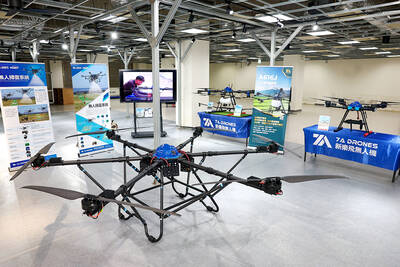
DRONE CENTRAL: Taiwan aims to become Asia’s democratic hub for drones, with most exports focused on high-quality military-grade models, an official said Taiwan’s drone industry is expected to expand significantly by 2030, producing 100,000 units per month and exporting half of them, the Ministry of Economic Affairs said yesterday. Current drone production capacity is about 15,000 units per month, but the industry can quickly scale up as demand increases, Industrial Development Administration Director-General Chiou Chyou-huey (邱求慧) told a news conference in Taipei. Taiwan’s drone output grew 2.5-fold last year to NT$12.9 billion (US$408.3 million) under a government program to develop the uncrewed vehicle sector, he said. The Executive Yuan in October last year approved plans to invest NT$44.2 billion into domestic production of uncrewed aerial
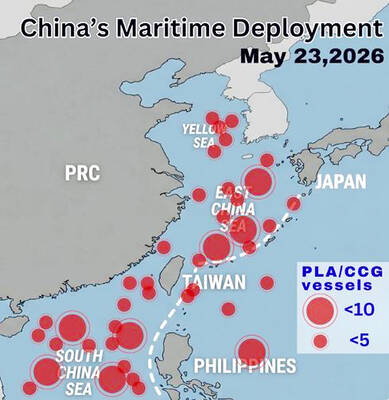
WARNING: China should stop engaging in actions that undermine regional peace and stability, as it would only build resentment among people across the Strait, the CGA said China has deployed more than 100 navy, coast guard and other vessels in waters from the Yellow Sea to the South China Sea and the western Pacific since US President Donald Trump and Chinese President Xi Jinping (習近平) met in Beijing, National Security Council Secretary-General Joseph Wu (吳釗燮) said yesterday. “In this part of the world, #China is the one & only PROBLEM wrecking the #StatusQuo & threatening regional peace & stability,” Wu wrote on X. In a separate post, he said Beijing was coercing Taiwan’s maritime domain, calling it illegal and provocative, after the Coast Guard Administration (CGA) expelled a
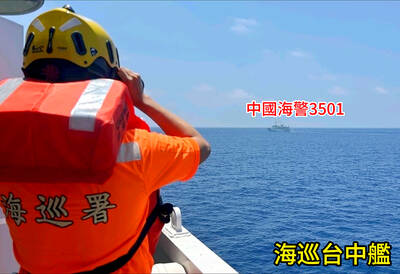
VERBOSE VESSELS: A CGA cutter and a China Coast Guard exchanged verbal barbs for more than a day in Taiwanese-controlled waters before the Chinese vessel left The Taiwanese and Chinese coast guards had a standoff near the strategically located Pratas Islands (Dongsha Islands, 東沙群島) in the north of the South China Sea, the Coast Guard Administration (CGA) said yesterday. The two sides engaged in intense radio exchanges over sovereignty claims during the 33-hour standoff. China Coast Guard vessel 3501 eventually left the restricted waters, 26.6 nautical miles (49.2km) west of the Pratas Islands, at 5pm yesterday, the CGA said. Lying approximately between southern Taiwan and Hong Kong, the Taiwan-controlled Pratas are seen by some security experts as vulnerable to Chinese attack due to their distance — more than
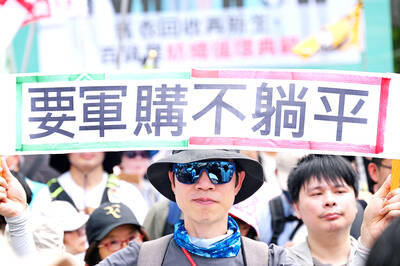
More than 8,000 people took part in a rally in Taipei yesterday to express support for more defense spending, after the opposition slashed the Cabinet’s proposed NT$1.25 trillion (US$39.6 billion) special defense budget and capped it at NT$780 billion. The demonstrators urged the Cabinet to propose another bill. Taiwan Economic Democracy Union convener Lai Chung-chiang (賴中強) said the main problem of the passed budget plan is the removal of funding for critical items, not just that the total amount is smaller. Critical budget items included purchasing or developing uncrewed vehicles, Strong Bow (強弓) missile systems, additional ammunition, artificial intelligence-powered combat systems and Taiwan-US


 RSS
RSS