


Developing a strong economy for sustainable livelihoods is the unavoidable responsibility of a national leader and President Ma Ying-jeou (馬英九) should put his money where his mouth is, Democratic Progressive Party (DPP) Chairman Su Tseng-chang (蘇貞昌) and former DPP chairperson Tsai Ing-wen (蔡英文) said yesterday in response to Ma’s National Day speech.
“The biggest wish of Taiwanese on National Day is to enjoy a better standard of living, rather than watching a president talking,” Su said in Lioujiao Township (六腳), Chiayi County.
“Instead of boasting about tomorrow, I would advise the president visit local communities and gain first-hand experience of people’s suffering,” said Su, who turned down an invitation from the Presidential Office to attend the National Day ceremony.
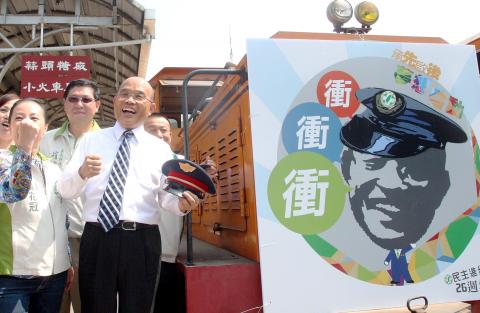
Photo: CNA
The Ma administration has failed to listen to the people’s voice, evidenced by the president’s recent “inflammatory remark” that laziness was why people do not exercise as often as they should.
Tsai, who also skipped the ceremony and visited Nantou County, told reporters the economy is key for Taiwan and that people expect a competent and responsible government to help the country emerge from the economic slump.
Asked to comment on Ma’s speech, Tsai said his pledges were empty and sounded “more like a first-year president than a fifth-year president” because Ma “keeps telling people what he plans to do, rather than what he has achieved.”
The former DPP presidential candidate also offered advice to Ma on her Facebook page.
Quoting former US president Andrew Jackson, who said the greatness of an administration is built upon freedom, abundance and the fearlessness of its people, Tsai said a government which lacks the determination to safeguard freedoms and cannot take care of people’s everyday lives is not qualified to demand the loyalty of its people.
The worsening economic situation, including rising prices, an growing unemployment rate, furloughs and stagnant wages, has affected everyone — young and old — nationwide, Tsai said.
“The government appears to be the culprit of the people’s suffering,” she wrote.
The Ma administration has turned a deaf ear to warnings about the economy from the DPP and academics, Tsai said, adding that Taiwan’s overdependence on the Chinese market and the failure of industries to upgrade had hurt the nation’s global competitiveness.
Ma’s decision to raise electricity and fuel prices was like adding fuel to the fire, as the poor get poorer and the middle-class is struggling like never before, she said.
Tsai said she had expressed hope that Ma would “listen to the voice of the people, and take care of each and every Taiwanese” in her concession speech on the night of the presidential election on Jan. 14, but it is obvious that Ma had not been listening.
“I want to remind you [Ma] again, on National Day, that people are not required to lend unconditional support to the country unless their freedoms and well-being are amply protected,” Tsai said.

‘NO SECURITY RISK’: The Railway Bureau reassured the public that the technicians’ activities were limited to technical guidance and did not involve sensitive systems The Railway Bureau yesterday said it had invited eight Chinese technicians to assist with an airport MRT construction project. The bureau issued the confirmation after an Internet user said Chinese nationals had entered the construction zone of Taiwan Taoyuan International Airport’s Terminal 3 project. They asked why “individuals from an enemy state” were allowed access to such a major national infrastructure project, which raised serious concerns over Taiwan’s industrial safety, sensitive systems and information security. The bureau’s Northern Region Engineering Branch Office said subcontractor Taiwan Handle Industrial Co (台灣手把工業) of the Taoyuan airport MRT’s “Contract No. CU05 Project A14 Station Civil, MEP &

The National Chungshan Institute of Science and Technology yesterday showcased its locally developed variants of the Vision 60 robotic patrol dog, which it plans to deploy on the nation’s outlying territories in the South China Sea. The variants were produced under the Joint Lab project — created by the institute and domestic companies — and assembled with domestically produced motors, lenses and artificial intelligence (AI) systems alongside licensed tech from the US, Missile and Rocket Systems Research Division deputy director Jen Kuo-kang (任國光) told the media event at a military base in Taipei’s Dazhi (大直) area. Taiwan has built up its strengths

NOT IMMEDIATE: Taiwan has a chance to appeal the proposed 10 percent tariff before it starts, while other countries face a 12.5 percent tariff from the trade office Taiwan is among 60 economies determined by the US to have failed to impose or enforce a ban on the importation of goods produced with forced labor, according to a notice released on Tuesday by the Office of the US Trade Representative (USTR), which proposed imposing an additional 10 percent or more tariff on them. The USTR in a statement said that following an investigation, it had determined under Section 301 of the Trade Act of 1974 that the failure of the 60 economies to impose and effectively enforce a prohibition on the importation of goods produced with forced labor is
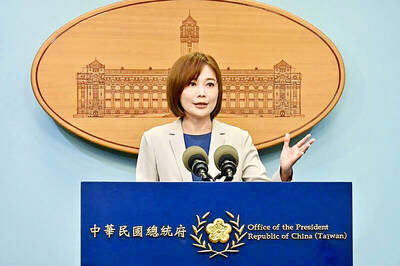
TIT-FOR-TAT: The US allegedly revoked the visa of a Chinese national working at Xinhua News Agency in the US in response to Beijing’s expulsion of Vivian Wang The Presidential Office yesterday condemned China for expelling a New York Times correspondent from Beijing following the newspaper’s interview with President William Lai (賴清德), saying the move highlighted Beijing’s suppression of press freedom and its threat to international news media. Taiwan has noted a series of recent incidents in which Beijing used similar tactics to “threaten and pressure international media outlets and journalists,” Presidential Office spokeswoman Karen Kuo (郭雅慧) said in a statement. “This concerns not only press freedom and freedom of expression, but also the safety of journalists, and Taiwan and relevant partners are paying close attention to the situation,” she


 RSS
RSS