


Vice President Wu Den-yih (吳敦義) yesterday denied he or his wife played a role in the corruption scandal involving former Executive Yuan secretary-general Lin Yi-shih (林益世), dismissing accusations that he was involved in the case.
Following accusations that Wu introduced businessman Chen Chi-hsiang (陳啟祥) to Lin, who allegedly accepted NT$63 million (US$2.15 million) from Chen to help secure contracts with China Steel Corp (中鋼) and its subsidiaries, the Chinese-language Next Magazine yesterday claimed Wu’s wife, Tsai Ling-yi (蔡令怡), had made a phone call to a family friend, Wu Men-chung (吳門忠), to complain about their relationship being exposed by the magazine.
Wu Men-chung, a major votes broker for the vice president in his Nantou County hometown, is the father of Chen’s girlfriend’s daughter-in-law.
The magazine claimed that when Wu Den-yih denied having a relationship with Chen last week, Tsai made a call to Wu Men-chung on the same day and said he should have told Wu Den-yih about his family’s relationship with Chen’s girlfriend, Cheng Tsai-mei (程彩梅), before the magazine picked up the story, prompting Wu Men-chung to publicly clarify the issue.
The magazine also claimed that Wu Men-chung’s wife had accepted NT$10 million from Chen.
The vice president yesterday denied the story and insisted his wife never made the telephone call. He also urged the magazine to stop making groundless accusations about him and his family.
“My wife did not call Wu Men-chung last week. If she did, then we would not be able to clarify the situation and the rumors would spread,” he said on the sidelines of an event in Taipei.
Speculations about the vice president’s involvement in the case first surfaced last week when political commentator Hu Chung-hsin (胡忠信) said a high-ranking government official was also involved in the corruption scandal, claiming that “Mr X” introduced Chen to Lin and implying that Mr X was Wu Den-yih.
Next Magazine also linked Wu Den-yih to the case by claiming last week that Lin bragged about his relations with Wu Den-yih when asking for bribes from Chen, saying he was handling all of Wu Den-yih’s matters.
In other news, the vice president also dismissed speculation that he would run for the Chinese Nationalist Party (KMT) chairmanship now that President Ma Ying-jeou’s (馬英九) all-time low support rating has prompted calls for him to step down as the party chairman to focus his efforts on his presidential duties.
The vice president also denied a Next Magazine report that he had collaborated with Legislative Speaker Wang Jin-pyng (王金平) to strengthen the anti-Ma force in the KMT.
“I support the president continuing to serve as KMT chairman. I did not attend Speaker Wang’s banquet with local government heads in May. The magazine is making stories up,” he said.
Ma announced on Wednesday last week that he would seek re-election as KMT chairman next year. Wang, a possible challenger to Ma in the election, has denied having any intention of competing.

‘NO SECURITY RISK’: The Railway Bureau reassured the public that the technicians’ activities were limited to technical guidance and did not involve sensitive systems The Railway Bureau yesterday said it had invited eight Chinese technicians to assist with an airport MRT construction project. The bureau issued the confirmation after an Internet user said Chinese nationals had entered the construction zone of Taiwan Taoyuan International Airport’s Terminal 3 project. They asked why “individuals from an enemy state” were allowed access to such a major national infrastructure project, which raised serious concerns over Taiwan’s industrial safety, sensitive systems and information security. The bureau’s Northern Region Engineering Branch Office said subcontractor Taiwan Handle Industrial Co (台灣手把工業) of the Taoyuan airport MRT’s “Contract No. CU05 Project A14 Station Civil, MEP &

A US uncrewed surface vessel (USV) encountered multiple Chinese warships during an autonomous transit of the Taiwan Strait, US defense company Seasats said in a statement on Wednesday. Seasats announced that a Lightfish USV had completed the first autonomous transit of the Taiwan Strait. Over five days, the USV traversed the entire length of the Strait while constantly monitoring surface vessel traffic, the company said. The Lightfish encountered multiple Chinese warships, one of which was a Chinese People’s Liberation Army Navy (PLAN) Type 056 corvette, it said. The Chinese vessels were operating “well within Taiwan’s exclusive economic zone without transmitting their identity via the
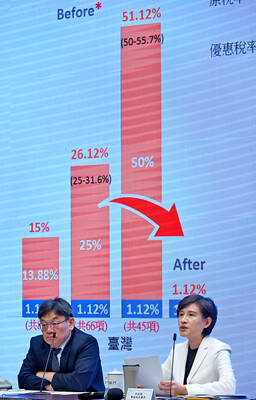
GREATER REACH? Auto parts and wood products would face tariffs of up to 15%, matching those targeting the EU, Japan and South Korea, Vice Premier said The US has announced that preferential tariff treatment for Taiwan’s non-semiconductor Section 232 goods would take effect retroactively from May 1, the Executive Yuan said yesterday. The US government yesterday posted a notice on the Federal Register’s public inspection Web site previewing tariff concessions for Taiwan under a memorandum of understanding (MOU) on Taiwan-US investment after two months of negotiations. The MOU signed on Jan. 15 stipulated three major preferential tariff arrangements: a 15 percent “reciprocal” tariff rate for Taiwan without stacking most-favored nation (MFN) rates; preferential Section 232 treatment for semiconductors and related products; and preferential Section 232 treatment for non-semiconductor
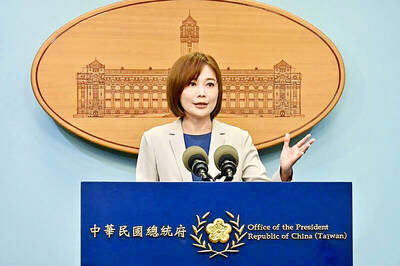
TIT-FOR-TAT: The US allegedly revoked the visa of a Chinese national working at Xinhua News Agency in the US in response to Beijing’s expulsion of Vivian Wang The Presidential Office yesterday condemned China for expelling a New York Times correspondent from Beijing following the newspaper’s interview with President William Lai (賴清德), saying the move highlighted Beijing’s suppression of press freedom and its threat to international news media. Taiwan has noted a series of recent incidents in which Beijing used similar tactics to “threaten and pressure international media outlets and journalists,” Presidential Office spokeswoman Karen Kuo (郭雅慧) said in a statement. “This concerns not only press freedom and freedom of expression, but also the safety of journalists, and Taiwan and relevant partners are paying close attention to the situation,” she


 RSS
RSS