


Falun Gong practitioners filed a lawsuit against Beijing Mayor Guo Jinlong (郭金龍), who arrived in Taiwan yesterday afternoon, saying he had committed crimes against humanity, including his alleged involvement in the torture and abuse of Falun Gong practitioners and Tibetans.
A group of Falun Gong practitioners in Taiwan, accompanied by attorney Theresa Chu (朱婉琪), filed a lawsuit against Guo yesterday morning with the Taiwan High Prosecutors’ Office, asking it to launch a probe into Guo’s alleged crimes against humanity.
Guo arrived in Taiwan hours after the lawsuit was filed to take part in Beijing Culture Week, hosted by the Taipei City Government.
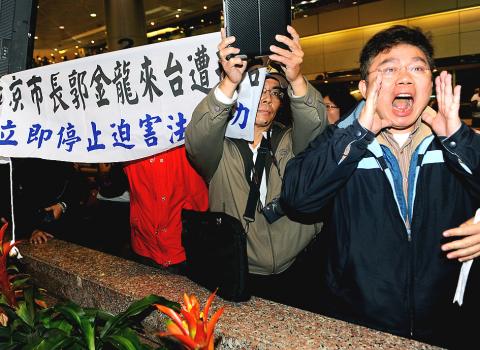
Photo: Chu Pei-hsiung, Taipei Times
“Guo’s record of human rights violations started with the repression of Tibetans in Tibet, who struggled for their freedom when he served as the Chinese Communist Party [CCP] chief in the Tibetan Autonomous Region,” Chu told the media outside the prosecutors’ office in Taipei. “Then, when Guo was party chief in Anhui Province, he prepared reports and a strategic handbook for the repression of Falun Gong activities in the province, leading to the illegal arrest of at least 37 Falun Gong practitioners.”
A member of the Beijing Olympics Organizing Committee, Guo was involved in the arrests of 586 Falun Gong practitioners in a six-month period, and more than 100 have been arrested in Beijing since he was sworn in as mayor of China’s capital, Chu said.
Guo became mayor of Beijing in January 2008.
“Guo’s role in the repression of Falun Gong practitioners and Tibetan activists constitutes crimes against humanity, as well as violations of the International Covenant on Civil and Political Rights and the International Covenant on Economic, Social and Cultural Rights,” Chu said. “As those human rights covenants have been adopted by the Legislative Yuan as domestic laws, the judiciary should take action if someone accused of such crimes is in the country, as many other countries that have prosecuted Chinese officials have done.”
Chu also panned the government for permitting Guo to visit Taiwan.
“We’ve delivered evidence of human rights abuses for which Guo was responsible to the National Immigration Agency, but he was still granted a permit to enter the country,” Chu said. “Most shockingly, Guo submitted his application [for a permit to visit Taiwan] on Feb. 4, and it was approved on Feb. 8 — even though there was a two-day weekend at that time.”
Guo, who was invited by the Chinese Nationalist Party (KMT), is the ninth Chinese official to be sued for alleged crimes against humanity since 2009.
Upon arriving in Taipei yesterday, he visited former KMT chairman Lien Chan (連戰) at Lien’s office before attending a dinner banquet hosted by former KMT chairman Wu Poh-hsiung (吳伯雄) at the Grand Hotel.
The six-day trip is Guo’s first visit to Taiwan and he is expected to discuss cross-strait issues and exchanges with various politicians during his stay.
The KMT insists Guo is in Taiwan to promote cross-strait cultural exchanges and his itinerary will focus on activities surrounding Beijing Culture Week.
Guo will visit the National Palace Museum and Songshan Cultural and Creative Park today, and head to Eslite Bookstore’s Xinyi flagship store before attending a cultural night at the Taipei Arena tomorrow.
Taipei City’s Department of Cultural Affairs, co-organizer of the Beijing Culture Week, said Taipei Mayor Hau Lung-bin (郝龍斌) would accompany Guo to the exhibitions at Songshan Cultural and Creative Park, and would introduce art and design work by Taiwanese artists.
Beijing Culture Week is a large-scale cultural event co-organized by Taipei and Beijing, launched seven years ago. Taipei and Beijing take turns hosting the event every six months.
Guo is also looking to use his visit to meet local politicians.
Information provided by the KMT shows he will visit also Greater Taichung, Changhua County and Nantou County and meet local KMT government leaders in those cities.
Hau and New Taipei City (新北市) Mayor Eric Chu (朱立倫) will meet with Guo and discuss the possibility of more city-to-city exchanges.

DRONE CENTRAL: Taiwan aims to become Asia’s democratic hub for drones, with most exports focused on high-quality military-grade models, an official said Taiwan’s drone industry is expected to expand significantly by 2030, producing 100,000 units per month and exporting half of them, the Ministry of Economic Affairs said yesterday. Current drone production capacity is about 15,000 units per month, but the industry can quickly scale up as demand increases, Industrial Development Administration Director-General Chiou Chyou-huey (邱求慧) told a news conference in Taipei. Taiwan’s drone output grew 2.5-fold last year to NT$12.9 billion (US$408.3 million) under a government program to develop the uncrewed vehicle sector, he said. The Executive Yuan in October last year approved plans to invest NT$44.2 billion into domestic production of uncrewed aerial
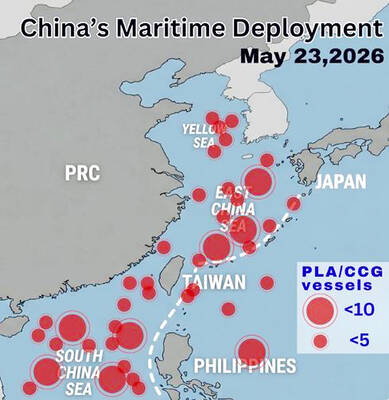
WARNING: China should stop engaging in actions that undermine regional peace and stability, as it would only build resentment among people across the Strait, the CGA said China has deployed more than 100 navy, coast guard and other vessels in waters from the Yellow Sea to the South China Sea and the western Pacific since US President Donald Trump and Chinese President Xi Jinping (習近平) met in Beijing, National Security Council Secretary-General Joseph Wu (吳釗燮) said yesterday. “In this part of the world, #China is the one & only PROBLEM wrecking the #StatusQuo & threatening regional peace & stability,” Wu wrote on X. In a separate post, he said Beijing was coercing Taiwan’s maritime domain, calling it illegal and provocative, after the Coast Guard Administration (CGA) expelled a

VERBOSE VESSELS: A CGA cutter and a China Coast Guard exchanged verbal barbs for more than a day in Taiwanese-controlled waters before the Chinese vessel left The Taiwanese and Chinese coast guards had a standoff near the strategically located Pratas Islands (Dongsha Islands, 東沙群島) in the north of the South China Sea, the Coast Guard Administration (CGA) said yesterday. The two sides engaged in intense radio exchanges over sovereignty claims during the 33-hour standoff. China Coast Guard vessel 3501 eventually left the restricted waters, 26.6 nautical miles (49.2km) west of the Pratas Islands, at 5pm yesterday, the CGA said. Lying approximately between southern Taiwan and Hong Kong, the Taiwan-controlled Pratas are seen by some security experts as vulnerable to Chinese attack due to their distance — more than
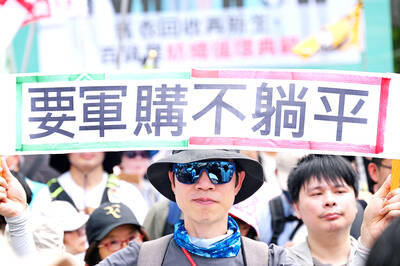
More than 8,000 people took part in a rally in Taipei yesterday to express support for more defense spending, after the opposition slashed the Cabinet’s proposed NT$1.25 trillion (US$39.6 billion) special defense budget and capped it at NT$780 billion. The demonstrators urged the Cabinet to propose another bill. Taiwan Economic Democracy Union convener Lai Chung-chiang (賴中強) said the main problem of the passed budget plan is the removal of funding for critical items, not just that the total amount is smaller. Critical budget items included purchasing or developing uncrewed vehicles, Strong Bow (強弓) missile systems, additional ammunition, artificial intelligence-powered combat systems and Taiwan-US


 RSS
RSS