


President Ma Ying-jeou’s (馬英九) re-election campaign office yesterday denied that China had gotten involved in his presidential election campaign because of concerns about Ma’s plummeting support, while insisting that his camp opposed any political interference from China.
Ma’s campaign office spokesperson Lee Chia-fei (李佳霏) dismissed a story in the Chinese-language Next Magazine that The United Front Work Department’s office in Shanghai had invited the local directors of Ma’s support groups to visit China from Nov. 17 to Nov. 21 in an attempt to boost Ma’s re-election chances amid a neck-and-neck battle against Democratic Progressive Party (DPP) Chairperson Tsai Ing-wen (蔡英文).
“The camp firmly opposes any political interference from the mainland in elections in Taiwan. We are also opposed to any attempt to intervene in Taiwan’s elections through the mainland,” she said.
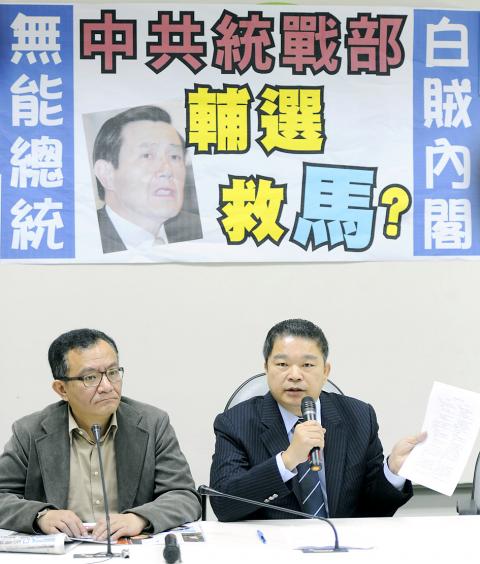
Photo: George Tsorng, Taipei Times
According to the magazine, the trip, led by the deputy honorary chairman of Ma’s support group in the sports industry, Chang Chao-kuo (張朝國), was arranged by the Chinese Communist Party’s United Front Works Department head in Shanghai, Yang Xiaodu (楊曉渡).
A total of 28 local directors of Ma’s support groups around the nation, including Chang, were invited to tour Shanghai and Suzhou, -Jiangsu Province, on the five-day trip, which was paid for by the Chinese Communist Party’s Shanghai office.
During the trip, Yang openly called on the directors to strengthen efforts to help Ma’s election campaign.
Suzhou officials even expressed opposition to People First Party (PFP) Chairman James Soong’s (宋楚瑜) participation in the presidential election, calling on the PFP chairman to stay out of the race to avoid affecting Ma’s re-election chances.
Lee yesterday insisted that the trip to China was an “individual decision” made by Chang and the other support group heads, adding that Chang and the others should explain their visit and the details of the trip to the public.
While declining to confirm whether the Ma camp would bar support group officials from visiting China before the presidential and legislative elections on Jan. 14, Lee repeated that the camp would not allow China to interfere in the election.
Meanwhile, Tsai urged Beijing to refrain from interfering in Taiwan’s elections, saying this was a “basic guideline for any civilized country.”
Tsai, who was traveling along Taiwan’s southwest coastal areas in a five-day campaign trip, made the comments in response to the Next Magazine report.
“I hope Beijing will respect Taiwan’s democracy and the choice of the Taiwanese people and refrain from interfering in Taiwan’s elections,” she said in Yunlin County. “[Maintaining a neutral position to elections in another country] is the basic guideline for any civilized country.”
Tsai said there had been many reports of Chinese officials receiving various Taiwanese groups and organizations, so she was not surprised about the case.
At a separate press conference called by the DPP’s caucus in Taipei, DPP Legislator Tsai Huang--liang (蔡煌瑯) urged Ma to call for Beijing’s neutrality on Taiwan’s presidential election.
“Beijing’s continued interference with our elections would eventually erode Taiwan’s -democratic system, identity and sovereignty,” he said. “President Ma is advised to clearly state his position to China that no one should interfere in Taiwan’s elections.”
DPP spokesperson Chen Chi-mai (陳其邁) last month listed five ways in which China had interfered with the run-up to elections, including sending provincial-level purchasing delegations and providing incentives for Taiwanese businesspeople in China to return to Taiwan for the January elections.
Soong, when asked for comment on the Next Magazine report, said “Taiwan’s democracy cannot tolerate intervention from outside forces.”
Additional reporting by staff writer

‘NO SECURITY RISK’: The Railway Bureau reassured the public that the technicians’ activities were limited to technical guidance and did not involve sensitive systems The Railway Bureau yesterday said it had invited eight Chinese technicians to assist with an airport MRT construction project. The bureau issued the confirmation after an Internet user said Chinese nationals had entered the construction zone of Taiwan Taoyuan International Airport’s Terminal 3 project. They asked why “individuals from an enemy state” were allowed access to such a major national infrastructure project, which raised serious concerns over Taiwan’s industrial safety, sensitive systems and information security. The bureau’s Northern Region Engineering Branch Office said subcontractor Taiwan Handle Industrial Co (台灣手把工業) of the Taoyuan airport MRT’s “Contract No. CU05 Project A14 Station Civil, MEP &

The National Chungshan Institute of Science and Technology yesterday showcased its locally developed variants of the Vision 60 robotic patrol dog, which it plans to deploy on the nation’s outlying territories in the South China Sea. The variants were produced under the Joint Lab project — created by the institute and domestic companies — and assembled with domestically produced motors, lenses and artificial intelligence (AI) systems alongside licensed tech from the US, Missile and Rocket Systems Research Division deputy director Jen Kuo-kang (任國光) told the media event at a military base in Taipei’s Dazhi (大直) area. Taiwan has built up its strengths

NOT IMMEDIATE: Taiwan has a chance to appeal the proposed 10 percent tariff before it starts, while other countries face a 12.5 percent tariff from the trade office Taiwan is among 60 economies determined by the US to have failed to impose or enforce a ban on the importation of goods produced with forced labor, according to a notice released on Tuesday by the Office of the US Trade Representative (USTR), which proposed imposing an additional 10 percent or more tariff on them. The USTR in a statement said that following an investigation, it had determined under Section 301 of the Trade Act of 1974 that the failure of the 60 economies to impose and effectively enforce a prohibition on the importation of goods produced with forced labor is

TIT-FOR-TAT: The US allegedly revoked the visa of a Chinese national working at Xinhua News Agency in the US in response to Beijing’s expulsion of Vivian Wang The Presidential Office yesterday condemned China for expelling a New York Times correspondent from Beijing following the newspaper’s interview with President William Lai (賴清德), saying the move highlighted Beijing’s suppression of press freedom and its threat to international news media. Taiwan has noted a series of recent incidents in which Beijing used similar tactics to “threaten and pressure international media outlets and journalists,” Presidential Office spokeswoman Karen Kuo (郭雅慧) said in a statement. “This concerns not only press freedom and freedom of expression, but also the safety of journalists, and Taiwan and relevant partners are paying close attention to the situation,” she


 RSS
RSS