


China’s Xinjiang region was hit by a wave of violence at the weekend that saw 10 people killed by knife-wielding assailants and another four shot dead by police, state media and authorities said yesterday.
The unrest happened in the ancient Silk Road city of Kashgar in two separate attacks and local residents said yesterday the city center was under lockdown, with security forces patrolling the streets.
Xinjiang has seen several outbreaks of ethnic violence in recent years as the mainly Muslim Uighur minority bridles under what it regards as oppression by the Chinese government.
In the first attack on Saturday evening, seven people were killed and 28 others hurt at a night market by two attackers with knives, one of whom was later killed in violence, the authorities said.
DETAINED
Hou Hanmin (侯漢敏), spokeswoman for the government of the northwestern region, said the attackers were both Uighurs, adding the suspect who was still alive had been detained.
“The case is still under investigation, so I don’t have more information,” she said.
Yesterday, three people were “hacked to death” by “rioters,” Xinhua news agency said.
It had earlier reported they died in an explosion, but a follow-up report left it unclear whether there had been a blast or not.
A posting on China’s Twitter-like Weibo service by a producer from China Central Television, China’s state television station, said gunshots were heard, not an explosion.
Police shot dead four suspects allegedly involved in the attack and detained four others, Xinhua said, while another four were on the run.
BYSTANDERS HURT
The agency said more than 10 bystanders and police officers were also injured. The government spokeswoman was not available when contacted about yesterday’s bout of violence.
A receptionist at a restaurant near a street where yesterday’s violence took place said the road had been blocked off.
“Neither cars nor pedestrian are allowed to enter. There are police patrolling everywhere,” the receptionist said.
A hotel receptionist described the current situation in Kashgar as a “mess.”
According to tianshannet.com, a Web site run by the regional government, the suspects in Saturday’s attack hijacked a truck that was waiting at a light at the food market in Kashgar, not far from the border with Kyrgyzstan.
They killed the driver, plowed the vehicle into passers-by on a nearby pavement, then got out of the truck and stabbed people at random, leaving six bystanders dead before the crowd turned on them and killed one attacker.
Dilxat Raxit, a spokesman for the Germany-based World Uyghur Congress — an exile group — cited local sources as saying the assailants had clashed with members of a civilian force that maintains public security.
He did not give specific details of yesterday’s attack, but called for China to “immediately stop its long-term, systematic repressive measures ... to prevent further unrest.”
Raxit said at least 100 Uighurs had been detained following Saturday’s incident.

PROVOCATIVE: Chinese Deputy Ambassador to the UN Sun Lei accused Japan of sending military vessels to deliberately provoke tensions in the Taiwan Strait China denounced remarks by Japan and the EU about the South China Sea at a UN Security Council meeting on Monday, and accused Tokyo of provocative behavior in the Taiwan Strait and planning military expansion. Ayano Kunimitsu, a Japanese vice foreign minister, told the Council meeting on maritime security that Tokyo was seriously concerned about the situation in the East China and South China seas, and reiterated Japan’s opposition to any attempt to change the “status quo” by force, and obstruction of freedom of navigation and overflight. Stavros Lambrinidis, head of the EU delegation to the UN, also highlighted South China Sea
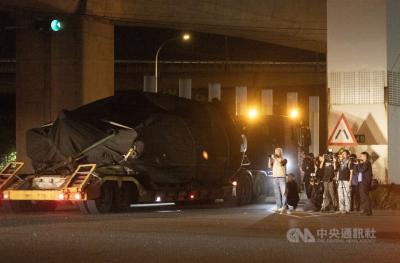
The final batch of 28 M1A2T Abrams tanks purchased from the US arrived at Taipei Port last night and were transported to the Armor Training Command in Hsinchu County’s Hukou Township (湖口), completing the military’s multi-year procurement of 108 of the tanks. Starting at 12:10am today, reporters observed more than a dozen civilian flatbed trailers departing from Taipei Port, each carrying an M1A2T tank covered with black waterproof tarps. Escorted by military vehicles, the convoy traveled via the West Coast Expressway to the Armor Training Command, with police implementing traffic control. The army operates about 1,000 tanks, including CM-11 Brave Tiger
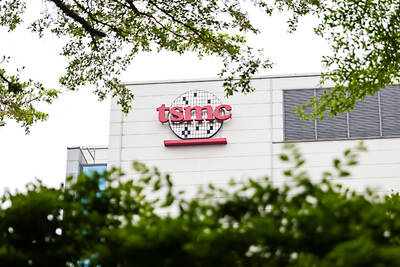
Taiwan Semiconductor Manufacturing Co (TSMC, 台積電), the world’s largest contract chipmaker, said it expects its 2-nanometer (2nm) chip capacity to grow at a compound annual rate of 70 percent from this year to 2028. The projection comes as five fabs begin volume production of 2-nanometer chips this year — two in Hsinchu and three in Kaohsiung — TSMC senior vice president and deputy cochief operating officer Cliff Hou (侯永清) said at the company’s annual technology symposium in Silicon Valley, California, last week. Output in the first year of 2-nanometer production, which began in the fourth quarter of last year, is expected to

Taiwan’s drone exports surged past US$100 million in the first quarter, exceeding last year’s full-year total, with the Czech Republic emerging as the largest buyer, the Ministry of Economic Affairs said. Exports of complete drones reached US$115.85 million in the period, about 1.2 times the total recorded for all of last year, the ministry said in a report. Exports to the Czech Republic accounted for about US$100 million, far outpacing other markets. Poland, last year’s top destination, recorded about US$11.75 million in the first quarter. Taiwan’s drone exports have expanded rapidly in the past few years, with last year’s total


 RSS
RSS