


Holding yellow banners and clutching sunflowers, thousands took to the streets in Taipei yesterday as part of a nationwide “430 Sunflower No Nuke Action” protest, urging the government to stop construction of the Fourth Nuclear Plant in Gongliao District (貢寮), New Taipei City (新北市), and pursue a more sustainable energy policy.
With “smile at the sun, keep away from nuclear disasters” as the theme of the parade, yellow flowers were picked to symbolize sustainability. Some also held handmade paper windmills, symbolizing green energy and a bright future without the fear of a potential nuclear crisis.
The nation’s anti-nuclear movement gained new momentum in the middle of March after a massive earthquake struck Japan and unleashed a tsunami that damaged the Fukushima Dai-ichi nuclear power plant, causing radiation to be released, which has endangered northeastern Japan’s food and water supplies.
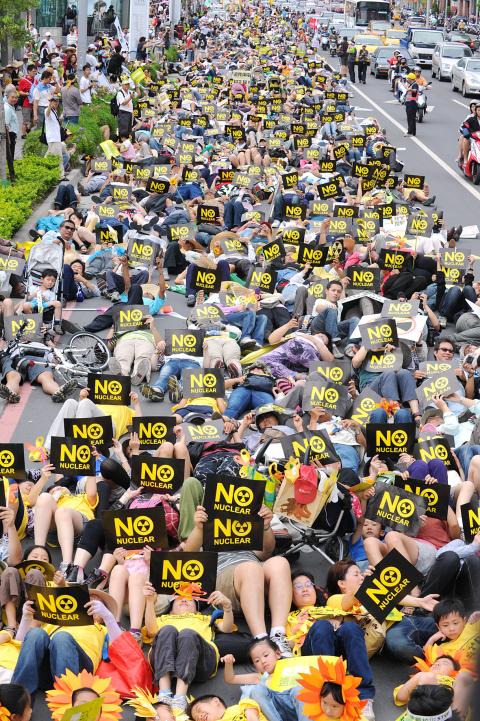
Photo: Huang Chih-yuan, Taipei Times
The disaster resonated especially strongly in Taiwan because, like Japan, it is prone to earthquakes that could lead to scenarios similar to those that crippled the Japanese plant.
People of all ages took part in the carnival-like parade yesterday.
A section of the parade, called the “Keep Away from Nuclear Disaster Division,” was led by about 20 people holding up a long yellow banner with the words “No Nukes” written on it, followed by a group of protesters wearing radiation protection suits to remind people about the potential severity of nuclear disasters.
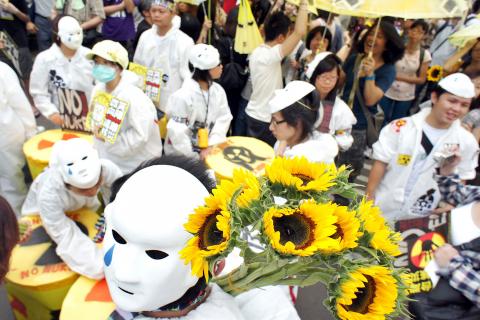
Photo: CNA
Another section was -comprised mostly of students from several universities.
Young people dressed in colorful clothes danced to music as they shouted anti--nuclear power slogans and paraded through the bustling streets.
“I think the government should replace nuclear power with other safer energy sources,” said a mother surnamed Chang (張), who stood on the sidewalk with other parents and children for a short break during the parade.
She said she wanted her daughter, who is in the first grade, to take part in the parade because they had been taught about nuclear power issues at school, and her daughter was happy to participate.
A student from an Aboriginal Tao village on Orchid Island (蘭嶼), where a nuclear waste storage facility is located, said the Tao people believed that nuclear radiation, which has no form or color, is like evil spirits and must be banished.
This inspired him to wear a traditional Tao warriors helmet made out of paper to symbolize fighting off evil spirits.
A 35-year-old woman surnamed Chen (陳) was dressed in a wedding gown and said that while the government is concerned about the nation’s low fertility rate, “we don’t want to get married and raise our children in such a dangerous environment.”
“After the Fukushima nuclear crisis, I think there are some things that are non-negotiable,” she added.
At one point, the crowd lay on the ground, pretending to be dead, after a simulated nuclear leakage siren sounded.
The display, called “If that day comes,” symbolized the many people that could die in Taiwan if a nuclear crisis were to unfold, the organizer said.
Appealing to the government to map out retirement plans for the nation’s three operational nuclear power plants, to put an end to the construction of the Fourth Nuclear Power Plant and to create a nuclear-free homeland where everyone can live without fear of a nuclear disaster, the protesters shouted slogans such as, “Cherish life, end nuclear power,” and “I want a nuclear-free homeland.”
Their two-and-a-half-hour parade eventually led them to the Presidential Office on Ketagalan Boulevard.
Two Japanese, Ono Saiko and Oga Ayako, who said they were forced to leave their homes in Fukushima Prefecture because of the nuclear crisis, joined the parade in Taipei and shared their thoughts with the crowd.
“The Fukushima nuclear crisis is still going on in Japan; we are not in the mood to find fault with the cause, but we are facing a problem of how are we to protect our next generation,” Saiko said.
She said that she hopes people in Taiwan can join forces with people in Fukushima and take nuclear problems more seriously.
Oga Ayako said she saw “hope and power” in the protest in Taipei, and hopes that the next time they are in Taiwan it will be a nation free from nuclear threats.
Organizers estimated that at least 5,000 people turned out for the protest in Taipei, but no police figure was immediately available.
Additional reporting by AFP and CNA

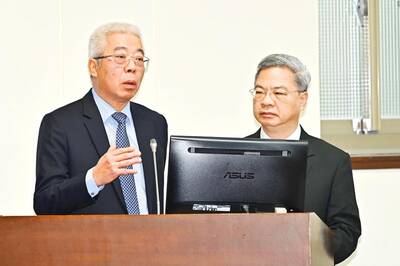
Taiwan has arranged for about 8 million barrels of crude oil, or about one-third of its monthly needs, to be shipped from the Red Sea this month to bypass the Strait of Hormuz and ease domestic supply pressures, CPC Corp, Taiwan (CPC, 台灣中油) said yesterday. The state-run oil company has worked with Middle Eastern suppliers to secure routes other than the Strait of Hormuz, through which about 20 percent of the world’s oil and liquefied natural gas typically passes, CPC chairman Fang Jeng-zen (方振仁) said at a meeting of the legislature’s Economics Committee in Taipei. Suppliers in Saudi Arabia have indicated they
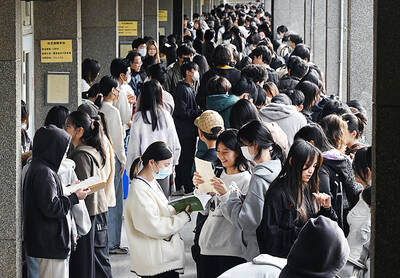
A global survey showed that 60 percent of Taiwanese had attained higher education, second only to Canada, the Ministry of the Interior said. Taiwan easily surpassed the global average of 43 percent and ranked ahead of major economies, including Japan, South Korea and the US, data from the Organisation for Economic Co-operation and Development (OECD) for 2024 showed. Taiwan has a high literacy rate, data released by the ministry showed. As of the end of last year, Taiwan had 20.617 million people aged 15 or older, accounting for 88.5 percent of the total population, with a literacy rate of 99.4 percent, the data
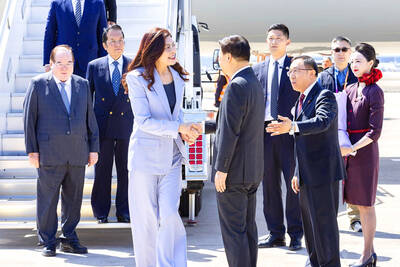
CCP ‘PAWN’? Beijing could use the KMT chairwoman’s visit to signal to the world that many people in Taiwan support the ‘one China’ principle, an academic said Chinese Nationalist Party (KMT) Chairwoman Cheng Li-wun (鄭麗文) yesterday arrived in China for a “peace” mission and potential meeting with Chinese President Xi Jinping (習近平), while a Taiwanese minister detailed the number of Chinese warships currently deployed around the nation. Cheng is visiting at a time of increased Chinese military pressure on Taiwan, as the opposition-dominated Legislative Yuan stalls a government plan for US$40 billion in extra defense spending. Speaking to reporters before going to the airport, Cheng said she was going on a “historic journey for peace,” but added that some people felt uneasy about her trip. “If you truly love Taiwan,

NEW LOW: The council in 2024 based predictions on a pessimistic estimate for the nation’s total fertility rate of 0.84, but last year that rate was 0.69, 17 percent lower An expected National Development Council (NDC) report expects the nation’s population to drop below 12 million by 2065, with the old-age dependency ratio to top 100 percent sooner than 2070, sources said yesterday. The council is slated to release its latest population projections in August, using an ultra-low fertility model, the sources said. The previous report projected that Taiwan’s population would fall to 14.37 million by 2070, but based on a new estimate of the total fertility rate (TFR) — the average number of children born to a woman over her lifetime — the population is expected to reach 12 million by


 RSS
RSS