


The Kaohsiung City Council recently passed a motion demanding that the city government and private organizations not be allowed to invite to the city Chinese officials who have been accused of violating human rights. The motion included making the same suggestion to the central government, asking it to refuse such officials entry to Taiwan.
With Chinese officials increasingly leading delegations to Taiwan, Kaohsiung City Councilor Kang Yu-cheng (康裕成) of the Democratic Progressive Party (DPP) suggested that Chinese officials who have violated human rights should be refused entry to the country.
The motion was supported by councilors from both the pan-blue and pan-green camps last week and it has now been submitted to the Mainland Affairs Council, the National Immigration Agency and the Kaohsiung City Government.
Kang said that because Guangdong Province Governor Huang Huahua (黃華華), Shaanxi Province Vice Governor and Acting Governor Zhao Zhengyong (趙正永), State Administration of Religious Affairs Director Wang Zuoan (王作安) and Chinese Communist Party (CCP) Deputy Secretary of Hubei Province Yang Song (楊松) all have allegedly participated in China’s persecution of Falun Gong practitioners, Falun Gong practitioners in Taiwan had filed a criminal lawsuit with the Taiwan High Court Prosecutors’ Office against them when they visited Taiwan.
The central government should investigate the human rights record of these Chinese officials when checking their applications to enter Taiwan, Kang said.
Adding that Kaohsiung City is a modern metropolis that protects human rights, Kang said both the city and private organizations should therefore highlight the universality of human rights. If it is discovered that Chinese officials planning to visit Kaohsiung have a track record of violating human rights or if they have been charged and are being tried in court, such officials should not be invited, welcomed or given any support, she said.
While Falun Gong practitioners are suffering heavy persecution by the CCP, the motion is not aimed at pleasing the Falun Gong; no one who is guilty of persecuting anyone else should be welcomed to Kaohsiung, she said.
“I am very excited over the fact that the motion was unanimously passed by both the pan-green and pan-blue camps,” Kang added.
DPP Kaohsiung City Councilor Chou Lin-wen (周玲玟) said that while China was important to the global economy, it ignores human rights and democracy.
“Kaohsiung is a friendly city but many people don’t know very much about CCP persecution and that is why it is necessary to ask the central government to control these issues,” she said.
Expressing a wish that every tourist area in Taiwan reveal the truth to Chinese tourists, she added: “Only by traveling to Taiwan will they be able to see the persecution that underlies the Chinese economy.”
Falun Dafa in Taiwan welcomed the motion and called on each level of government to take a close look at the issue.
Cheng Chi-mei (鄭其美), a representative of the movement, said it was shameful to see Chinese officials coming to Taiwan shaking hands with Taiwanese and receiving expensive gifts with blood on their hands.

LEVERAGE: China did not ‘need to fire a shot’ to deny Taiwan airspace over Africa when it owns ‘half the continent’s debt,’ a US official said, calling it economic warfare The EU has raised concerns about overflight rights following the delay of President William Lai’s (賴清德) planned state visit to the Kingdom of Eswatini after three African nations denied overflight clearance for his charter at the last minute. Taiwanese allies Paraguay and Saint Kitts and Nevis, as well as several US lawmakers and the Inter-Parliamentary Alliance on China (IPAC) condemned China for allegedly pressuring the countries. Lai was scheduled to fly directly to Taiwan’s only African ally from yesterday to Sunday to celebrate the 40th anniversary of King Mswati III’s accession and his 58th birthday, but Seychelles, Mauritius and Madagascar suddenly revoked
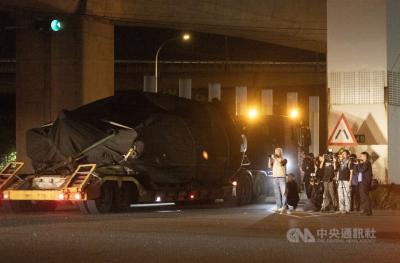
The final batch of 28 M1A2T Abrams tanks purchased from the US arrived at Taipei Port last night and were transported to the Armor Training Command in Hsinchu County’s Hukou Township (湖口), completing the military’s multi-year procurement of 108 of the tanks. Starting at 12:10am today, reporters observed more than a dozen civilian flatbed trailers departing from Taipei Port, each carrying an M1A2T tank covered with black waterproof tarps. Escorted by military vehicles, the convoy traveled via the West Coast Expressway to the Armor Training Command, with police implementing traffic control. The army operates about 1,000 tanks, including CM-11 Brave Tiger

PROVOCATIVE: Chinese Deputy Ambassador to the UN Sun Lei accused Japan of sending military vessels to deliberately provoke tensions in the Taiwan Strait China denounced remarks by Japan and the EU about the South China Sea at a UN Security Council meeting on Monday, and accused Tokyo of provocative behavior in the Taiwan Strait and planning military expansion. Ayano Kunimitsu, a Japanese vice foreign minister, told the Council meeting on maritime security that Tokyo was seriously concerned about the situation in the East China and South China seas, and reiterated Japan’s opposition to any attempt to change the “status quo” by force, and obstruction of freedom of navigation and overflight. Stavros Lambrinidis, head of the EU delegation to the UN, also highlighted South China Sea
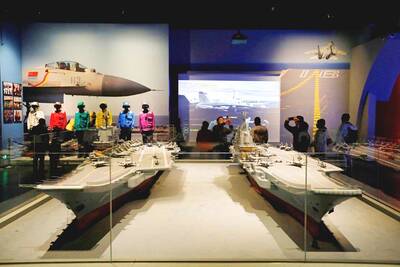
China on Wednesday teased in a video an aircraft carrier that could be its fourth, and the first using nuclear power, while making an allusion to Taiwan and vowing to further build up its islands, as it looks to boost maritime power, secure resources and bolster territorial claims. The video, issued on the eve of the 77th founding anniversary of the Chinese People’s Liberation Army Navy, featured fictional officers with names that are homophones of three commissioned aircraft carriers, the Liaoning (遼寧), Shandong (山東) and Fujian (福建). Titled Into the Deep, it showed a 19-year-old named “Hejian” (何劍) joining the group, sparking


 RSS
RSS