


Surrounded by supporters and party stalwarts, former premier Su Tseng-chang (蘇貞昌) of the Democratic Progressive Party (DPP) yesterday officially declared his intention to run in the year-end election for Taipei City mayor.
“If Taipei City residents want change, the DPP has a responsibility to nominate good candidates to provide them with choices. If the party needs me, I will welcome this great challenge,” he said at Dalongdong Baoan Temple.
The announcement comes after weeks of media speculation that Su would seek the DPP’s nomination to run in either Taipei or Sinbei City — as Taipei County will be known after it is upgraded to a special municipality.
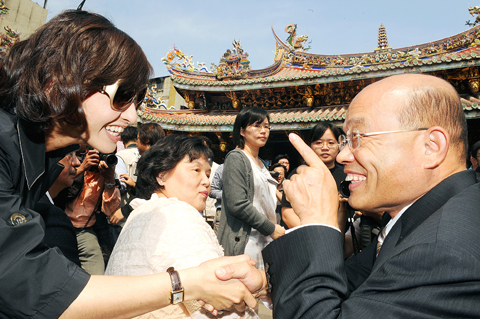
PHOTO: CHIEN JUNG-FONG, TAIPEI TIMES
DPP officials said Su informed DPP Chairperson Tsai Ing-wen (蔡英文) of his decision in a meeting on Tuesday at the party’s headquarters.
The 62-year-old Su, who has previously served as county commissioner in Taipei and Pingtung, is considered to be the party’s front-runner in the special municipal elections scheduled for December and the presidential election in 2012.
He promised, however, that if elected mayor, he would not consider running for president and would serve out the entire four-year term, which expires in late 2014.
“Every election to me is sacred and when I do choose to run, I will make sure I run to win. And if I win, I will make sure that I do a good job, which will require me to serve out my term and not run for president in 2012,” Su said.
Su said he would work on improving the livelihood of Taipei residents and giving them a voice in government.
“The DPP should return to its roots, return to the people ... and humbly listen to their needs,” he said.
News of the announcement was warmly welcomed in the party’s headquarters, with DPP officials saying Su could improve the party’s overall showing during the December elections.
“Chairperson Tsai Ing-wen recognizes Su’s past achievements and fully supports his bid,” DPP Spokesman Tsai Chi-chang (蔡其昌) said. “Su has always been part of the DPP overall policy for winning the year-end elections.”
Speaking after a party committee meeting yesterday, Kaohsiung County Commissioner Yang Chiu-hsing (楊秋興), who is seeking the party’s nomination in the soon-to-be merged Kaohsiung City and County, called Su a “strong candidate,” but added that winning Taipei City would be a tough battle.
Chinese Nationalist Party (KMT) lawmakers have questioned Su’s motives in running for mayor.
They have said he would only use the position as a springboard for a presidential bid in 2012.
Both President Ma Ying-jeou (馬英九) and his predecessor, Chen Shui-bian (陳水扁), served as Taipei mayors before moving on to the nation’s top post.
Taipei Mayor Hau Lung-bin (郝龍斌) of the KMT yesterday questioned Su’s sincerity in running for mayor, saying Su would lose both the Taipei and presidential polls if he only intended to capitalize on the sympathy generated from a loss in the capital city to run for president.
Hau, seeking to secure the party’s nomination for a re-election bid, said candidates should make a fundamental promise to finish their term, but it could be too big a promise for Su to make.
“If he intends to steal two bases, he will face a double-play,” Hau said.
Hau enumerated the achievements made during his tenure, including an urbanization project and road improvement program, adding that he also pushed internationalization, commercial development and supported the economic cooperation framework agreement (ECFA).
Hau said Taiwan must sign the proposed pact with Beijing and that it would be bad for the city’s development if Su won given the DPP’s conservative cross-strait policy. Hau also asked Su to make clear his position on an ECFA.
Hau described Su as a well-matched contender and promised to do his best to engage in a “gentleman’s game.”
KMT Secretary-General King Pu-tsung (金溥聰) said he hoped the Taipei City election would be a “benign contest” and that he believed the KMT candidate was the best.
Asked whether Su’s decision to stand would have any impact on the KMT’s nomination process, King said the election situation was changing fast and his party’s nomination process would proceed as scheduled. King said he would soon visit those interested in the elections and hoped to finalize the nomination by the end of May.
Both the KMT and the DPP have publicly announced their goal of winning at least three of the five cities being contested. Taipei and Sinbei are seen as important political battlegrounds that could swing either way.
KMT Legislator Ting Shou-chung (丁守中) yesterday also expressed an interest in running for Taipei mayor.
KMT spokesman Su Jun-pin (蘇俊賓) said the party’s nomination would focus on elevating the competitiveness of the five special municipalities, a very different strategy from the DPP’s, which he claimed had its eye solely on winning the next election.
With the DPP’s registration deadline for nominations rapidly approaching, many potential candidates have been scrambling to get their names in to a nomination team led by DPP Secretary-General Su Jia-chyuan (蘇嘉全).
Former Taipei County commissioner You Ching (尤清) said on Monday that he would be vying for the party’s nomination in Sinbei City. There is also speculation that former premiers Frank Hsieh (謝長廷) and Yu Shyi-kun, as well as former DPP legislator Chen Chin-jun (陳景峻), were potential candidates in the newly upgraded city.
The party is hoping it could reach a decision on party nominees through dialogue rather than resorting to internal party polls. While the party does not have a firm timeline for deciding on its candidates for Taipei, Sinbei and Taichung, the nomination list for Tainan and Kaohsiung will be finalized before May 19, Tsai Chi-chang said.
Meanwhile, Chen Shui-bian’s office said he respected Su’s decision to run for the capital city’s top job, although the former president had hoped Su would contest Sinbei City.
His secretary, Chiang Chih-ming (江志銘), said Chen Shui-bian could only give Su his blessing and concurred with Su that only when the party does not focus so much on the 2012 presidential election does it stand a better chance of winning in Taipei
City.
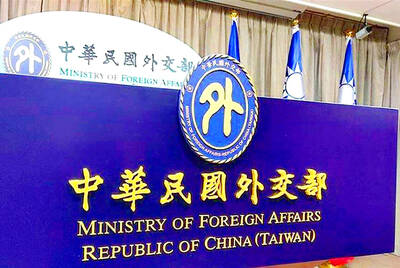
The Ministry of Foreign Affairs (MOFA) yesterday said it is closely monitoring developments in Venezuela, and would continue to cooperate with democratic allies and work together for regional and global security, stability, and prosperity. The remarks came after the US on Saturday launched a series of airstrikes in Venezuela and kidnapped Venezuelan President Nicolas Maduro, who was later flown to New York along with his wife. The pair face US charges related to drug trafficking and alleged cooperation with gangs designated as terrorist organizations. Maduro has denied the allegations. The ministry said that it is closely monitoring the political and economic situation
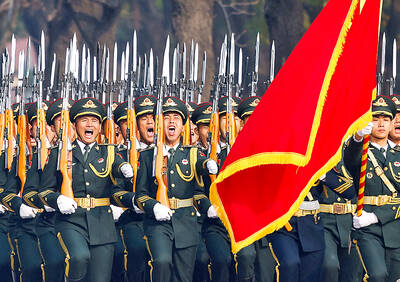
Conflict with Taiwan could leave China with “massive economic disruption, catastrophic military losses, significant social unrest, and devastating sanctions,” a US think tank said in a report released on Monday. The German Marshall Fund released a report titled If China Attacks Taiwan: The Consequences for China of “Minor Conflict” and “Major War” Scenarios. The report details the “massive” economic, military, social and international costs to China in the event of a minor conflict or major war with Taiwan, estimating that the Chinese People’s Liberation Army (PLA) could sustain losses of more than half of its active-duty ground forces, including 100,000 troops. Understanding Chinese

UNRELENTING: China attempted cyberattacks on Taiwan’s critical infrastructure 2.63 million times per day last year, up from 1.23 million in 2023, the NSB said China’s cyberarmy has long engaged in cyberattacks against Taiwan’s critical infrastructure, employing diverse and evolving tactics, the National Security Bureau (NSB) said yesterday, adding that cyberattacks on critical energy infrastructure last year increased 10-fold compared with the previous year. The NSB yesterday released a report titled Analysis on China’s Cyber Threats to Taiwan’s Critical Infrastructure in 2025, outlining the number of cyberattacks, major tactics and hacker groups. Taiwan’s national intelligence community identified a large number of cybersecurity incidents last year, the bureau said in a statement. China’s cyberarmy last year launched an average of 2.63 million intrusion attempts per day targeting Taiwan’s critical
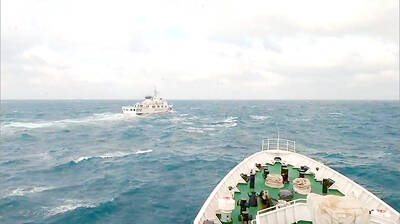
‘SLICING METHOD’: In the event of a blockade, the China Coast Guard would intercept Taiwanese ships while its navy would seek to deter foreign intervention China’s military drills around Taiwan this week signaled potential strategies to cut the nation off from energy supplies and foreign military assistance, a US think tank report said. The Chinese People’s Liberation Army (PLA) conducted what it called “Justice Mission 2025” exercises from Monday to Tuesday in five maritime zones and airspace around Taiwan, calling them a warning to “Taiwanese independence” forces. In a report released on Wednesday, the Institute for the Study of War said the exercises effectively simulated blocking shipping routes to major port cities, including Kaohsiung, Keelung and Hualien. Taiwan would be highly vulnerable under such a blockade, because it


 RSS
RSS