


The Democratic Progressive Party (DPP) scored a landmark election success yesterday, sweeping all three seats in legislative by-elections in Taoyuan, Taichung and Taitung counties.
The victory in Taitung marked the first time the party won a legislative seat in the county.
Although the Central Election Commission (CEC) did not announce the official results until 6:30pm, all three DPP candidates declared victory before 6pm, while their rivals all conceded defeat.
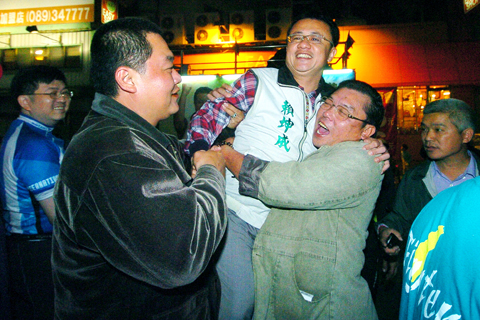
PHOTO: HUANG CHIH-YUAN, TAIPEI TIMES
Speaking after declaring victory, DPP Taitung County legislator-elect Lai Kun-cheng (賴坤成) told supporters gathered outside his campaign headquarters: “This moment is a moment everyone has waited for decades [to come]. This moment that so many people have expected for so long, has finally come.”
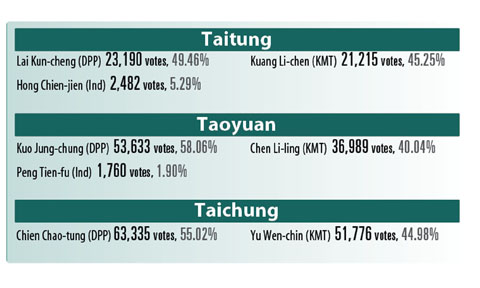
With 23,190 votes, Lai defeated his Chinese Nationalist Party (KMT) rival, Kuang Li-chen (鄺麗貞), by just 1,975 votes, election results released by the CEC showed.
He said the DPP’s first victory in a legislative election in Taitung County meant more than just one additional seat in the legislature for the party. Rather, it set a precedent in Taitung’s political history.
“I would like to give my most sincere thanks to the people of Taitung. We would not have made such an accomplishment without you,” Lai said. “I will not forget my promises to you and will work hard in the Legislative Yuan to make Taitung a better place.”
Following Lai’s victory declaration, Kuang also appeared briefly at her campaign headquarters.
Kuang thanked those who had voted for her and her campaign team, but did not answer questions from reporters on whether she had expected the result, or whether she thought President Ma Ying-jeou (馬英九), who doubles as KMT chairman, did not offer enough help in her campaign.
The DPP’s legislator-elect in Taoyuan, Kuo Jung-chung (郭榮宗), said it was “a responsibility as well as an honor for voters to entrust me with defending [the national interests of] Taiwan, and [the welfare of] the people at the legislature.”
He also thanked former DPP legislator Peng Tien-fu (彭添富), who withdrew from the by-election at the last minute to throw his support behind Kuo.
Kuo also expressed surprise at winning Yangmei Township (楊梅), a traditional KMT stronghold.
“This means a lot to me, and I will not disappoint the voters in Yangmei,” he said.
Kuo received 53,633 votes, defeating his KMT rival, Chen Li-ling (陳麗玲), by more than 16,000 votes, CEC figures showed.
The DPP Taichung County legislator-elect Chien Chao-tung (簡肇棟) said the DPP’s “home-run” victory should send a clear message to Ma and to the KMT.
He obtained 63,335 votes, while his KMT rival, Yu Wen-chin (余文欽), garnered 51,776 votes, the CEC said.
“The voters are trying to tell the government that the people are suffering,” he said, adding that he would push for a legislative resolution to ask Ma to deliver a “state of the nation” address to tell the people what policy objectives he has in mind to deal with high unemployment, the deteriorating economy, rising consumer prices and to explain to the public the economic cooperation framework agreement (ECFA) that the government plans to sign with China.
Voter turnout was below 50 percent in all three districts, the CEC said in a press release, with only 38.42 percent turnout in Taoyuan, 45.09 in Taichung and 39.44 in Taitung.
Speaking at the party’s headquarters, DPP Secretary-General Su Jia-chyuan (蘇嘉全) said: “We humbly thank supporters for their votes. The three winners will provide you with the best service in order to pay you back for your support.”
Su also urged voters to continue supporting the party in the four by-elections scheduled for Feb. 27 in Hualien, Taoyuan, Hsinchu and Chiayi counties.
The three additional seats in the legislature mean the DPP has met the threshold of more than a quarter of seats required to launch a motion to recall the president, demand for a constitutional interpretation or request the president to report to the legislature.
Su, however, said the party would not initiate a motion to impeach the president, but was still deliberating over whether to ask the president to appear at the legislature. The decision will be made after the party has a chance to seek public opinion on the issue, he said.
Meanwhile, KMT Secretary-General King Pu-tsung (金溥聰) acknowledged the party’s defeat and vowed to learn from the lesson and continue with party reform.
“We will face the results with humility and learn from this lesson. The KMT will continue the efforts on party reform and move forward,” King told a press conference at the KMT headquarters.
King acknowledged that election bribery was a problem that plagued the KMT, and pledged to examine its nomination mechanism to nominate better candidates in future elections.
Two of the three seats were left vacant when former KMT legislators Liao Cheng-ching (廖正井) from Taoyuan and Chiang Lien-fu (江連福) from Taichung County were relieved of their elected status after being found guilty of vote-buying.
The other was vacated when Taitung County Commissioner Justin Huang (黃健庭) resigned as a legislator last year to take part in last month’s county commissioner election.
King, however, declined to comment on whether he or any KMT officials would step down to take responsibility for the defeat, repeating the party’s determination on party reform when asked for further comment.
Ma did not appear at party headquarters yesterday, and did not offer any comments on the party’s disappointing performance.
He was also notably absent until the last day of the by-election’s campaign. King yesterday denied that Ma had tried to separate himself from the by-election, reiterating that both Ma and the party will face the election result and continue party reforms.
“The chairman did not necessarily go to the frontier in the legislative by-elections ... We remain hopeful and confident about our performance in the future,” he said.
The by-election marked the first election for King since taking over as the party’s secretary-general.
Ma appointed King last month after the party suffered what has been perceived as a significant setback in local government elections on Dec. 5. He was expected to help Ma organize the campaign for the legislative by-elections and the special municipality elections this December.
King yesterday lauded the party’s defeated candidate in Taoyuan, Chen Li-ling (陳麗玲), for her campaigning efforts, but did not mention the two candidates in Taitung and Taichung — Kuang and Yu.
King declined to comment on the party’s nomination of Kuang despite controversy over her frequent foreign trips during typhoon seasons while she was Taitung County commissioner, and also refused to discuss the reasons behind yesterday’s defeat.
He said the party has already begun to organize the campaign for the special municipality elections this year, and will announce the nominees as soon as possible.
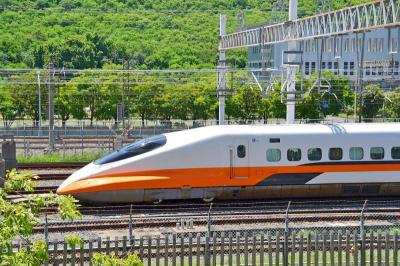
A signaling system malfunction disrupted high-speed rail (HSR) services beginning at 8am today, with trains temporarily reduced to three northbound and three southbound trains per hour as authorities conduct inspections. The malfunction occurred on a section of track in Miaoli County during pre-operation checks early this morning, forcing northbound and southbound trains to use a single track, the HSR operator said. The regular schedule has been replaced with three hourly trains offering only nonreserved seating in each direction, stopping at every station, it said, adding that business class cars would still have reserved seating. Departures from terminal stations are scheduled at the top
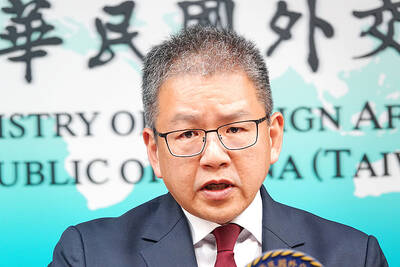
Taiwan is still in the process of assessing the possibility of recruiting workers from Eswatini, the Ministry of Foreign Affairs said yesterday, adding that its goal is to help Eswatini upgrade its vocational training centers. If there are plans to recruit workers from Eswatini, safeguarding national security, protecting public health and ensuring the employment rights of Taiwanese would be prerequisites, Department of West Asian and African Affairs Director-General Yen Chia-liang (顏嘉良) told a news conference. Key considerations would also include filling labor shortages in specific industries, and fostering bilateral professional and technical exchanges, he said. Yen was asked about the progress of labor

VERBOSE VESSELS: A CGA cutter and a China Coast Guard exchanged verbal barbs for more than a day in Taiwanese-controlled waters before the Chinese vessel left The Taiwanese and Chinese coast guards had a standoff near the strategically located Pratas Islands (Dongsha Islands, 東沙群島) in the north of the South China Sea, the Coast Guard Administration (CGA) said yesterday. The two sides engaged in intense radio exchanges over sovereignty claims during the 33-hour standoff. China Coast Guard vessel 3501 eventually left the restricted waters, 26.6 nautical miles (49.2km) west of the Pratas Islands, at 5pm yesterday, the CGA said. Lying approximately between southern Taiwan and Hong Kong, the Taiwan-controlled Pratas are seen by some security experts as vulnerable to Chinese attack due to their distance — more than
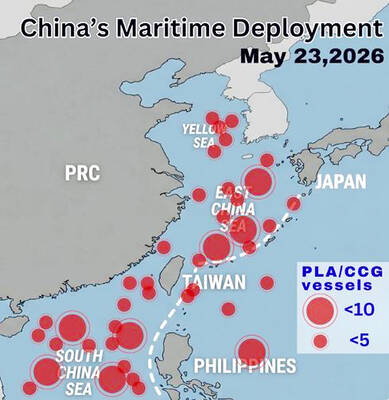
WARNING: China should stop engaging in actions that undermine regional peace and stability, as it would only build resentment among people across the Strait, the CGA said China has deployed more than 100 navy, coast guard and other vessels in waters from the Yellow Sea to the South China Sea and the western Pacific since US President Donald Trump and Chinese President Xi Jinping (習近平) met in Beijing, National Security Council Secretary-General Joseph Wu (吳釗燮) said yesterday. “In this part of the world, #China is the one & only PROBLEM wrecking the #StatusQuo & threatening regional peace & stability,” Wu wrote on X. In a separate post, he said Beijing was coercing Taiwan’s maritime domain, calling it illegal and provocative, after the Coast Guard Administration (CGA) expelled a


 RSS
RSS