


Taiwan opened a representative office in Sapporo yesterday, its first new representative office in Japan in 30 years.
Legislative Speaker Wang Jin-pyng (王金平) described the opening of the office as a “breakthrough in Japan-Taiwan relations.”
Wang, along with dignitaries from Japan and Taiwan, attended a ceremony marking the opening of the office, the first since a representative office was opened in Yokohama in 1979.
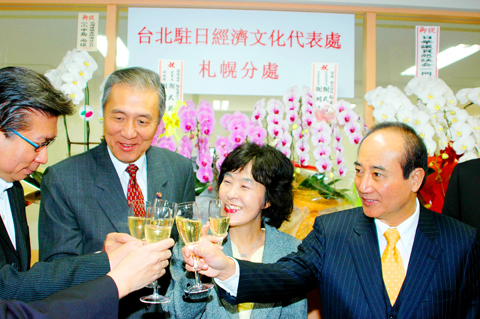
PHOTO: CNA
Wang said the move was a promising development in bilateral ties and would be “a shot in the arm for tourism exchanges.”
He said that since relatively few residents of Hokkaido, of which Sapporo is the capital city, visited Taiwan, he hoped the opening of the Sapporo office would help encourage more people from the northern Japanese island to vacation in Taiwan.
“The hospitable Taiwanese people welcome Japanese visitors with open arms,” Wang said.
Addressing the ceremony, Hokkaido Governor Harumi Takahashi said Taiwan is very important to Hokkaido in terms of tourism.
“The opening of the Taiwan office in Sapporo will help facilitate Taiwanese tourists’ visits here and further bolster bilateral exchanges,” she said.
She said authorities from Hokkaido’s Kushiro sub-prefecture would give a pair of Japanese-bred red-crowned cranes to the Taipei Zoo as a token of friendship.
Shinichi Sakamoto, head of a Hokkaido tourism organization, said his organization would cooperate more closely with Taiwan’s office in Sapporo to get more people in Hokkaido interested in sightseeing in Taiwan.
Sakamoto said he believed most Hokkaido residents who had visited Taiwan would be happy to repeat their trips there, attracted by Taiwan’s delicious food, good tea and convenient high-speed railway system.
Also attending the opening were Taiwan’s top representative to Japan, John Feng (馮寄台), and Atsushi Hatanaka, chairman of the Japan Interchange Association, the de facto Japanese embassy authorized to handle civilian exchanges with Taiwan in the absence of formal diplomatic relations.
The Sapporo office is the sixth Taiwanese liaison office established in Japan, after offices in Tokyo, Osaka, Okinawa, Fukuoka and Yokohama.

FUKUOKA SITUATION: Japanese media reported that the pathogen is expected to be identified by the summer, while the CDC downplayed the idea that it was hMPV A “mysterious cold-like illness” reported in Japan’s Fukuoka Prefecture does not seem to be a new disease, but Japanese authorities have been asked about the situation, the Centers for Disease Control (CDC) said yesterday. The Fukuoka Prefectural Medical Association on Wednesday told a news conference that a “mystery cold” that has become a hot topic on social media is “highly likely to be caused by some kind of viral infection,” Japan’s KBC News reported. “Many people are experiencing symptoms starting with a sore throat, followed by a runny nose, phlegm and a severe cough,” KBC News reported, citing association officials. Health authorities are

Nvidia Corp CEO Jensen Huang (黃仁勳) arrived in Taiwan yesterday ahead of upcoming AI and technology events, saying he plans to meet with clients and Taiwan Semiconductor Manufacturing Co Chairman C.C. Wei (魏哲家) during his visit. After landing at Taipei Songshan Airport, Huang posed for photos with fans and handed out Yakult drinks to reporters and supporters waiting at the scene, saying he has “a lot to do” during the trip. Asked about reports that Nvidia’s planned headquarters site in Taipei’s Beitou Shilin Technology Park could break ground on May 27, Huang said that if the company holds an event, he would

Carrefour Taiwan is to begin using a new name from the start of July, but it cannot divulge the name until then, the chairman of the supermarket chain's parent company said today. President Chain Store Co chairman Lo Chih-hsien (羅智先) was asked by reporters after a shareholders' meeting to confirm whether the company has settled on a new name for the supermarket brand. In March, the government-registered name of two Carrefour Taiwan branches was quietly changed to "Le Chia Kang" (樂家康) in Chinese, raising speculation that has been selected as the name. Lo said that because of local regulations and contractual obligations, the

The Philippines would likely be involved in any conflict over Taiwan due to its proximity to the democracy claimed by China, President Ferdinand Marcos Jr said, reiterating a stance that risks angering Beijing. “In the Philippines, we do not have a choice because Taiwan is so close to the Philippines and we have almost 200,000 Filipino nationals living and working in Taiwan,” Marcos said in an interview with Japanese media in Manila on Monday. The Philippine leader’s comments come ahead of a state visit to Japan next week, where he is to meet with Japanese Prime Minister Sanae Takaichi to discuss security


 RSS
RSS