


Taiwan got back on the medal trail at the World Games yesterday with a silver medal in jujitsu and a bronze in korfball.
After a lull on Monday in which Taiwan earned just one silver in the softball, an invitational event, the nation’s athletes returned to their winning ways yesterday.
The two medals took Taiwan’s overall haul to a healthy five gold, five silver and three bronze in the first five days of competition, putting the nation fourth in the medals table.
Yang Hsien-tzu narrowly missed out on jujitsu gold, losing to Sabrina Hatzky of Germany in the final of the women’s 62kg division at the Sun Yat-sen University Gymnasium.
Earlier, in the men’s 69kg category, Liu Chieng-hung lost out on a bronze medal when he was defeated by Germany’s Andrej Tierbach in the repechage.
The nation’s first medal of the day had come earlier at the National Kaohsiung University gym as Taiwan secured third place and a bronze in the korfball third-fourth place playoff match against Russia. Leading 15-10 at halftime, Taiwan extended their lead in the second half on the back of some sharp shooting from No. 11 Wu Chun-hsien, who finished the match with six goals.
The Netherlands beat Belgium 25-20 for the gold medal and retained their title in a battle between the two traditional korfball powers.
Meanwhile, the second day of boules at the 228 Memorial Park saw Taiwanese duo Chen Hung-wen and Sun Chaia-yi grab another win, beating Belgium 13-6 to qualify for the final four before losing 13-4 against the same opponents in the semi-final. The women, however, were eliminated after another defeat when they lost 6-4 to Israel.
In the boules raffa, men’s doubles duo Chen Hung-ting and Huang Wei-hsiang were eliminated after being soundly beaten 15-0 by Brazil.
In the ladies’ division Chung Yu-chun and Tang Ya-ting suffered the same fate, losing 15-1 to Italian duo Loana Capelli and Elisa Luccarini.
The women’s boules Lyonnaise precision-throw preliminary round saw Taiwan’s Tsao Chia-hui go into the bronze-medal match after finishing fourth, while in the men’s event Huang Hsien-chang was eliminated after finishing fifth. In the shuttle throw semi-finals, home girl Huang Yu-ju finished fourth and was eliminated.
Meanwhile, in the 10-pin bowling singles, Wang Yu-ling qualified for the women’s top 10 round today, while compatriot Fang Chin-nan failed, finishing 13th overall in the men’s qualifying.
Also See: Taiwan suffers big losses in squash and air sports
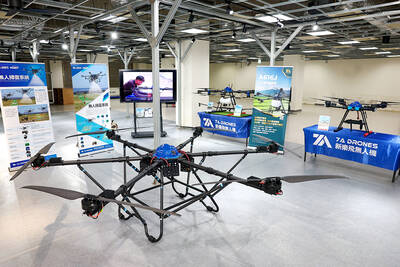
DRONE CENTRAL: Taiwan aims to become Asia’s democratic hub for drones, with most exports focused on high-quality military-grade models, an official said Taiwan’s drone industry is expected to expand significantly by 2030, producing 100,000 units per month and exporting half of them, the Ministry of Economic Affairs said yesterday. Current drone production capacity is about 15,000 units per month, but the industry can quickly scale up as demand increases, Industrial Development Administration Director-General Chiou Chyou-huey (邱求慧) told a news conference in Taipei. Taiwan’s drone output grew 2.5-fold last year to NT$12.9 billion (US$408.3 million) under a government program to develop the uncrewed vehicle sector, he said. The Executive Yuan in October last year approved plans to invest NT$44.2 billion into domestic production of uncrewed aerial
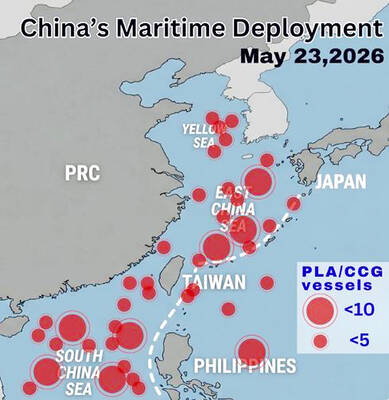
WARNING: China should stop engaging in actions that undermine regional peace and stability, as it would only build resentment among people across the Strait, the CGA said China has deployed more than 100 navy, coast guard and other vessels in waters from the Yellow Sea to the South China Sea and the western Pacific since US President Donald Trump and Chinese President Xi Jinping (習近平) met in Beijing, National Security Council Secretary-General Joseph Wu (吳釗燮) said yesterday. “In this part of the world, #China is the one & only PROBLEM wrecking the #StatusQuo & threatening regional peace & stability,” Wu wrote on X. In a separate post, he said Beijing was coercing Taiwan’s maritime domain, calling it illegal and provocative, after the Coast Guard Administration (CGA) expelled a

VERBOSE VESSELS: A CGA cutter and a China Coast Guard exchanged verbal barbs for more than a day in Taiwanese-controlled waters before the Chinese vessel left The Taiwanese and Chinese coast guards had a standoff near the strategically located Pratas Islands (Dongsha Islands, 東沙群島) in the north of the South China Sea, the Coast Guard Administration (CGA) said yesterday. The two sides engaged in intense radio exchanges over sovereignty claims during the 33-hour standoff. China Coast Guard vessel 3501 eventually left the restricted waters, 26.6 nautical miles (49.2km) west of the Pratas Islands, at 5pm yesterday, the CGA said. Lying approximately between southern Taiwan and Hong Kong, the Taiwan-controlled Pratas are seen by some security experts as vulnerable to Chinese attack due to their distance — more than

More than 8,000 people took part in a rally in Taipei yesterday to express support for more defense spending, after the opposition slashed the Cabinet’s proposed NT$1.25 trillion (US$39.6 billion) special defense budget and capped it at NT$780 billion. The demonstrators urged the Cabinet to propose another bill. Taiwan Economic Democracy Union convener Lai Chung-chiang (賴中強) said the main problem of the passed budget plan is the removal of funding for critical items, not just that the total amount is smaller. Critical budget items included purchasing or developing uncrewed vehicles, Strong Bow (強弓) missile systems, additional ammunition, artificial intelligence-powered combat systems and Taiwan-US


 RSS
RSS