


A proposal by the Ministry of the Interior (MOI) yesterday to create red light districts where the sex trade would be legal sparked debate among civic groups.
The proposal, made at a preparatory meeting ahead of the Executive Yuan’s Human Rights Protection and Promotion Committee meeting, could be endorsed when the committee convenes later this month.
The MOI proposed decriminalization of the sex industry through setting up red light districts after holding several citizens’ conferences on the subject over the last year.
Although the proposal is still far from being a done deal, and requires legislative approval, several women’s groups slammed the ministry at a joint press conference in Taipei.
“The sex industry is about hurting and exploiting disadvantaged women,” said Garden of Hope Foundation executive director Chi Hui-jung (紀惠容). “Sure you can find women who ‘chose’ to become prostitutes, but they often did so because they didn’t have any other choices.”
“The Garden of Hope has interviewed numerous prostitutes, and they all told us that they would have picked another trade if they’d had any other choice, not to mention those who were forced into it,” she said.
Citing figures released by the EU, Chi said that between 92 percent and 95 percent of women in the sex industry said they want to quit.
“Prostitutes don’t make money — it’s the human traffickers, pimps and their bosses who make the money,” she said.
Instead of allowing economically disadvantaged women to work in the sex industry, Chi said that the government should come up with more policies to increase welfare and employment opportunities for women.
Taiwan Women’s Link secretary-general Tsai Wan-fen (蔡宛芬) cited examples from other countries showing that legalizing the sex industry would not solve sex exploitation and human trafficking.
“In red light districts in the Netherlands, more than 50 percent of sex workers say they are often threatened, beaten or even raped by pimps or customers,” Tsai said. “The Dutch police just discovered the largest human trafficking group in its history last year.”
Tsai added that the Amsterdam City Government was “considering shrinking the size of the red light district” because it realized that it had become a center for human trafficking, sex exploitation and money laundering.
On the other hand, Sex Workers and Supporters Collective member Chien Chia-ying (簡嘉瑩) said that no one should pretend that the sex industry does not exist.
“The sex trade has always been there and still will be there whether it’s legal or not,” Chien told the Taipei Times via telephone. “By making the industry legal, the government can regulate it and reduce the possibility of exploitation.”
“In all trades and businesses, there are people who act illegally, but that’s not a reason to outlaw the entire industry,” she said.
Earlier at the meeting, Huang Bi-hsia (黃碧霞), director of the Department of Social Affairs of the MOI, briefed the attendees on the ministry’s position.
Research, Development and Evaluation Commission Deputy Minister Sung Yu-hsieh (宋餘俠) quoted the MOI’s assessment report on the issue at the meeting, saying that establishing a red light district was one option to effectively manage prostitution.
Sung said that those at the meeting, including academics and officials from the National Policy Agency, the Ministry of Justice and the Ministry of Foreign Affairs, all agreed to decriminalize consensual sex between adults, but were at odds on whether to set up red light districts.
Under current regulations governing sexual transactions in Article 80 of the Social Order Maintenance Act (社會秩序維護法), prostitutes can be detained for a maximum of three days and fined up to NT$30,000.
Law enforcement authorities also have the power to send prostitutes to correctional institutions for a period of six to 12 months.
Customers, however, are not subject to any punishment under current rules and regulations.

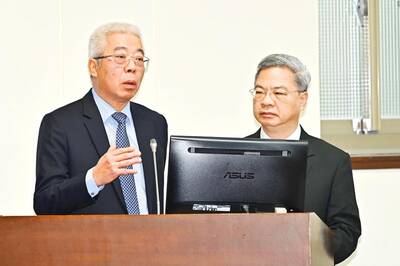
Taiwan has arranged for about 8 million barrels of crude oil, or about one-third of its monthly needs, to be shipped from the Red Sea this month to bypass the Strait of Hormuz and ease domestic supply pressures, CPC Corp, Taiwan (CPC, 台灣中油) said yesterday. The state-run oil company has worked with Middle Eastern suppliers to secure routes other than the Strait of Hormuz, through which about 20 percent of the world’s oil and liquefied natural gas typically passes, CPC chairman Fang Jeng-zen (方振仁) said at a meeting of the legislature’s Economics Committee in Taipei. Suppliers in Saudi Arabia have indicated they
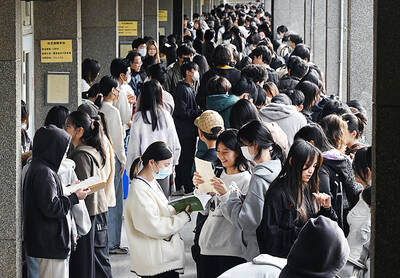
A global survey showed that 60 percent of Taiwanese had attained higher education, second only to Canada, the Ministry of the Interior said. Taiwan easily surpassed the global average of 43 percent and ranked ahead of major economies, including Japan, South Korea and the US, data from the Organisation for Economic Co-operation and Development (OECD) for 2024 showed. Taiwan has a high literacy rate, data released by the ministry showed. As of the end of last year, Taiwan had 20.617 million people aged 15 or older, accounting for 88.5 percent of the total population, with a literacy rate of 99.4 percent, the data

CCP ‘PAWN’? Beijing could use the KMT chairwoman’s visit to signal to the world that many people in Taiwan support the ‘one China’ principle, an academic said Chinese Nationalist Party (KMT) Chairwoman Cheng Li-wun (鄭麗文) yesterday arrived in China for a “peace” mission and potential meeting with Chinese President Xi Jinping (習近平), while a Taiwanese minister detailed the number of Chinese warships currently deployed around the nation. Cheng is visiting at a time of increased Chinese military pressure on Taiwan, as the opposition-dominated Legislative Yuan stalls a government plan for US$40 billion in extra defense spending. Speaking to reporters before going to the airport, Cheng said she was going on a “historic journey for peace,” but added that some people felt uneasy about her trip. “If you truly love Taiwan,

NEW LOW: The council in 2024 based predictions on a pessimistic estimate for the nation’s total fertility rate of 0.84, but last year that rate was 0.69, 17 percent lower An expected National Development Council (NDC) report expects the nation’s population to drop below 12 million by 2065, with the old-age dependency ratio to top 100 percent sooner than 2070, sources said yesterday. The council is slated to release its latest population projections in August, using an ultra-low fertility model, the sources said. The previous report projected that Taiwan’s population would fall to 14.37 million by 2070, but based on a new estimate of the total fertility rate (TFR) — the average number of children born to a woman over her lifetime — the population is expected to reach 12 million by


 RSS
RSS