


WHO Director-General Margaret Chan’s (陳馮富珍) opening address to the World Health Assembly (WHA) in Geneva, Switzerland, on Monday was marred by protesters complaining about the WHO’s designation of Taiwan, one day after Department of Health Minister Yeh Ching-chuan (葉金川) was heckled by Taiwanese students who accused him of “selling out Taiwan.”
Shortly after Chan addressed the WHA, several people in the public gallery on the second floor of the assembly hall in the UN’s Geneva headquarters shouted “Taiwan is not part of China.”
The protesters were quickly removed by UN security guards.
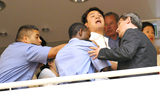
PHOTO: EPA
During a break in the meeting following Chan’s speech, Chinese Health Minister Chen Zhu (陳竺) intercepted Yeh as he was preparing to leave the assembly hall. The two men shook hands and chatted briefly.
Taiwan was invited to attend this year’s WHA meeting as an observer under the designation “Chinese Taipei” following 12 failed attempts to join the WHO because of Beijing’s interference. The Republic of China (ROC) left the UN in 1971.
US Secretary of Health and Human Services Kathleen Sebelius welcomed Taiwan’s presence at the WHA session, saying its participation was worth celebrating.
During her speech to the assembly, Czech Health Minister Dana Juraskova also welcomed Taiwan’s participation on behalf of all EU member states.
Meanwhile, Yeh told Taipei-based reporters in a phone interview yesterday that he was doing the right thing for Taiwan by participating in the WHA meeting.
“We shared our experiences with fellow allies and we learned something from them at the same time. This is the most important thing,” Yeh said.
“We also received lots of attention from the international press. This is something we could not imagine before,” he said. “I am proud of my country. I am proud of Taiwan.”
When asked about his confrontation on Sunday night with two Taiwanese students and his threat to file lawsuits against them when he returns home, Yeh said he did not want to discuss the incident.
“Everybody has the right to speak out. I endorse the rights of the two students to speak out. But, when you do [protest], you need to make sure what you do is legal and show proper respect to others,” Yeh said.
Judicial Reform Foundation executive director Lin Feng-jeng (林峰正) said Yeh could file the lawsuits against the students even though the incident did not take place in Taiwan.
“If they have ROC nationality, they are under the jurisdiction of the courts in Taiwan,” he said, but if they were not Taiwanese, Yeh could not press charges.
Chief Prosecutor Huang Mo-hsin (黃謀信) of the Taipei District Court said that articles 5 to 7 of the Criminal Code state that, under certain conditions, the code would apply to any ROC citizen committing a criminal offense outside the territory of the ROC.
“Prosecutors still have to investigate the case to decide whether or not to indict, but [Yeh] has the right to file a lawsuit,” Huang said.
The student protesters issued a press release accusing Yeh of losing control when confronted by demonstrators on Sunday night.
“The minister lost control and became emotional. This showed that he has difficulty managing crises,” the release said.
“During the protest, the protest was reported to Swiss police. Taiwanese officials and diplomats watched a female Taiwanese being violently pinned down on the ground by Swiss police officers and even sneered at the student protesters,” the release said.
Video footage of the confrontation showed the students heckling Yeh after the Taiwanese delegation’s dinner for Taiwan’s diplomatic allies, not during the dinner as some local Chinese-language media reported.
The students urged Yeh to apologize for his “mishap.”
The Chinese Nationalist Party (KMT) yesterday condemned the protesters and backed Yeh.
KMT spokesman Lee Chien-rong (李建榮) said Taiwan’s participation in the WHA was a big breakthrough and an achievement to be cherished but the protesters’ actions had damaged the nation’s international image.
Lin Hung-chih (林鴻池), a KMT caucus deputy secretary-general, urged the protesters not to let political wrangling overshadow participation in the WHA.
KMT legislators Lee Hung-chun (李鴻鈞) and Lee Ching-hua (李慶華) said the students should have protested to China and the WHO for not allowing Taiwan to participate in the WHA under the name “Republic of China.”
“They protested [to Yeh] only because they were jealous [that Taiwan was able to attend the WHA]. If they wanted to heckle someone, they should heckle China,” Lee Ching-hua said.
ADDITIONAL REPORTING BY MO YAN-CHIH

Taiwan Semiconductor Manufacturing Co (TSMC, 台積電), the world’s largest foundry service provider, yesterday said that global semiconductor revenue is projected to hit US$1.5 trillion in 2030, after the figure exceeds US$1 trillion this year, as artificial intelligence (AI) demand boosts consumption of token and compute power. “We are still at the beginning of the AI revolution, but we already see a significant impact across the whole semiconductor ecosystem,” TSMC deputy cochief operating officer Kevin Zhang (張曉強) said at the company’s annual technology symposium in Hsinchu City. “It is fair to say that in the past decade, smartphones and other mobile devices were
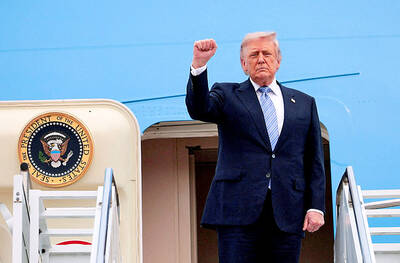
US-CHINA SUMMIT: MOFA welcomed US reassurance of no change in its Taiwan policy; Trump said he did not comment when Xi talked of opposing independence US President Donald Trump yesterday said he has not made a decision on whether to move forward with a major arms package for Taiwan after hearing concerns about it from Chinese President Xi Jinping (習近平). Trump’s comments on Taiwan came as he flew back to Washington after wrapping up critical talks in which both leaders said important progress was made in stabilizing US-China relations even as deep differences persist between the world’s two biggest powers on Iran and Taiwan. “I will make a determination,” Trump said, adding: “I’ll be making decisions. But, you know, I think the last thing we need right
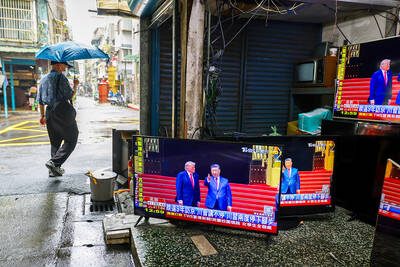
TAIWAN ISSUE: US treasury secretary Scott Bessent said on the first day of meetings that ‘it wouldn’t be a US-China summit without the Taiwan issue coming up’ There were no surprises on the first day of the summit between US President Donald Trump and Chinese President Xi Jinping (習近平), the Mainland Affairs Council (MAC) said yesterday, as the government reiterated that cross-strait stability is crucial to the Asia-Pacific region, as well as the world. As the two presidents met for a highly anticipated summit yesterday, Chinese state media reported that Xi warned Trump that missteps regarding Taiwan could push their two countries into “conflict.” Trump arrived in China with accolades for his host, calling Xi a “great leader” and “friend,” and extending an invitation to visit the White House
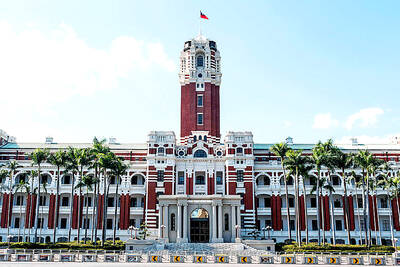
SECURITY: Taipei presses the US for arms supplies, saying the arms sales are not only a reflection of the US security commitment to Taiwan but also serve as a mutual deterrent against regional threats Taiwan is committed to preserving the cross-strait “status quo” and contributing to regional peace and stability, the Presidential Office said yesterday. “It is an undeniable fact that the Republic of China is a sovereign and independent democratic nation,” Presidential Office spokeswoman Karen Kuo (郭雅慧) reiterated, adding that Beijing has no right to claim sovereignty over Taiwan. The statements came after US President Donald Trump warned against Taiwanese independence. Trump wrapped up a state visit to Beijing on Friday, during which Chinese President Xi Jinping (習近平) had pressed him not to support Taiwan. Taiwan depends heavily on US security backing to deter China from carrying


 RSS
RSS