


A top US intelligence official has warned that the danger of military confrontation in the Taiwan Strait is one of the most worrying potential threats facing the US in coming years.
Thomas Fingar, the deputy director of the Office of the Director of National Intelligence, made the comment on Wednesday in testimony before a hearing of the House Armed Services Committee on the US intelligence community's annual assessment of global threats to US security.
"The danger of [the situation in the Strait] spinning out of control is real," Fingar said.
Asked by committee members about the biggest potential threats to US security, the intelligence analyst cited global terrorism as the top danger.
Beyond that threat, Fingar said, "in terms of conventional military threats, I think the greatest danger is one of misperception, miscalculation or escalation of regional conflicts."
"To be more specific," Fingar said, singling out Taiwan, danger could stem from "miscalculation by any of the parties involved in watching the Taiwan Strait situation -- by Taiwan, by the mainland, their perceptions of what we may or may not do."
He said that the danger could come from "judgments about what anticipatory or pre-emptive actions may be necessary in order to deter one or the other of the parties. The danger of that spinning out of control is real."
On a broader level, aside from terrorism, Fingar said, China's military buildup is the largest potential threat.
"Improvements in China's theater range missile capability will put US forces at greater risk from conventional weapons. In addition, Beijing seeks to modernize China's strategic nuclear force to address concerns about the survivability of those systems," Fingar said.
"If present trends in global development of China's space capabilities continue ... China will have an increasing ability to target US military, intelligence and navigational satellites to degrade our command and control systems and our ability to use effectively our precision weapons systems," he said.
In a lengthy written statement presented to the committee, Fingar mentioned Taiwan's presidential election and planned referendums on UN membership.
In this, he echoed his boss, Michael McConnell, the director of national intelligence, who testified on the annual assessment to the Senate Select Committee on Intelligence last week.
Fingar's statement, like McConnell's, said that President Chen Shui-bian (陳水扁) "is seeking to affirm Taiwan's sovereignty and separate identity from the mainland."
Fingar also said that China's leaders "say they are prepared for military contingencies and have occasionally cited Beijing's 2005 `Anti-Secession' Law, which authorized the use of force if Beijing's leaders deem it necessary."

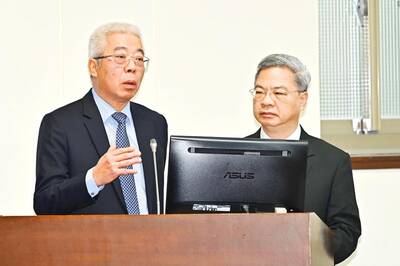
Taiwan has arranged for about 8 million barrels of crude oil, or about one-third of its monthly needs, to be shipped from the Red Sea this month to bypass the Strait of Hormuz and ease domestic supply pressures, CPC Corp, Taiwan (CPC, 台灣中油) said yesterday. The state-run oil company has worked with Middle Eastern suppliers to secure routes other than the Strait of Hormuz, through which about 20 percent of the world’s oil and liquefied natural gas typically passes, CPC chairman Fang Jeng-zen (方振仁) said at a meeting of the legislature’s Economics Committee in Taipei. Suppliers in Saudi Arabia have indicated they
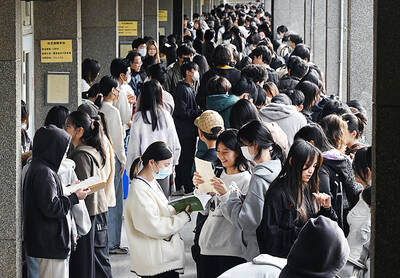
A global survey showed that 60 percent of Taiwanese had attained higher education, second only to Canada, the Ministry of the Interior said. Taiwan easily surpassed the global average of 43 percent and ranked ahead of major economies, including Japan, South Korea and the US, data from the Organisation for Economic Co-operation and Development (OECD) for 2024 showed. Taiwan has a high literacy rate, data released by the ministry showed. As of the end of last year, Taiwan had 20.617 million people aged 15 or older, accounting for 88.5 percent of the total population, with a literacy rate of 99.4 percent, the data
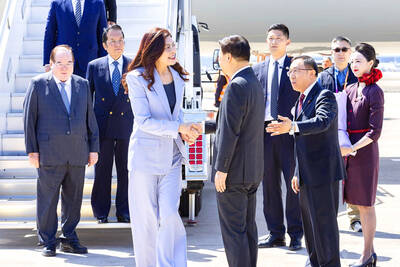
CCP ‘PAWN’? Beijing could use the KMT chairwoman’s visit to signal to the world that many people in Taiwan support the ‘one China’ principle, an academic said Chinese Nationalist Party (KMT) Chairwoman Cheng Li-wun (鄭麗文) yesterday arrived in China for a “peace” mission and potential meeting with Chinese President Xi Jinping (習近平), while a Taiwanese minister detailed the number of Chinese warships currently deployed around the nation. Cheng is visiting at a time of increased Chinese military pressure on Taiwan, as the opposition-dominated Legislative Yuan stalls a government plan for US$40 billion in extra defense spending. Speaking to reporters before going to the airport, Cheng said she was going on a “historic journey for peace,” but added that some people felt uneasy about her trip. “If you truly love Taiwan,

NEW LOW: The council in 2024 based predictions on a pessimistic estimate for the nation’s total fertility rate of 0.84, but last year that rate was 0.69, 17 percent lower An expected National Development Council (NDC) report expects the nation’s population to drop below 12 million by 2065, with the old-age dependency ratio to top 100 percent sooner than 2070, sources said yesterday. The council is slated to release its latest population projections in August, using an ultra-low fertility model, the sources said. The previous report projected that Taiwan’s population would fall to 14.37 million by 2070, but based on a new estimate of the total fertility rate (TFR) — the average number of children born to a woman over her lifetime — the population is expected to reach 12 million by


 RSS
RSS