

One of the prime suspects in the sabotage that caused a recent train derailment -- who in a Hitchcock-esque twist was also the husband of the only woman who died in the incident -- hanged himself yesterday, police said.
Lee Shuang-chuan's (
Several bizarre coincidences surrounding the death of his Vietnamese wife, Chen Hong-chen (
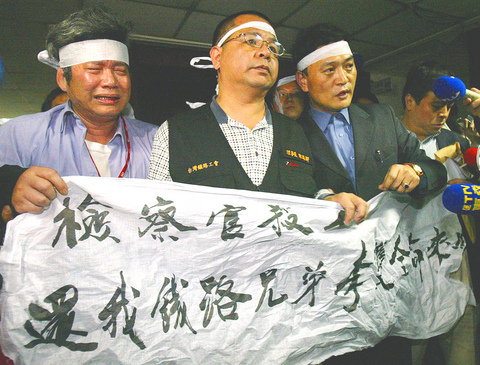
PHOTO: CNA
Chen suffered no obvious physical injuries in the derailment, which occurred on March 17. However, she died shortly afterwards. Although an initial examination showed no evidence of poison, investigators have ordered that her body not be cremated, so that an autopsy can be performed.
The suspicion of police was aroused after they discovered that Lee's second wife -- also Vietnamese -- died under mysterious circumstances four years ago. At the time, Lee and his family claimed that her death was the result of a snake bite, according to prosecutors. Lee was divorced from his first wife.
Police became even more interested in Lee after they learned that he had taken out a NT$20 million (US$625,000) insurance policy on Chen Hong-chen covering "accidental death" just days before the derailment.
The details of the case were revealed by Chuang Jung-sung (
Chuang said another element implicating Lee was the fact that he and his wife had been on trains that had derailed twice before.
On June 21 last year, both Lee and his wife were on a train that derailed, as well as aboard another that derailed on Oct. 21, 2004.
According to Chuang, the couple was originally sitting in the fifth car of the train last Friday night, and then moved to the rear of the seventh car. When Lee returned to the fifth car to pick up his newspaper, the "accident" occurred.
After the derailment, Lee told investigators that the couple was going to Vietnam to visit his wife's relatives. But investigators learned that he had not reported this to his company nor asked for a leave of absence.
Chuang said that as Lee was a Taiwan Railway Administration employee and worked as a railway inspector two years ago, prosecutors believe he was familiar with railway matters.
Since Lee's previous Vietnamese wife was killed under suspicious circumstances, prosecutors were highly suspicious.
Pingtung prosecutors last night disclosed that Lee had lost more than NT$33 million on the stock market between 2001 and 2004.
"We are now trying to determine where this money came from," Chuang said.
Lee was being hounded by the media at the time of his death, as details of the case had been leaked by the authorities. The investigators said they had found two notes next to Lee's body, but had yet to reveal whether they were in fact suicide notes or whether they shed light on any of the circumstances surrounding the bizarre case.

Taiwan, which accounts for more than half of the global outsourced semiconductor assembly and testing market, is well-positioned to develop copackaged optics (CPO) and manufacture precision silicon photonics chips, the Ministry of Economic Affairs said yesterday. Silicon photonics are emerging as a mainstream optical communications technology and is seen as key to overcoming bottlenecks in AI computing power. The technology is a key project under the government’s New 10 Major AI Infrastructure Projects, with industry, government, academia and research institutions working to overcome critical technological hurdles and build a self-reliant silicon photonics supply chain, the ministry said. Nvidia Corp in March invested US$4
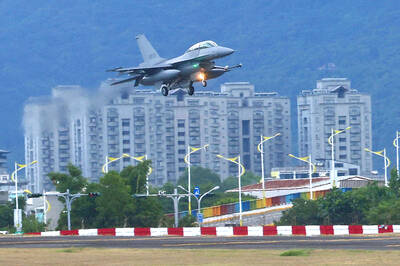
The air force plans to build 26 more hardened aircraft shelters as the number of F-16Vs stationed along Taiwan’s east coast is expected to reach 120 when the final shipment of 66 jets procured from the US arrives. The incoming jets would be stationed at Chihhang Air Base in Taitung County, augmenting the F-16V Block 20s operated by the 5th Tactical Fighter Wing in Hualien County, officials said yesterday. The air force plans to allocate more than NT$6.88 billion (US$218.1 million) from next year to 2031 to build the shelters in Hualien and Taitung as part of the implementation of a “one
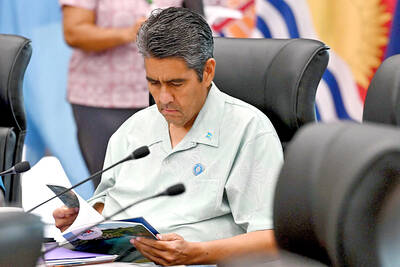
Palau’s president yesterday called for a “unified” Pacific response to a missile test by China in July, while Taiwan and its Pacific allies a day earlier at the Pacific Islands Forum (PIF) reaffirmed their commitment to peace, stability and prosperity. China gave only a handful of nations short notice before test-firing an intercontinental ballistic missile in July, sparking condemnation from several Pacific leaders. The 18-member PIF being held in Palau was expected to release a communique after press time last night, with a formal response to the test possibly included. Palau, which invited Taiwan to attend sideline events as an aid partner, urged
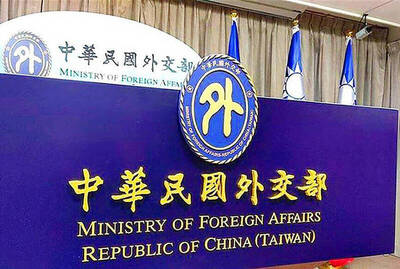
China’s continued efforts to inject geopolitical rivalry into the region and disrupt Pacific nations’ discussions of regional issues warrant greater international attention, a foreign affairs official said yesterday. Minister of Foreign Affairs Lin Chia-lung (林佳龍) last week led a delegation to diplomatic ally Palau to attend events related to the 55th Pacific Islands Forum (PIF) summit. However, the absence of some member-state leaders has been interpreted by some people as a sign of fracturing in Pacific unity. Thirteen PIF members were represented by their heads of state or government, while Fiji, New Caledonia, Vanuatu and Samoa sent ministerial-level representatives, a diplomatic official


 RSS
RSS