


Sea levels around the world are rising twice as fast as they were 150 years ago because of human-induced global warming, US scientists say in a study released on Thursday.
Sea levels are now rising almost 2mm per year, compared to 1mm annually for the last several thousand years, a team of scientists at Rutgers University and other institutions said.
"The main thing that's changed since the 19th century and the beginning of modern observation has been the widespread increase in fossil-fuel use and more greenhouse gases," said Rutgers professor Kenneth Miller, who led the study. "Our record therefore provides a new and reliable baseline to use in addressing global warming."
The findings, based on drilling studies in New Jersey along the Atlantic Coast of the US, are published in the Nov. 25 issue of the weekly US journal Science.
The study claims that ocean levels 100 million years ago and earlier were 150m to 200m lower than previously thought. It also questions whether any of the Earth's warmer areas were ever fully ice-free.
In a separate study published in the same issue, European researchers found that today's atmospheric carbon dioxide is at the highest level in 650,000 years.
Levels of carbon dioxide, the principal gas that drives global warming, are now 27 percent higher than at any point in the last 650,000 years, according to research into Antarctic ice cores published on Thursday.
The evidence comes from the world's deepest ice core, drilled at a site called Dome Concordia (Dome C) in East Antarctica by European scientists who battled blizzards and an average year-round temperature of minus 54oC and made a 1,000km trek to bring up supplies.
The core, extracted using a 10cm-wide drill bit in 3m sections, brought up ice that was deposited by snows up to 650,000 years ago, as determined by estimated layers of annual snowfall.
Analysis of carbon dioxide trapped in tiny bubbles in the ancient ice showed that at no point during this time frame did levels get anywhere close to today's CO2 concentrations of around 380 parts per million.
Today's rising CO2 concentrations are 27 percent higher than at the highest level seen over the 650,000-year time scale, according to the study, which also appears in Science.
The Dome C core, extracted by the 10-country European Project for Ice Coring in Antarctica (EPICA), outstrips by 210,000 years the previous record-holder, drilled at an Antarctic site called Vostok.
In the past five years, the average global temperature has risen by 0.2oC and this year is on course for being the hottest year on record.
Also see stories:

The Tourism Administration yesterday announced that it would reward repeat international visitors with incentives of up to NT$8,000 to boost inbound tourism. The incentives are available to all international tourists, it said, adding that repeat visitors would be rewarded with NT$5,000 and would receive an additional NT$3,000 if they bring travel companions. The nation received 2,990,657 inbound visitors during the first quarter, marking a 3.8 percent increase from the same period last year, agency data showed. Japanese nationals are among groups visiting Taiwan the most. About 1.48 million Japanese tourists arrived last year, a year-on-year increase of more than 12
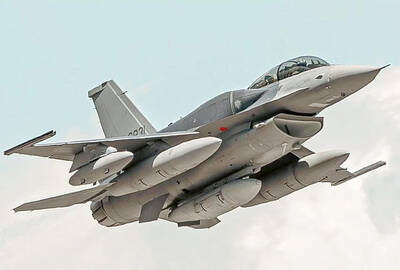
66 FIGHTER JETS: The aircraft is likely undergoing preparations for its transfer to Taiwan — a significant step forward in the nation’s modernization program, a lawmaker said The first of Taiwan’s order of F-16V Block 70 aircraft has been sighted in Texas ahead of delivery, Democratic Progressive Party (DPP) Legislator Wang Ting-yu (王定宇) said. Taiwan’s first F-16V Block 70 two-seat aircraft, tail number 6831, was seen flying from Lockheed Martin’s production facility in Greenville, South Carolina, to Naval Air Station Joint Reserve Base Fort Worth in Texas, Wang wrote on Facebook yesterday. The plane is likely undergoing preparations for its transfer to Taiwan, marking a significant step forward in the Republic of China Air Force’s modernization program, Wang said, citing military analysts. The F-16V Block 70 is a new-build version
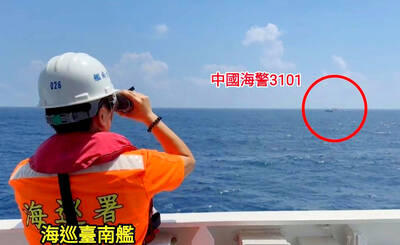
‘BRAZEN’: The holiday did not stop China from activities that infringe on Taiwan’s maritime jurisdiction, but the CGA is ready to defend the nation, Kuan Bi-ling said Beijing is intensifying maritime pressure on Taiwan, but the nation will never yield, Ocean Affairs Council Deputy Minister Sung Chen-en (宋承恩) said. The Coast Guard Administration (CGA) has adopted a “shadowing and monitoring” approach to avoid falling into a Chinese trap to escalate tensions and deepen the conflict, Sung said in an interview published yesterday in the Chinese-language Liberty Times (the Taipei Times’ sister newspaper). China Coast Guard formations patrolling waters east of Taiwan, as well as official Chinese vessels entering areas around Itu Aba Island (Taiping Island, 太平島) and Pratas Islands (Dongsha Islands, 東沙群島) show Beijing’s attempts to significantly step up
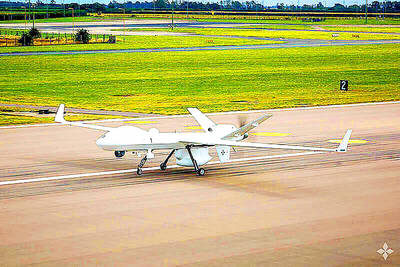
BOOST: By operating the same advanced systems as the US military, Taiwan would be better positioned to share and integrate intelligence with partners, an expert said The first batch of MQ-9B SkyGuardian drones has arrived in Taiwan, and is being assembled and tested by drone manufacturer General Atomics and the military ahead of flight trials as part of the air force’s acquisition to bolster its aerial surveillance capabilities, a source said yesterday. The air force allocated a budget of NT$21.7 billion (US$687 million) from 2022 to 2029 to procure four MQ-9B uncrewed aerial vehicles (UAVs) manufactured by General Atomics along with associated equipment such as ground control stations. The US has agreed to deliver the four MQ-9Bs to Taiwan in two batches this year and next


 RSS
RSS