


In a dramatic reversal of its previous position, the White House this week conceded that emissions of carbon dioxide and other heat-trapping gases were the only likely explanation for global warming.
Citing the "best possible scientific information," an administration official, James Mahoney, delivered a report to Congress that essentially reversed the previous White House position set out by US President George Bush, who had refused to link carbon dioxide emissions to climate change.
Two years ago, when his administration last published a document claiming that global warming over the last few decades had been prompted by human behavior, Bush dismissed it as something "put out by the bureaucracy."
One of Bush's first acts on the international scene as president was to refuse to ratify the Kyoto treaty, which aimed to cut emissions by 5.2 percent from 1990 levels by 2012 -- prompting outrage throughout the world.
"We must argue with the Americans and get them to agree we have to have a global solution, and America is a very important part of that solution," British deputy prime minister, John Prescott, said at the time.
But Bush also alienated himself from members of his own Cabinet as he overrode the recommendations of his newly-appointed head of the Environmental Protection Agency, Christine Todd Whitman. This was widely seen as a payback to the energy lobby which had donated a huge amount to his campaign.
At the time Bush cast doubts on the science, claimed restrictions would hamper economic growth, and said the treaty was "unfair to the United States and to other industrialized nations" because it exempted developing countries.
However, it will be far more difficult for him to distance himself from the current report, because it has been signed by the secretaries of energy and commerce in his administration.
Coming just days before the Republican convention opens in New York, it is thought to be another attempt by the administration to show moderate leanings.
The report, which also quotes studies that indicate that carbon dioxide stimulates the growth of invasive weeds more than it does crops, is part of a regular series submitted to Congress to monitor global trends.
Bush's former allies in the energy industry criticized the findings. Myron Ebell, of the Competitive Enterprise Institute, told the New York Times it was "another indication that the administration continues to be incoherent in its global warming policies."
Environmentalists say the report's conclusions simply highlight the distance between what the Bush administration has done and what good science suggests should be done.
"For four years the Bush administration has brought the international global warming negotiations to a virtual standstill by claiming that uncertainties in climate science do not justify the cost of tackling it," said Rob Gueterbock of Greenpeace.

Right-wing political scientist Laura Fernandez on Sunday won Costa Rica’s presidential election by a landslide, after promising to crack down on rising violence linked to the cocaine trade. Fernandez’s nearest rival, economist Alvaro Ramos, conceded defeat as results showed the ruling party far exceeding the threshold of 40 percent needed to avoid a runoff. With 94 percent of polling stations counted, the political heir of outgoing Costa Rican President Rodrigo Chaves had captured 48.3 percent of the vote compared with Ramos’ 33.4 percent, the Supreme Electoral Tribunal said. As soon as the first results were announced, members of Fernandez’s Sovereign People’s Party
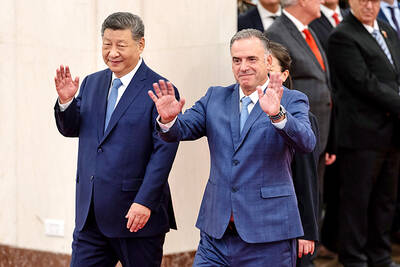
EMERGING FIELDS: The Chinese president said that the two countries would explore cooperation in green technology, the digital economy and artificial intelligence Chinese President Xi Jinping (習近平) yesterday called for an “equal and orderly multipolar world” in the face of “unilateral bullying,” in an apparent jab at the US. Xi was speaking during talks in Beijing with Uruguayan President Yamandu Orsi, the first South American leader to visit China since US special forces captured then-Venezuelan president Nicolas Maduro last month — an operation that Beijing condemned as a violation of sovereignty. Orsi follows a slew of leaders to have visited China seeking to boost ties with the world’s second-largest economy to hedge against US President Donald Trump’s increasingly unpredictable administration. “The international situation is fraught
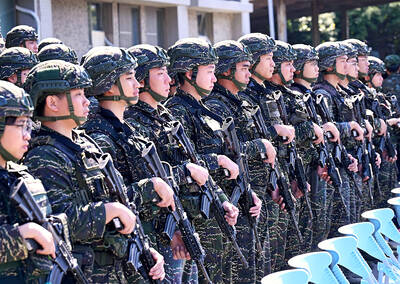
MORE RESPONSIBILITY: Draftees would be expected to fight alongside professional soldiers, likely requiring the transformation of some training brigades into combat units The armed forces are to start incorporating new conscripts into combined arms brigades this year to enhance combat readiness, the Executive Yuan’s latest policy report said. The new policy would affect Taiwanese men entering the military for their compulsory service, which was extended to one year under reforms by then-president Tsai Ing-wen (蔡英文) in 2022. The conscripts would be trained to operate machine guns, uncrewed aerial vehicles, anti-tank guided missile launchers and Stinger air defense systems, the report said, adding that the basic training would be lengthened to eight weeks. After basic training, conscripts would be sorted into infantry battalions that would take

GROWING AMBITIONS: The scale and tempo of the operations show that the Strait has become the core theater for China to expand its security interests, the report said Chinese military aircraft incursions around Taiwan have surged nearly 15-fold over the past five years, according to a report released yesterday by the Democratic Progressive Party’s (DPP) Department of China Affairs. Sorties in the Taiwan Strait were previously irregular, totaling 380 in 2020, but have since evolved into routine operations, the report showed. “This demonstrates that the Taiwan Strait has become both the starting point and testing ground for Beijing’s expansionist ambitions,” it said. Driven by military expansionism, China is systematically pursuing actions aimed at altering the regional “status quo,” the department said, adding that Taiwan represents the most critical link in China’s


 RSS
RSS