


Guerrillas detonated a car bomb outside an Iraqi security force base just north of Baghdad yesterday, killing nine people and wounding dozens in the latest attack on Iraqis cooperating with occupying troops.
With the formal handover of sovereignty to an Iraqi government less than four weeks away, Baghdad has seen a surge in deadly attacks in recent days.
The 15-nation UN Security Council was called into a special session yesterday amid signs that the US is close to securing agreement on a draft UN resolution on the future of Iraq after June 30.
"A vehicle-borne improvised explosive device was detonated," US Major Andreas Dekunpfy said at the scene of the blast at the Iraqi Civil Defense Corps base in Taji. US troops are also based nearby.
It was not clear whether the bombing was a suicide attack, a tactic regularly used by insurgents.
The US military said six people were killed, but hospital officials later said nine Iraqis were killed and 61 wounded.
On Saturday, two soldiers were killed and two wounded when a bomb was detonated near their convoy in the northeast of the capital. The previous day, five soldiers were killed in a guerrilla attack in the same area.
Insurgents also attacked foreigners traveling in civilian four-wheel drive vehicles on the airport road on Saturday. After the attack two vehicles were in flames and witnesses said they saw at least two bodies. The US military had no information.
South of Baghdad, gunmen burst into a police station in the town of Mussayab on Saturday and forced police into a cell before detonating explosives in the building, police said. They said at least 10 policemen and two civilians were killed.
Iraqi police and security personnel are regularly targeted by guerrillas, who have repeatedly threatened Iraqis who work with occupying troops and foreign organizations.
Also see story:
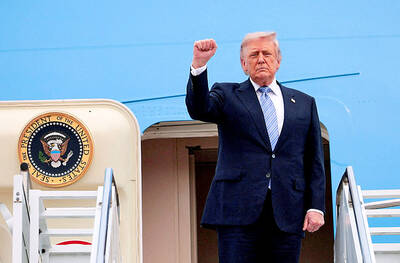
US-CHINA SUMMIT: MOFA welcomed US reassurance of no change in its Taiwan policy; Trump said he did not comment when Xi talked of opposing independence US President Donald Trump yesterday said he has not made a decision on whether to move forward with a major arms package for Taiwan after hearing concerns about it from Chinese President Xi Jinping (習近平). Trump’s comments on Taiwan came as he flew back to Washington after wrapping up critical talks in which both leaders said important progress was made in stabilizing US-China relations even as deep differences persist between the world’s two biggest powers on Iran and Taiwan. “I will make a determination,” Trump said, adding: “I’ll be making decisions. But, you know, I think the last thing we need right
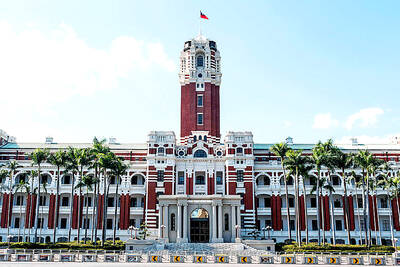
SECURITY: Taipei presses the US for arms supplies, saying the arms sales are not only a reflection of the US security commitment to Taiwan but also serve as a mutual deterrent against regional threats Taiwan is committed to preserving the cross-strait “status quo” and contributing to regional peace and stability, the Presidential Office said yesterday. “It is an undeniable fact that the Republic of China is a sovereign and independent democratic nation,” Presidential Office spokeswoman Karen Kuo (郭雅慧) reiterated, adding that Beijing has no right to claim sovereignty over Taiwan. The statements came after US President Donald Trump warned against Taiwanese independence. Trump wrapped up a state visit to Beijing on Friday, during which Chinese President Xi Jinping (習近平) had pressed him not to support Taiwan. Taiwan depends heavily on US security backing to deter China from carrying
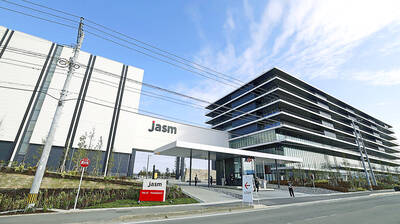
The subsidiary of Taiwan Semiconductor Manufacturing Co (TSMC, 台積電) in Kumamoto, Japan, turned a profit in the first quarter of this year, marking the first time the first fab of the unit has become profitable since mass production started at the end of 2024. According to the contract chipmaker’s financial statement released on Friday, Japan Advanced Semiconductor Manufacturing Inc (JASM), a joint venture running the fab in Kumamoto, posted NT$951 million (US$30.19 million) in profit in the January-to-March period, compared with a loss of NT$1.39 billion in the previous quarter, and a loss of NT$3.25 billion in the first quarter of
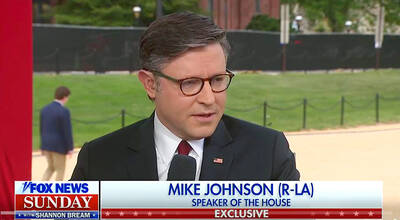
RESOLUTE BACKING: Two Republican senators are planning to introduce legislation that would impose immediate sanctions on China if it attempts to invade Taiwan US House of Representatives Speaker Mike Johnson on Sunday reaffirmed US congressional support for Taiwan, saying the US and “all freedom-loving people” have a stake in preventing China from seizing Taiwan by force. Johnson made the remarks in an interview with Fox News Sunday on US President Donald Trump’s summit with Chinese President Xi Jinping (習近平) last week. In an interview that aired on Friday on Fox News, just as Trump wrapped up a high-stakes visit to China, he said he has yet to green-light a new US$14 billion arms package to Taiwan and that it “depends on China.” “It’s a very good


 RSS
RSS