


In a surprise move, Prime Minister Ariel Sharon yesterday dissolved parliament and called elections for early February after he failed to rebuild his crumbling government.
Sharon's challenger in upcoming primaries for leadership of the Likud party, former prime minister Benjamin Netanyahu, then announced he would serve as Sharon's foreign minister until the election.
The dramatic developments throw Israel into a turbulent election campaign at a time when the nation is facing severe problems -- the two-year-old conflict with the Palestinians, a deepening economic crisis and the possibility of an Iraqi attack on Israel in the event of a US strike against Saddam Hussein.
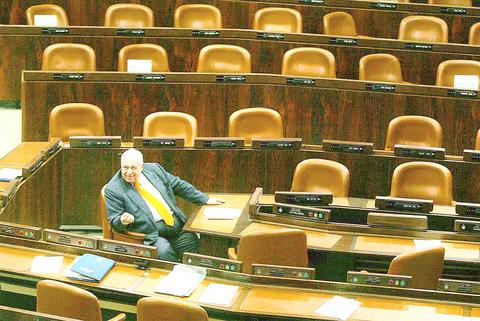
PHOTO: AP
Sharon said he made the decision reluctantly, but that he had no choice because the alternative -- succumbing to political blackmail by potential right-wing coalition partners -- would have been worse.
"Elections are the last thing this country needs right now," Sharon told a hastily called news conference at his office.
He chided his former allies in the moderate Labor Party and a far-right party, the National Union-Israel Beitenu, blaming them for the end of his 20-month-old government. Israel has had five prime ministers in the past seven years.
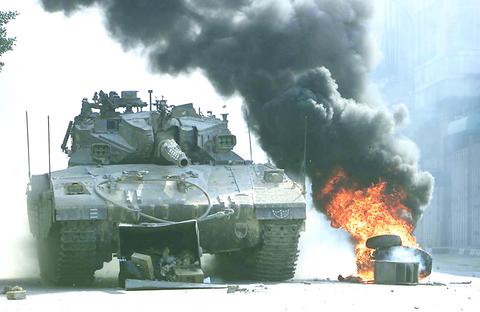
PHOTO: AP
While there had been expectations that Sharon would be forced into early elections, the speed of the announcement took many by surprise. Many believed Sharon would spend more time trying to lure the National Union into his coalition.
February elections -- the emerging date was Feb. 4 -- would leave an unusually short time for campaigning, and both Sharon and the main opposition party, Labor, face leadership primaries this month.
Nabil Abu Rdeneh, an adviser to Palestinian leader Yasser Arafat, said he hopes Israelis will choose a different government.
"What we are interested in right now is an Israeli government which is committed to the peace process, because the current government has failed in achieving peace and stability in the region," Abu Rdeneh said.
Sharon's broad coalition broke apart last week, after Labor quit in a dispute over funding for Jewish settlements in the West Bank and Gaza, and the prime minister yesterday accused his former coalition partner of acting irresponsibly. Labor's departure was a "political caprice," Sharon said.
Labor leader Binyamin Ben-Eliezer returned the blame, saying: "The government fell because you [Sharon] have contempt for the poor."
Ben-Eliezer had demanded that settlement funding be cut by US$145 million for the benefit of pensioners, students and poorer Israelis in provincial towns.
Ben-Eliezer and other Labor leaders have suggested that they will try to focus the coming campaign on the hobbled economy instead of the conflict with the Palestinians, an issue where Likud's harder line is currently more popular.
Sharon also had harsh words for the National Union, saying it had come with a long list of demands, including that he change the basic government guidelines and that he reject outright a new US-backed peace plan.
"I made it clear that I am not going to change the guidelines, or the commitments that I took upon myself in my talks with the White House, and I will not deviate from the budget," Sharon said.
The Israeli election campaign will be held amid fears that Iraq could attack Israel if the US launched a war to topple Iraqi leader Saddam Hussein. Asked how he felt about the possibility of Israelis going to the polls while wearing gas masks -- a protection against non-conventional weapons Israel fears Saddam might use -- Sharon said: "I don't think it's responsible to talk about that sort of thing."
He also said that his transition government will fight Palestinian militants without compromise. Sharon's announcement came a day after a Palestinian suicide bomber from the Islamic Jihad faction blew himself up in a shopping mall in the central town of Kfar Saba, also killing two Israelis and wounding 11.
An Islamic Jihad spokesman, Mohammed al-Hindi, said he believed his group had contributed to the breakup of the coalition.
"This is another achievement of the uprising, and this is another failure of the occupation policy against the Palestinian people," he said.
Polls suggest Sharon's Likud may grow somewhat stronger, but many observers are predicting the elections will be followed by yet another Likud-Labor coalition.
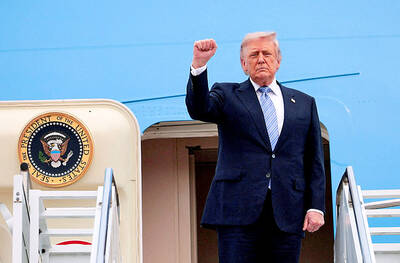
US-CHINA SUMMIT: MOFA welcomed US reassurance of no change in its Taiwan policy; Trump said he did not comment when Xi talked of opposing independence US President Donald Trump yesterday said he has not made a decision on whether to move forward with a major arms package for Taiwan after hearing concerns about it from Chinese President Xi Jinping (習近平). Trump’s comments on Taiwan came as he flew back to Washington after wrapping up critical talks in which both leaders said important progress was made in stabilizing US-China relations even as deep differences persist between the world’s two biggest powers on Iran and Taiwan. “I will make a determination,” Trump said, adding: “I’ll be making decisions. But, you know, I think the last thing we need right
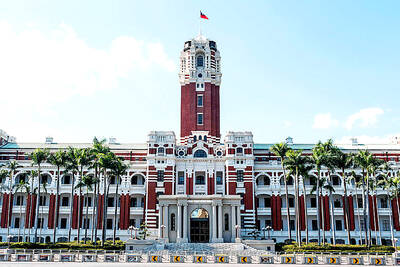
SECURITY: Taipei presses the US for arms supplies, saying the arms sales are not only a reflection of the US security commitment to Taiwan but also serve as a mutual deterrent against regional threats Taiwan is committed to preserving the cross-strait “status quo” and contributing to regional peace and stability, the Presidential Office said yesterday. “It is an undeniable fact that the Republic of China is a sovereign and independent democratic nation,” Presidential Office spokeswoman Karen Kuo (郭雅慧) reiterated, adding that Beijing has no right to claim sovereignty over Taiwan. The statements came after US President Donald Trump warned against Taiwanese independence. Trump wrapped up a state visit to Beijing on Friday, during which Chinese President Xi Jinping (習近平) had pressed him not to support Taiwan. Taiwan depends heavily on US security backing to deter China from carrying
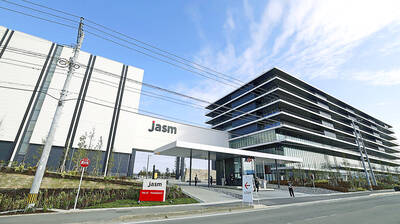
The subsidiary of Taiwan Semiconductor Manufacturing Co (TSMC, 台積電) in Kumamoto, Japan, turned a profit in the first quarter of this year, marking the first time the first fab of the unit has become profitable since mass production started at the end of 2024. According to the contract chipmaker’s financial statement released on Friday, Japan Advanced Semiconductor Manufacturing Inc (JASM), a joint venture running the fab in Kumamoto, posted NT$951 million (US$30.19 million) in profit in the January-to-March period, compared with a loss of NT$1.39 billion in the previous quarter, and a loss of NT$3.25 billion in the first quarter of
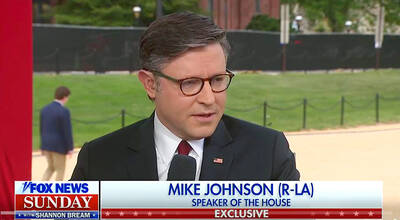
RESOLUTE BACKING: Two Republican senators are planning to introduce legislation that would impose immediate sanctions on China if it attempts to invade Taiwan US House of Representatives Speaker Mike Johnson on Sunday reaffirmed US congressional support for Taiwan, saying the US and “all freedom-loving people” have a stake in preventing China from seizing Taiwan by force. Johnson made the remarks in an interview with Fox News Sunday on US President Donald Trump’s summit with Chinese President Xi Jinping (習近平) last week. In an interview that aired on Friday on Fox News, just as Trump wrapped up a high-stakes visit to China, he said he has yet to green-light a new US$14 billion arms package to Taiwan and that it “depends on China.” “It’s a very good


 RSS
RSS