


In forceful and unyielding testimony, Attorney General John Ashcroft on Thursday defended the administration's array of anti-terrorism proposals and charged that some of the program's critics are aiding terrorists by providing "ammunition to America's enemies."
Emboldened by public-opinion surveys showing that Americans overwhelmingly support the administration's initiatives against terrorism, Ashcroft told the Senate Judiciary Committee, "To those who scare peace-loving people with phantoms of lost liberty, my message is this: your tactics only aid terrorists."
He said that people who were hoping that the kind of attacks that occurred on Sept. 11 would not be repeated "were living in a dream world."
Holding up what he said was a training manual for al-Qaeda, Ashcroft said that "terrorists are taught how to use America's freedoms as a weapon against us."
The Democratic critics on the committee were careful in their questioning and most laced their remarks with some support for the administration, even for the proposal thought to be the most controversial, the establishment of military tribunals to try terrorists. But they also sought to show the potential for abuse raised by the broad scope of the presidential order on tribunals and called for more Congressional involvement in drafting such initiatives.
Senator Russ Feingold, who has been the Senate's most resolute critic of the administration's anti-terrorism proposals, quickly took on Ashcroft over his testimony that criticism of the administration "gives ammunition to America's enemies, and pause to America's friends."
He asked the attorney general if the series of Senate hearings culminating in Thursday's session was somehow aiding the enemy.
Ashcroft blandly replied that he welcomed the Senate hearings as proper oversight.
"We need discourse as opposed to fear-mongering," he said.
"This is the place where reasoning and discourse take place."
Some of the sharpest questioning came over the Justice Department's refusal to provide the FBI with information about whether any of the more than 1,200 people who have been detained in the investigation of the Sept. 11 attacks had sought to purchase guns.
The New York Times reported Thursday that some FBI and other law enforcement officials were frustrated by the Justice Depart-ment's decision to block its investigators from examining records of gun buyers' background checks to determine whether any of the detainees had purchased guns.
"Why is the department handcuffing the FBI in its efforts to investigate gun purchases by suspected terrorists?" asked Senator Edward M. Kennedy.
Ashcroft said that he believed the law that created the national directory of gun purchase applications could not be used for anything other than an audit of the system.
"I believe we did the right thing in observing what the law of the United States compels us to observe," he said.
Senator Charles Schumer suggested that Ashcroft's reasoning was incorrect and the decision reflected the administration's opposition to gun control.
"You're looking for new tools in every direction and I support most of those," he said. "But when it comes to the area of even illegal immigrants getting guns and finding out if they did, this administration becomes as weak as a wet noodle."
Senator Richard Durbin said that Ashcroft was exquisitely sensitive to the Second Amendment's right to bear arms while he was arguing for flexibility on other constitutional guarantees. Kennedy later said that it appeared that Ashcroft was "putting the interests of the gun lobby above above the nation's public safety in the battle against terrorism."
Senator Patrick Leahy, who is chairman of the committee, aimed his criticism largely at the administration's unwillingness to consult with Congress on several of its initiatives including the military tribunals, the order allowing authorities to monitor conversations between some terrorist suspects in jail and their lawyers and the planned questioning of some 5,000 men, mostly from the Middle East, now living in the US.
"The division of power and the checks and balances built into our system help sustain and earn the public's confidence in the actions taken by the government," Leahy said, pleading for a more active role for Congress. He said that it was always difficult to raise questions about the behavior of the executive branch in wartime.
"But whether the administration's recent actions are popular or unpopular at the moment -- well, that's not the issue."
Leahy said Congressional oversight was not "as some have mistakenly described it, to protect terrorists."
"It is to protect ourselves as Americans and protect our American freedoms."
Senator Orrin Hatch of Utah, the ranking Republican on the committee, said in response that there was sometimes too much Congressional oversight. He dismissed complaints that the Congress had not been consulted, saying: "It's not that we don't have a solemn obligation to assess the department's actions to ensure that they are both effective and sufficiently protective of our civil liberties, but do any members of this committee really believe that in this time of crisis, the American people, those who live outside the capital beltway, really care whether the president, the secretary of defense or the attorney general took the time to pick up the telephone and call us, prior to implementing these emergency measures?"
Leahy said that some of the concerns about the military tribunal order had been allayed by comments over the last several days by administration officials who suggested it would be used more narrowly that its scope would allow.
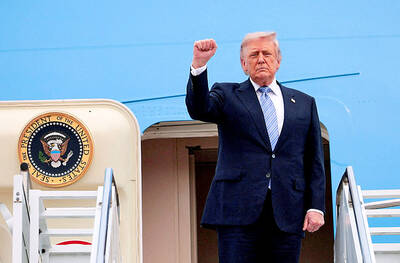
US-CHINA SUMMIT: MOFA welcomed US reassurance of no change in its Taiwan policy; Trump said he did not comment when Xi talked of opposing independence US President Donald Trump yesterday said he has not made a decision on whether to move forward with a major arms package for Taiwan after hearing concerns about it from Chinese President Xi Jinping (習近平). Trump’s comments on Taiwan came as he flew back to Washington after wrapping up critical talks in which both leaders said important progress was made in stabilizing US-China relations even as deep differences persist between the world’s two biggest powers on Iran and Taiwan. “I will make a determination,” Trump said, adding: “I’ll be making decisions. But, you know, I think the last thing we need right
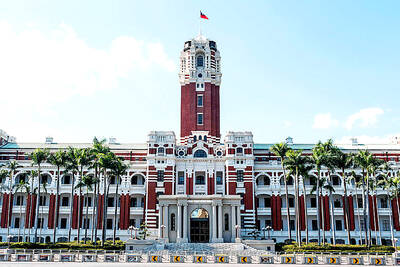
SECURITY: Taipei presses the US for arms supplies, saying the arms sales are not only a reflection of the US security commitment to Taiwan but also serve as a mutual deterrent against regional threats Taiwan is committed to preserving the cross-strait “status quo” and contributing to regional peace and stability, the Presidential Office said yesterday. “It is an undeniable fact that the Republic of China is a sovereign and independent democratic nation,” Presidential Office spokeswoman Karen Kuo (郭雅慧) reiterated, adding that Beijing has no right to claim sovereignty over Taiwan. The statements came after US President Donald Trump warned against Taiwanese independence. Trump wrapped up a state visit to Beijing on Friday, during which Chinese President Xi Jinping (習近平) had pressed him not to support Taiwan. Taiwan depends heavily on US security backing to deter China from carrying

The subsidiary of Taiwan Semiconductor Manufacturing Co (TSMC, 台積電) in Kumamoto, Japan, turned a profit in the first quarter of this year, marking the first time the first fab of the unit has become profitable since mass production started at the end of 2024. According to the contract chipmaker’s financial statement released on Friday, Japan Advanced Semiconductor Manufacturing Inc (JASM), a joint venture running the fab in Kumamoto, posted NT$951 million (US$30.19 million) in profit in the January-to-March period, compared with a loss of NT$1.39 billion in the previous quarter, and a loss of NT$3.25 billion in the first quarter of
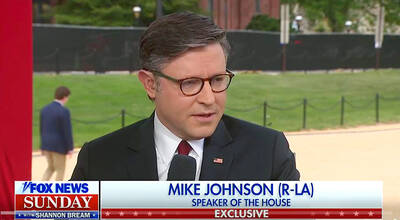
RESOLUTE BACKING: Two Republican senators are planning to introduce legislation that would impose immediate sanctions on China if it attempts to invade Taiwan US House of Representatives Speaker Mike Johnson on Sunday reaffirmed US congressional support for Taiwan, saying the US and “all freedom-loving people” have a stake in preventing China from seizing Taiwan by force. Johnson made the remarks in an interview with Fox News Sunday on US President Donald Trump’s summit with Chinese President Xi Jinping (習近平) last week. In an interview that aired on Friday on Fox News, just as Trump wrapped up a high-stakes visit to China, he said he has yet to green-light a new US$14 billion arms package to Taiwan and that it “depends on China.” “It’s a very good


 RSS
RSS