


Youngdoung Tenzin is living history of modern Tibet.
The Chinese government on Dec. 22 last year sanctioned him along with 19 other Canadians who were associated with the Canada Tibet Committee and the Uighur Rights Advocacy Project.
A former political chair of the Canadian Tibetan Association of Ontario and community outreach manager for the Canada Tibet Committee, he is now a lecturer and researcher in Environmental Chemistry at the University of Toronto.
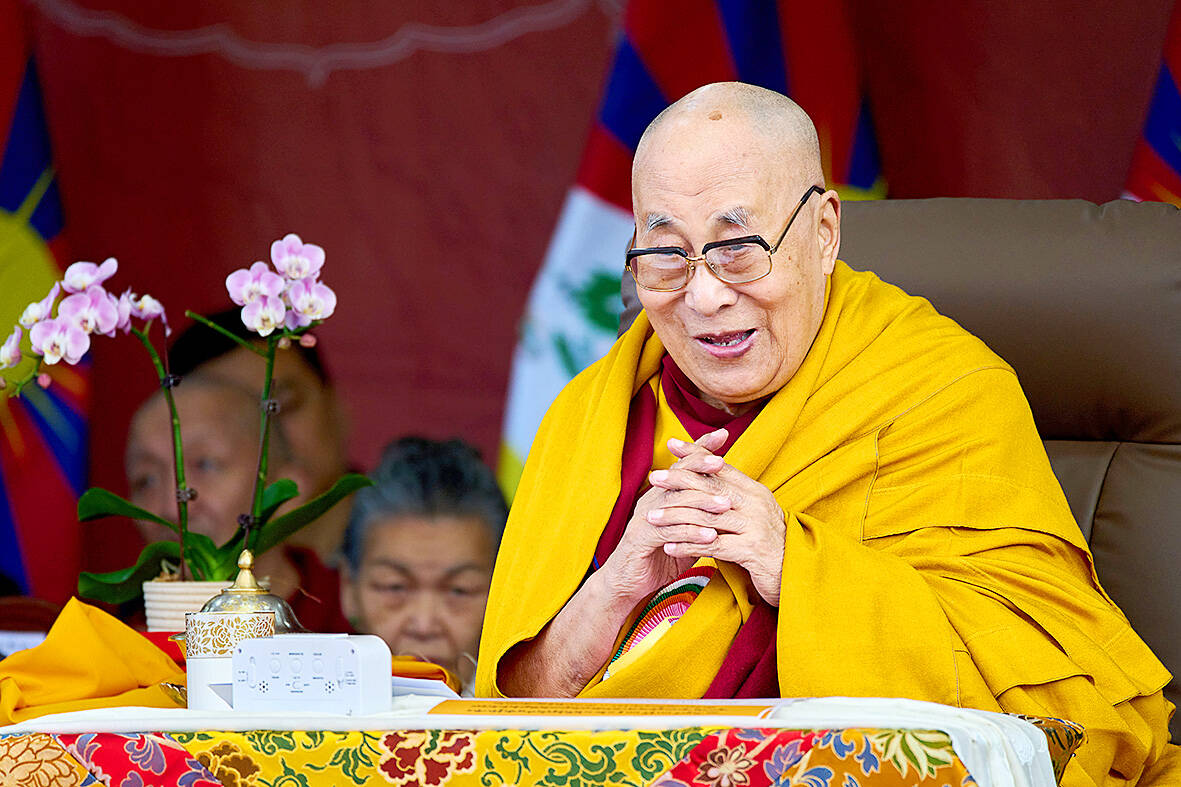
Photo: AP
“I was born into a nomadic Tibetan family in Tibet,” he says. “I came to India in 1999, when I was 11. I even met [His Holiness] the 14th the Dalai Lama after coming to India. But already at that age I could understand the repression Tibetans were facing in Tibet,” Tenzin tells the Taipei Times.
One of his uncles died during the Cultural Revolution, so even as a kid, he was already aware that Tibet was under occupation. Tenzin’s family has a long history of political action.
“My grandparents and uncles were involved in political movements in Tibet in the 1950s, and then again around the time of the Cultural Revolution. This is deep-rooted in my heart,” he says.
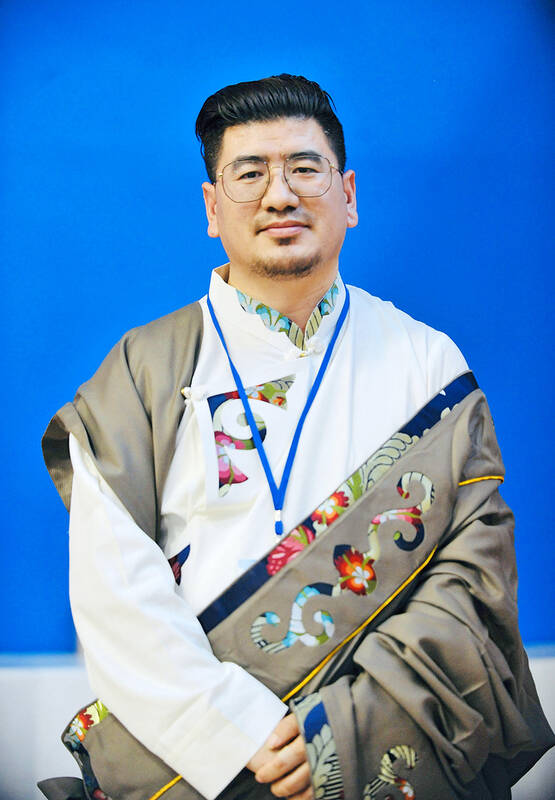
Photo courtesy of Youngdoung Tenzin
Tenzin names his meeting with the Dalai Lama as one of the best moments of his life.
“There were no Tibetan schools in my village. If I wanted to study in Tibet, I would have had to go to a Chinese school and learn Chinese and teach everything in Chinese. When I crossed the mountains with 43 other Tibetans, I was clear about what I wanted to do. I chose to study in the TCV Tibetan Children Village school Suja established by the Dalai Lama.”
In India, Tenzin was able to get an education that matched his culture. He studied up to Grade 12 in a Tibetan school in India and eventually received a PhD from Brandenburg University of Technology in Germany.
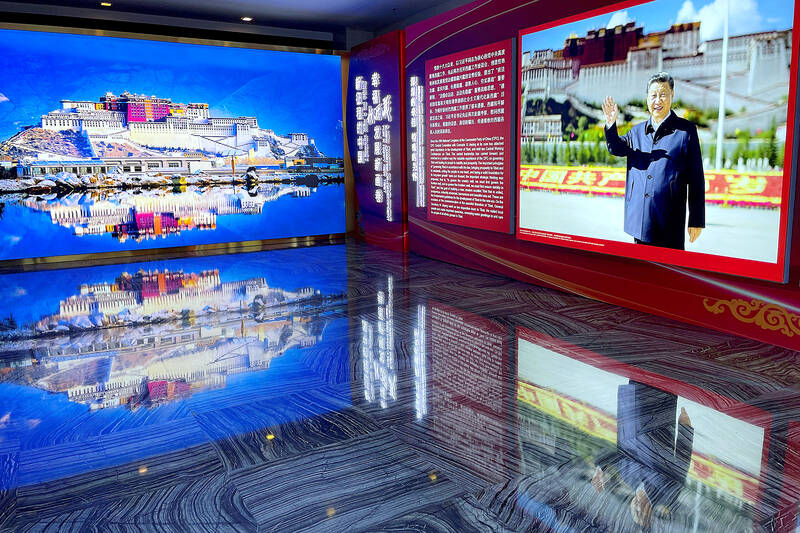
Photo: Reuters
DARK TURN
It was in India that he started his activism, but it took a darker turn in Germany.
“At an international student festival, I wore a Tibetan traditional dress and carried the Tibetan flag, and I was harassed by Chinese students. They told me Tibet is not a country and that I should carry the Chinese flag instead. I argued with them and had discussions.”
It was not in vain: “I was able to convince some of them,” he says.
But after this, more threats came from China, either from consular authorities or through social media, telling him his family in Tibet could face consequences.
This did not deter him, but it took a toll on him.
“By the end of 2019, I moved because of the threats I was facing in Germany. I tried to report it to the German police. Nothing happened, because I wasn’t a permanent resident or a citizen. In India, I had a resident certificate as a Tibetan that I had to renew once a year, so in Germany, I had no passport: I entered the country using a travel document from India.”
Tenzin then moved to Canada, because, he says, the Dalai Lama is an honorary citizen there, and there’s a large Tibetan community, where he became politically active between 2021 and 2023. In 2022, the Canadian Parliament called on China to engage with the Dalai Lama’s authorities.
But in the end, even after acquiring a Canadian passport, he was no safer than he had been in Germany.
“In Canada, it’s established that Chinese authorities are very influential in society. It was widely reported that there are Chinese police stations in Canada. We know they carry out transnational repression against us — Tibetans — as well as Uighurs, Taiwanese and Hong Kongers. I already understood this from the inside — the only difference now is that it reached me directly.”
Surprisingly, they did not limit themselves to threats: “they use this ‘hard’ way but also a ‘soft’ way,” he says. “I received messages from Chinese communities in the US and Canada who told me they could offer me good jobs with good pay if I stopped my activism. This is another way they try to silence you.”
CONSEQUENCES
Tenzin says that he fears for his family back home. He’s also been chased by a car and his social media accounts and phone have been hacked.
Indeed, the phenomenon is global. “China has infiltrated everywhere now, even in the US,” he says. “So there’s little point in going to Europe, the US or anywhere else. Chinese influence is everywhere.”
A recent investigation published by the Associated Press revealed how China provided Nepal with extensive technological means for surveillance, with cameras ubiquitous in its capital and a wide array of facial recognition and database tools to track down people. As a result, the number of Tibetans seeking refuge in Nepal has plummeted.
But Tenzin carries on.
“I keep doing this because around one million have died under the occupation, and hundreds have self-immolated. They are cracking down on scholars, writers, artists and singers. They even try to erase the name ‘Tibet’ itself. China tried to silence my voice but they failed because my spirit for Tibet is untouchable.”
For Tenzin, his story is a cautionary tale.
“China uses money and manpower inside democratic societies — Canada, Europe, the US — to repress communities. And it’s not only Tibetans. We should unite against Chinese repression.”

Michael slides a sequin glove over the pop star’s tarnished legacy, shrouding Michael Jackson’s complications with a conventional biopic that, if you cover your ears, sounds great. Antoine Fuqua’s movie is sanctioned by Jackson’s estate and its producers include the estate’s executors. So it is, by its nature, a narrow, authorized perspective on Jackson. The film ends before the flood of allegations of sexual abuse of children, or Jackson’s own acknowledgment of sleeping alongside kids. Jackson and his estate have long maintained his innocence. In his only criminal trial, in 2005, Jackson was acquitted. Michael doesn’t even subtly nod to these facts.
The March/April volume of Foreign Affairs, long a purveyor of pro-China pablum, offered up another irksome Beijing-speak on the issues and solutions for the problems vexing the People’s Republic of China (PRC) and the US: “America and China at the Edge of Ruin: A Last Chance to Step Back From the Brink” rang the provocative title, by David M. Lampton and Wang Jisi (王緝思). If one ever wants to describe what went wrong with US-PRC relations, the career of Wang Jisi is a good place to start. Wang has extensive experience in the US and the West. He was a visiting

The January 2028 presidential election is already stirring to life. In seven or eight months, the primary season will kick into high gear following this November’s local elections. By this point next year, we will likely know the Democratic Progressive Party (DPP) candidate and whether the Taiwan People’s Party (TPP) will be fielding a candidate. Also around this time, the Chinese Nationalist Party (KMT) will either have already completed their primary, or it will be heading into the final stretch. By next summer, the presidential race will be in high gear. The big question is who will be the KMT’s

One of the challenges with the sheer availability of food in today’s world is that lots of us end up spending many of our waking hours eating. Whether it’s full meals, snacks or desserts, scientists have found that it’s not uncommon for us to be mindlessly grazing at some point during all of our 16 or so waking hours. The problem? As soon as this food hits the bloodstream in the form of glucose, it initiates the release of the hormone insulin. This in turn activates a switch present in every one of our cells, which is responsible for driving cell


 RSS
RSS