


Like most people living in Taiwan, I’ve long been aware that the country has a small number of nuclear power stations, and that politicians and experts continue to argue about the future of atomic energy on this island. But until recently, I didn’t know that National Tsing Hua University (國立清華大學, NTHU) in Hsinchu has its own nuclear reactor.
In an article titled “Free China builds her first reactor,” the July 1961 issue of Free China Review reported that construction began in 1958. The following spring, “the equipment for the reactor arrived and actual engineering work was initiated to put the component parts together. With the insertion of enriched uranium fuel elements into the reactor core, the first nuclear reactor in Free China was finally brought to life on April 13 of this year.”
Reactor components were sourced from the General Electric Company, but local engineers were “exclusively” responsible for assembly, the article claims. They “modified certain specifications of the original plan to suit their own special needs … Where the original plan was found impractical, they improvised.”
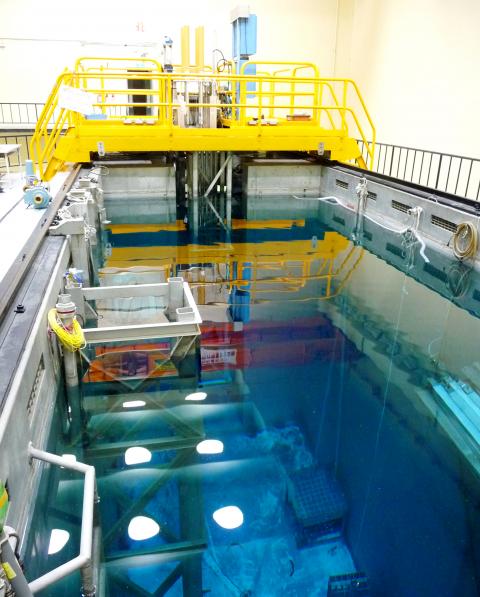
Photo by Steven Crook
According to the article, the reactor cost US$1.15 million, roughly US$10 million in today’s money. About a third of the budget came from the United States Atomic Energy Commission.
What’s known as the Tsing Hua Open-Pool Reactor (清華大學水池式反應器, THOR) is Taiwan’s only research reactor. Two others operated by NTHU, and three at the Taoyuan-based Institute of Nuclear Energy Research (核能研究所, INER), have been decommissioned and dismantled.
“Compared to nuclear power plants, research reactors are far simpler, and they generate much less waste, so decommissioning isn’t difficult,” Professor Yeh Tsung-kuang (葉宗洸), director of NTHU’s Nuclear Science and Technology Development Center, tells me before one of his colleagues gives me a tour of NTHU’s Nuclear Reactor Building.
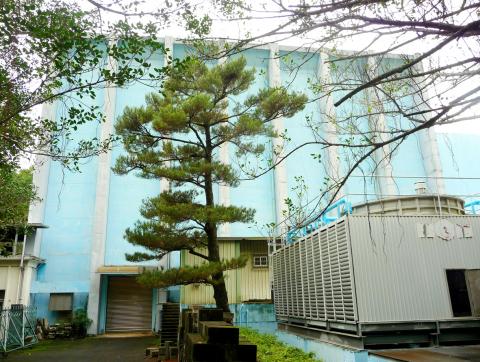
Photo by Steven Crook
Between the late 1960s and late 1980s, Taiwan hoped to arm itself with atom bombs. “Students have asked me, ‘Are we developing nuclear weapons here?’” Yeh says with a smile. “I’d tell them: ‘I hate to disappoint you, but, no, we’re not developing any on campus.’”
“When we’re working around the reactor, we always wear dosimeters,” explains nuclear technician Dr Lee Jin-der (李進得) as he leads me to THOR’s control room. “As you can see, the current radiation dose is about 0.15 microsieverts per hour, which is background radiation level. When the reactor is operating, there are always two people working here, and the level in the control room goes up to about 0.4. We don’t need to wear protective clothing. When you take a passenger jet, you’re exposed to much more radiation, around 2 microsieverts per hour.”
Inside the control room, which is smaller than many bedrooms, there’s a diagram which shows how water drawn from the municipal supply undergoes purification, enters the reactor’s high-power pool, flows into a clean-up tank that removes radioisotopes, proceeds to a heat exchanger for cooling, and then returns to the pool.
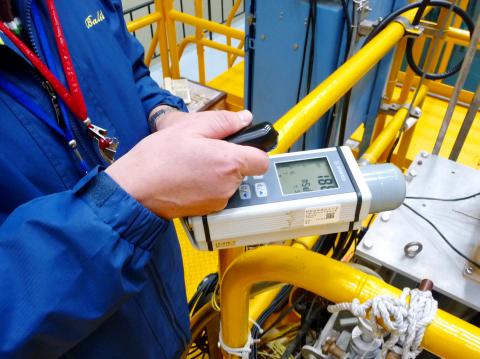
Photo by Steven Crook
Near an area radiation monitor displaying current levels of 15 categories of gamma and neutron radiation, Lee holds up a box of 3.5-inch diskettes: “We still use these to store data, because the computers were installed in 1993. We want to renew the system, but we don’t have enough money to do it,” he said, joking that if they ever run out of diskettes, they’d have to scour online auction sites to find new ones.
On the same side of the room, I notice a red button labeled “SCRAM.” If you’ve seen any nuclear-themed dramas, you’ll know this initiates an emergency shutdown of the reactor. The “UP” and “DOWN” buttons lift and lower the control blades, respectively increasing or reducing the rate of nuclear fission.
Another diagram shows the deployment of LEU (low enriched uranium) and STD (uranium sealed into zirconium alloy tubes) fuel rods, graphite, and vertical and horizontal tubes which are used for scientific experiments. Because the burnup rate is so slow, the reactor produces very little spent nuclear fuel compared to an atomic power station.
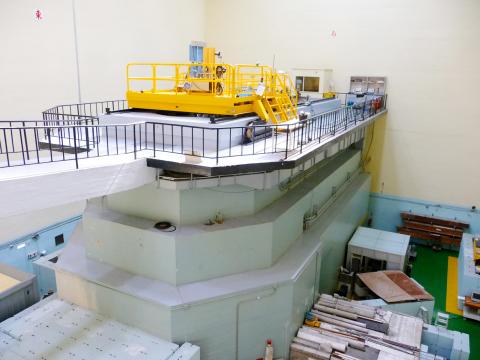
Photo by Steven Crook
When the reactor is operating, it produces radioactive gases including nitrogen-16 and argon-41. Most is removed to a hold-up tank for radioactive decay, while the remaining argon-41 (which has a half life of 109 minutes) is vented through the chimney, so as to reduce radiation exposure to those working around the reactor. The research reactor doesn’t produce any electricity; like the rest of NTHU’s campus, it depends on Taipower.
The control room overlooks the reactor, which fills much of a windowless hall 28.8m long, 22.6m wide, and 21.6m high. The core is suspended from a metal platform that sits above the rectangular pool. Lee demonstrates how, by using a hand crank, technicians can move this platform and the core to the low-power pool without exposing any of the fuel rods to the air. This is done whenever the high-power pool requires maintenance.
According to a safety analysis, even if there’s a complete loss of coolant from the 80,000-gallon (302,800-liter) pool and every control blade fails, there’d be no risk of a meltdown. The temperatures in the reactor core wouldn’t approach the safety limit temperature of 1,150 degrees Celsius, because the thermal power of THOR is just 2MW, compared to over 1,000MW for many nuclear power stations.
If you look into the pool when fission is underway, you’ll see a strikingly beautiful blue light. This is Cherenkov radiation, Lee explains. He points out that while standing so close isn’t standard procedure, it isn’t especially dangerous. The radiation exposure would be no worse than taking an international flight, because “10 meters of water is a very good barrier.”
Making our way down to the ground floor, we pause at a stack of hefty lead bricks used for additional shielding. This is the only location inside the building where Lee’s dosimeter shows any increase, registering 0.21 to 0.23 microsieverts per hour.
Beside the reactor, a suite of rooms has been constructed using high-density concrete blocks which incorporate lead. This is where NTHU’s reactor team has been working with doctors from Taipei Veterans General Hospital and scientists at Kyoto University to develop Boron Neutron Capture Therapy (BNCT), a type of cancer treatment that shows considerable promise.
People afflicted with hopelessly advanced head or neck tumors have traveled to NTHU, received injections of a drug containing boron-10 (which concentrates in tumor cells), and had their tumors irradiated with beams of low-energy neutrons. The alpha particles and lithium-7 produced by BNCT kill tumor cells while leaving normal cells largely unaffected.
Most of the patients thus treated responded well after just one treatment. Conventional radiotherapy, by contrast, usually consists of five or more treatments per week for several weeks. Also, BNCT seems not to cause serious adverse reactions. As the work being done at THOR shows, there’s a great deal more to nuclear science than making bombs and generating electricity.
Steven Crook has been writing about travel, culture, and business in Taiwan since 1996. He is the co-author of A Culinary History of Taipei: Beyond Pork and Ponlai, and author of Taiwan: The Bradt Travel Guide, the third edition of which has just been published.

Taiwan’s English education system is being pulled apart by three opposing forces. Bilingual Nation 2030 pulls students toward English and global communication. Artificial Intelligence (AI) readiness pulls them toward digital judgment, verification and AI-mediated work. But Taiwan’s old exam culture pulls them back toward memorization, grammar drills, timed reading and correct answers. If the education system keeps using old exams to define success, it risks producing graduates who are neither genuinely bilingual nor genuinely AI-ready, but trained for tasks machines can already perform. The first force is Bilingual Nation 2030. Launched in 2018, the policy aimed to “help Taiwan’s workforce connect
It seems every few days one bumps into one of those “real man” comments in which Taiwan is urged to “face reality” or similar, and “make a deal,” with the speaker implying that soon it will be too late. “Deal” advocates always present themselves as having a superior grip on reality, and the manly ability to make the “hard choice.” Their testosterone-laden language often echoes that of Taiwan sellout advocates. Note that such commentary always specifies a process (“make a deal, work with, make progress”), never the end state of what occupation by a violent authoritarian colonialist state will entail. In
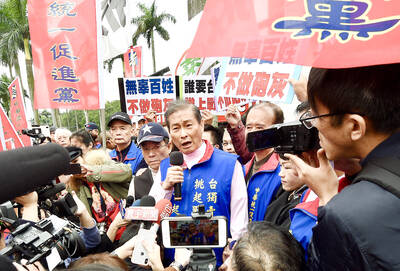
There are shadowy cabals plotting to sell out Taiwan to be annexed by China, by invasion if necessary. Fortunately, they are buffoons. In 2019, former Bamboo Union gangster and founder of the China Unification Promotion Party (CUPP), Chang An-le (張安樂, colorfully known as “White Wolf”), led a protest at the Legislative Yuan against comments made by then-premier Su Tseng-chang (蘇貞昌) that in the event of an attack by China, he would never surrender, but would protect the nation by fighting to the end, even if he only had a broom. Chang had party members bring a wooden casket that they
June 1 to June 7 "If all Taiwanese were as afraid of dying as you, then what would happen?” Physician Shih Chiang-nan (施江南) reportedly said this to his wife Chen Chiao-tung (陳焦桐) after she urged him to stop intervening on behalf of Taiwanese soldiers stranded overseas after serving in the Japanese Army during World War II. Shih had clashed with high-ranking officials over the issue, engaged in several heated arguments with Taiwan governor-general Chen Yi (陳儀) and allegedly shouted at general Ko Yuan-fen (柯遠芬), chief of staff of the Taiwan Garrison Command, over


 RSS
RSS