


I wonder how many Taiwanese are aware that the dominant theory about the spread of Micronesian peoples throughout the entire Pacific region, as far south as the Maori people of New Zealand, holds that their ultimate origins were the Aboriginal people of Taiwan?
The evidence is genetic (notably mitochondrial DNA, which can be used to trace descent through the female line over long periods) and linguistic, and the attribution of the origin of all these diverse movements to the Taiwanese Aboriginals is heavily favored by experts. In May last year, for instance, officials in Taiwan and New Zealand came together to deal with the issue, signing a document — “Arrangement on Cooperation on Indigenous Issues” — to establish a forum for contacts between Taiwan’s indigenous communities and the New Zealand Maori.
All in all it’s an extraordinary phenomenon, and something all Taiwanese should be both aware and proud of. New Zealand author Jeff Murray is a particular enthusiast for the concept, and it’s mentioned several times in his recently published novel Melt, an important and intriguing work.

The migration of the Taiwan’s indigenous communities was necessarily southwards, and this story, set in 2048, continues in that direction, with one of their descendants, a woman called Vai, going from the southern tip of New Zealand into the Antarctic.
It begins, though, with an eight-day storm over a Pacific island that persuades many of its inhabitants to migrate to safety in New Zealand, despite the arrival of aid from China. In doing so, one of them says, they are continuing the migration of their remote ancestors, indigenous people from Taiwan.
But their problems are not over once they’re in New Zealand. There is overcrowding — 20 migrants in a two-room apartment, tuberculosis, legal issues and the government’s intention that they should only stay a short time before returning to an island they deem uninhabitable.
In addition, the temporary accommodation they’re offered is deeply unattractive, afflicted by drought or flooding, not close to any likely work, and places that regular New Zealanders wouldn’t be willing to live in.
But they do attend a meeting that important employers are due to attend. Global warming was making the Antarctic more important, they learn, so the towns of southern New Zealand like Dunedin were going to become busier and offer more job opportunities. The migrants at the center of this tale therefore decide to try to settle there.
Vai then makes contact with the captain of a vessel due to leave for Antarctica, which he views as a lawless place still open to unprincipled adventurers. The ship has a water cannon that can kill anything within 20 meters. She signs up as a crew member.
As soon as the narrative moves to the Southern Ocean, the novel leaps to life. The ship’s purpose is to intercept vessels involved in illegal fishing and whaling, and its first encounter is with five South African fishing boats. The New Zealanders successfully cut their nets. Next they encounter a Japanese whaler which they sink. A Japanese navy ship threatens but, seen by a worldwide TV audience, they are saved by a Chinese destroyer that offers to escort them back to Dunedin.
This section includes some conversations between Vai and the boat’s captain, which encapsulates interesting theories on environmental activism. Violence is often necessary, the captain insists. He’s essentially a vagrant, though he’s based in Goa where, according to his tales, life is not as peaceful as it may seem.
From being a piece of sociological analysis, the novel has now become a thrilling narrative. It would be wrong to give away too much of what happens next, but Vai befriends a wealthy woman of Maori extraction with good government connections. But will their friendship last? The Chinese have their eyes on Antarctica, Vai hears, and view southern New Zealand as a natural jumping-off point.
From Dunedin she eventually returns to the Antarctic, to an unclaimed area called Marie Byrd Land, where there’s a major Chinese settlement named Beijing (which she thinks of as dominated by rats).
The Cambridge-educated, Auckland-based author has told me that China is viewed neutrally in this, his ambitious but ecologically aware first novel.
Russia is involved in the Arctic, the UK is under the influence of India because of their shared history and the “big three” as far as the development of the Antarctic is concerned are the US, India and China.
Refugees and climate change are this novel’s two main concerns. New Zealand is the same size as the UK, but it has only six million people (in 2048), whereas the UK has something like 80 million. Why isn’t New Zealand taking more refugees, someone asks.
“I see all the refugee camps and I see the future,” Vai, says, clearly echoing the author’s feelings. “I see the most courageous, diverse, determined people in the world, all birthed in a crucible. And they belong to no land, but they form a new society. They are an embryo of a global society, one that has its roots everywhere. We’re a new type of nation, one hundred million strong, and we’re the future for a world that needs to be global.”
Melt is a strong novel, perceptive on how individuals in government think and work, vivid in its description of natural landscapes and the impersonality of climate change and everywhere probing and thoughtful. Putting a woman at the center of the action, and seeing most things through her eyes, was a brave move for a male author, and it pays off.
This is the kind of novel that will appeal to climate-change activists everywhere, people like Taiwan’s Dan Bloom who has been whistling in the wind down in Chiayi hoping for the appearance of just such a book as Melt, and here it is. But this is not a scare story about climate catastrophe, but rather one that takes its likely economic and political results seriously. It’s an important addition to what is sure to become a growing genre.

Taiwan’s English education system is being pulled apart by three opposing forces. Bilingual Nation 2030 pulls students toward English and global communication. Artificial Intelligence (AI) readiness pulls them toward digital judgment, verification and AI-mediated work. But Taiwan’s old exam culture pulls them back toward memorization, grammar drills, timed reading and correct answers. If the education system keeps using old exams to define success, it risks producing graduates who are neither genuinely bilingual nor genuinely AI-ready, but trained for tasks machines can already perform. The first force is Bilingual Nation 2030. Launched in 2018, the policy aimed to “help Taiwan’s workforce connect
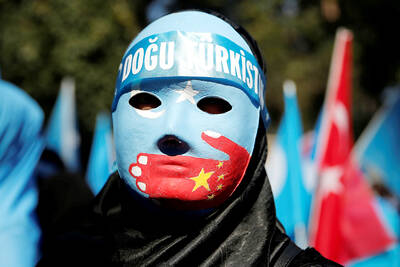
It seems every few days one bumps into one of those “real man” comments in which Taiwan is urged to “face reality” or similar, and “make a deal,” with the speaker implying that soon it will be too late. “Deal” advocates always present themselves as having a superior grip on reality, and the manly ability to make the “hard choice.” Their testosterone-laden language often echoes that of Taiwan sellout advocates. Note that such commentary always specifies a process (“make a deal, work with, make progress”), never the end state of what occupation by a violent authoritarian colonialist state will entail. In

There are shadowy cabals plotting to sell out Taiwan to be annexed by China, by invasion if necessary. Fortunately, they are buffoons. In 2019, former Bamboo Union gangster and founder of the China Unification Promotion Party (CUPP), Chang An-le (張安樂, colorfully known as “White Wolf”), led a protest at the Legislative Yuan against comments made by then-premier Su Tseng-chang (蘇貞昌) that in the event of an attack by China, he would never surrender, but would protect the nation by fighting to the end, even if he only had a broom. Chang had party members bring a wooden casket that they
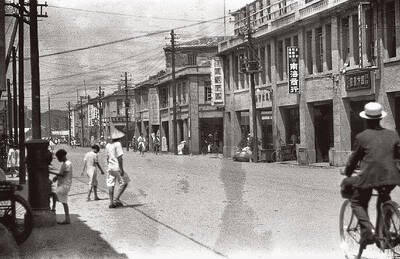
June 1 to June 7 "If all Taiwanese were as afraid of dying as you, then what would happen?” Physician Shih Chiang-nan (施江南) reportedly said this to his wife Chen Chiao-tung (陳焦桐) after she urged him to stop intervening on behalf of Taiwanese soldiers stranded overseas after serving in the Japanese Army during World War II. Shih had clashed with high-ranking officials over the issue, engaged in several heated arguments with Taiwan governor-general Chen Yi (陳儀) and allegedly shouted at general Ko Yuan-fen (柯遠芬), chief of staff of the Taiwan Garrison Command, over


 RSS
RSS