


Sept. 16 to Sept. 22
Chen Yu-lan’s (陳玉蘭) extended family lived in tents on the streets of Taichung for almost three weeks following the devastating 921 Earthquake of 1999. Their landlord evicted them from their rented apartment after it was damaged, and having nowhere else to go, the Aboriginal Amis family was running out of options.
Many shared Chen’s fate after the disaster. Lai Ta-ming (賴大明), a 70-year-old who lived alone, lost all his possessions and stayed in a tent for almost four months before a cold front prompted him to seek better options.
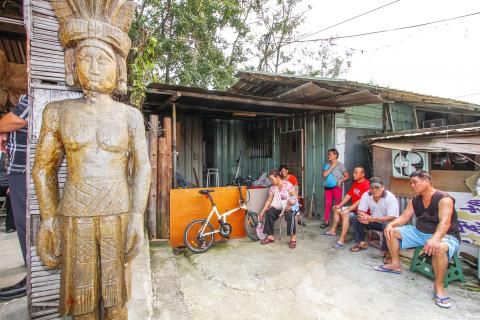
Photo: Huang Chung-shan, Taipei Times
The 7.3-magnitude earthquake struck at 1:47am on Sept. 21, 1999, causing widespread destruction and killing 2,415 people, while injuring 11,305. According to government compensation data, a total of 103,961 households were displaced.
Those who lost their home were offered three options by the government: live in a temporary prefabricated community, receive rent compensation or purchase public housing at a 30 percent discount.
The prefab houses were only meant to be used for a few years, but one community that still exists today is Puti Changching Village (菩提長青村) in Nantou County, which is composed of elderly residents who lost their homes in the earthquake. Originally a temporary site, the village was transformed into an experimental independent elderly community, whose residents were allowed to stay. This is where Lai went after leaving his tent.
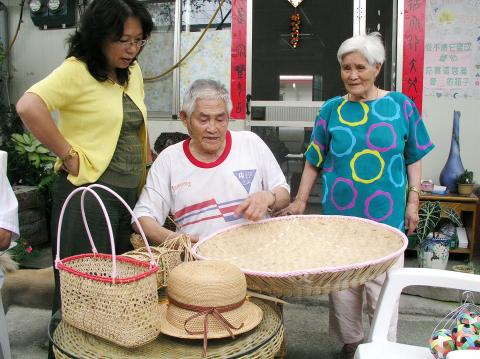
Photo: Tung Chen-kuo, Taipei Times
Chen’s family found a new home in Huatung New Village (花東新村), located in Taichung’s Wufeng District (霧峰). It was comprised of people from the Amis indigenous community living in the Taichung area who didn’t know each other, but came together after the disaster. They built their own temporary homes, and after waiting for 19 years, their village was given a makeover this year.
ELDERLY REFUGE
Volunteers to the disaster-struck areas soon noticed that there were many elderly living alone in tents, half destroyed homes or in shipping containers. Their relatives, if they had any, were either estranged or preoccupied with rebuilding efforts.
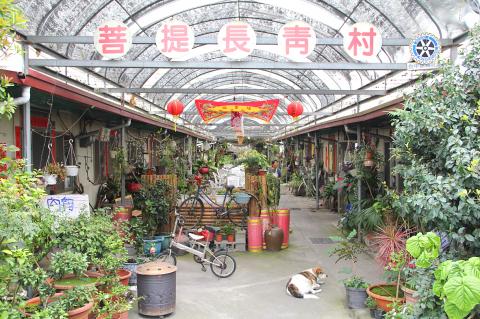
Photo: Tung Chen-kuo, Taipei Times
A Buddhist monk took them in, offering both shelter and food in a religious building in Puli Township (埔里), about 60km from the epicenter. The monk eventually entrusted them to the care of Chen Fang-tzu (陳芳姿), a local volunteer who lost both her and her husband’s businesses in the earthquake. Chen convinced the Puli government to rent land from the Taiwan Sugar Corporation to build a temporary prefab village for these residents.
Puti Changching, which means “Evergreen Bodhi,” was inaugurated on March 11, 2000, with construction funded by Oversea-Chinese Banking Corp and YWCA staff. It had 50 residential units and 25 public facilities, and residents enjoyed free rent, meals and utilities. Chen became the village’s first chief, dedicating her time and resources along with her husband, Wang Tzu-hua (王子華), to fundraising and ensuring quality living for the residents. External support was plenty, but Chen hoped that the residents could also earn income through selling crafts and other activities.
Despite everything being free, the residents were expected to contribute to the community. The able-bodied ones grew their own vegetables, worked on a flower garden and did their own laundry and cleaning. Each resident was also responsible for communal chores such as raising chickens or sweeping. Wang says that the residents were especially grateful to receive help from so many strangers, which motivated them to help out as much as they could. This boosted their self-worth and strengthened the sense of community, which was especially important to those who were already marginalized before the disaster.
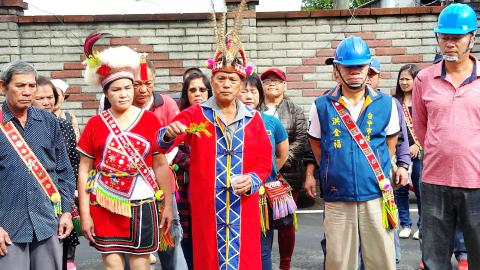
Photo: Chen Chien-chih, Taipei Times
The village contained a library, karaoke room and pottery classroom, and volunteer groups frequently visited to lead activities while Taichung Veterans General Hospital provided medical and mental health aid.
Hoping to rely less on outside funding, the residents sold vegetables, tofu and handmade crafts at markets, and also served coffee and food to visitors. They also catered events.
Although Puti Changching’s reputation grew quickly, it faced an uncertain fate, as these prefab villages were legally allowed to operate for a maximum of four years.
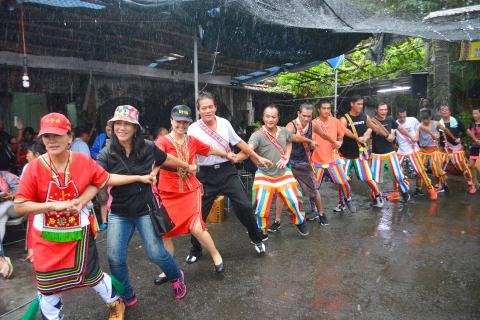
Photo: Chen Chien-chih, Taipei Times
By 2006, all prefab villages were demolished, save for two. For the first, the landlord said residents could remain, and the second was Puti Changching. That year, National Chi Nan University (國立暨南國際大學) took over the village as an “experimental site” for its social work and public administration departments, giving it a new lease on life.
The village still thrives today.
ABORIGINAL COHESION
The Amis of Taichung who settled at Huatung New Village were mostly temporary migrant laborers. Not having much to begin with, they lost even more in the disaster. In Chen’s case, since they didn’t qualify for government assistance, when the landlord asked them to move out, there was nowhere to go.
Through the city’s Indigenous Peoples Department (府原住民事務委員會), a group of six Amis households were allotted a piece of government land for temporary shelter. Due to their trade, they had the ability to construct their own homes using mostly scrap material from the rubble, constructing the first 22 units within 20 days.
Despite no formal planning, the village was built with two public plazas, a performance stage and a basketball court. Eventually, word spread and more displaced Amis arrived in the village, including Chen and her family.
“We just built these structures based on what we thought a house should look like. We used very rudimentary techniques since we thought we wouldn’t be here for more than a year,” Chen says in the study, “The Development of Huatung New Village in Wufeng” (霧峰花東新村的發展) by Chien Hung-che (簡宏哲).
After realizing that almost all the residents originated from the Amis homeland of Hualien and Taitung, it was given the portmanteau “Huatung” New Village.
Chien writes that since most villagers didn’t qualify for assistance, they would have nowhere to go if the village was demolished. After living together for so long, the villagers developed close bonds and became determined to stay as long as they could, fighting for years to have their dilapidated village rebuilt on site. However, the land belonged to the central government, turning the issue into a dispute that dragged on for years.
However, the Taichung City Government in October last year reached a deal with the central government. With the Buddhist Compassion Relief Tzu Chi Foundation agreeing to pay for new, proper houses for the villagers, construction broke ground in November, drawing a close to the 19-year saga.
Taiwan in Time, a column about Taiwan’s history that is published every Sunday, spotlights important or interesting events around the nation that have anniversaries this week.
Taiwan has next to no political engagement in Myanmar, either with the ruling military junta nor the dozens of armed groups who’ve in the last five years taken over around two-thirds of the nation’s territory in a sprawling, patchwork civil war. But early last month, the leader of one relatively minor Burmese revolutionary faction, General Nerdah Bomya, who is also an alleged war criminal, made a low key visit to Taipei, where he met with a member of President William Lai’s (賴清德) staff, a retired Taiwanese military official and several academics. “I feel like Taiwan is a good example of
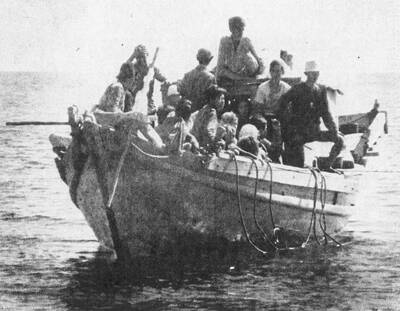
March 2 to March 8 Gunfire rang out along the shore of the frontline island of Lieyu (烈嶼) on a foggy afternoon on March 7, 1987. By the time it was over, about 20 unarmed Vietnamese refugees — men, women, elderly and children — were dead. They were hastily buried, followed by decades of silence. Months later, opposition politicians and journalists tried to uncover what had happened, but conflicting accounts only deepened the confusion. One version suggested that government troops had mistakenly killed their own operatives attempting to return home from Vietnam. The military maintained that the
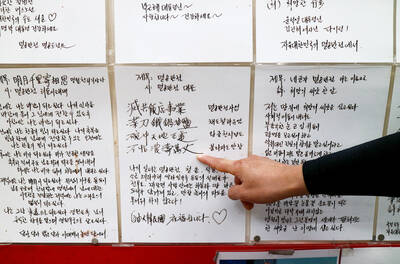
“M yeolgong jajangmyeon (anti-communism zhajiangmian, 滅共炸醬麵), let’s all shout together — myeolgong!” a chef at a Chinese restaurant in Dongtan, located about 35km south of Seoul, South Korea, calls out before serving a bowl of Korean-style zhajiangmian —black bean noodles. Diners repeat the phrase before tucking in. This political-themed restaurant, named Myeolgong Banjeom (滅共飯館, “anti-communism restaurant”), is operated by a single person and does not take reservations; therefore long queues form regularly outside, and most customers appear sympathetic to its political theme. Photos of conservative public figures hang on the walls, alongside political slogans and poems written in Chinese characters; South
Taipei Mayor Chiang Wan-an (蔣萬安) announced last week a city policy to get businesses to reduce working hours to seven hours per day for employees with children 12 and under at home. The city promised to subsidize 80 percent of the employees’ wage loss. Taipei can do this, since the Celestial Dragon Kingdom (天龍國), as it is sardonically known to the denizens of Taiwan’s less fortunate regions, has an outsize grip on the government budget. Like most subsidies, this will likely have little effect on Taiwan’s catastrophic birth rates, though it may be a relief to the shrinking number of


 RSS
RSS