


Is it really characteristic of Taipei, or Taiwan generally, that people avoid certain buildings because of fear of ghosts, that student suicides increase at the examination season, and that ghosts are believed capable of following you to Shanghai or even California?
Alvin Lu’s The Hell Screens was first published in 2000 by Four Walls Eight Windows and then went out of print. But earlier this month Taiwan’s ever-adventurous Camphor Press re-issued it, possibly to coincide with the Chinese Ghost Month. The novel is certainly concerned with ghosts on almost every page, and is set during Ghost Month, even though the actual existence of supernatural phenomena is never taken for granted.
Alvin Lu was born, and spent most of his life, in California. But his family’s origins are Taiwanese, and this novel takes place almost exclusively in Taipei.
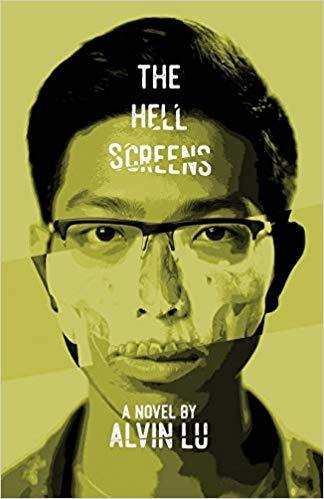
A block of apartments built over a graveyard, a fugitive taxi-driver, K, alleged to be a killer and rapist, a photographer named Fatty who wants to photograph a ghost and Wang who is trying to exorcise any spirits that may be around, plus someone aspiring to emigrate to the US — thus The Hell Screens begins.
“I saw myself no longer in contemporary Taipei but in the ghost city on which it based itself, in its imagination, if cities dream,” muses the narrator.
At the center of the tale is the narrator’s pursuit of a girl, Sylvia, who he thinks may be a ghost. She wonders if she was K’s former lover, but can’t be sure. Either way, her hands are unusually cold (said to be a characteristic of ghosts) and the narrator has trouble warming his after leaving her.
The narrator also has trouble with his contact lenses, a problem that fits neatly into his vision becoming ever more hallucinatory as the novel progresses.
There’s also reference to one Chuang Tian-yi, an eccentric left-wing film-maker, now reputed to be, not dead as some had assumed, but alive and living in Los Angeles.
At one stage the narrator goes on an excursion into the mountains, still experiencing problems with his contact lenses (one of them would “flick out with a strong blink”). There he encounters a variety of recluses, dog-ghosts and a blue-colored woman, who he presumes to be a ghost as well.
Back in the city things don’t get any better. A typhoon is raging, and ghost-like figures are everywhere. The narrative now gets truly convoluted, with random horrors such as a glimpsed newspaper headline “Deformed birth. Bones in eyes.”
The feeling now is that here is an intelligent writer who has opted to avoid saner options and instead pursue the remembered scenes of a nightmare.
Occasionally there are flashes of genuine Taiwan history — there’s a power outage, and the authorities are “proposing the building of another nuclear reactor along an earthquake fault because nobody wanted it anywhere else.”
In addition, the search for the elusive K continues. A friend has advised that the story here has echoes of the notorious case of Chen Chin-hsing (陳進興) from 1997, in which a South African military attache was taken hostage in Taipei. This may well be the case, with K standing in for Chen.
The predominant impression is of a polluted, ghost-filled gloom, from which figures emerge, talk, drink wine, then disappear again until some later phase of the story. At one point the narrator talks of “the island’s indefinability, its most elusive spirit”, and after completing this book you certainly know what he means.
This book seems to me a sport, a strange, elusive one-off that’s hard to pin down yet cannot be forgotten. But it’s hard to imagine a sequel.
Dreams and reality are constantly intermingling. The narrator lies on a bed and sees “blurred figures … they could have been outfitted with cat’s eyes, dog’s heads, horse’s heads, cow’s heads, snake’s heads. One of them, I did see, wore sunglasses and resembled a plump judge of hell … ” This is by no means untypical.
Yet there’s always a question mark. “When I was an ocean away in a place called home [i.e. the US], my bodily illness wouldn’t be diagnosed as possession by ghost.” But a Taiwanese comments “Because we live here, drowning in these myths, we attribute everything to spirits.”
Camphor’s John Ross, when offering this novel for review, said he didn’t think of it as a ghost story, but rather a thriller with ghost elements. I beg to differ. There’s scarcely a page in this book where ghosts aren’t mentioned, discussed or perhaps encountered, whereas pages dealing with K, presumably what Ross means by the thriller element, constitute only around 10 percent of the narrative. Moreover, these pages aren’t especially thrilling.
I literally lost sleep over this novel. How was I to review it without insulting both the author and Camphor Press? The author admits it’s “disorienting,” and I have to say I’ve never been so disoriented.
The tale begins in the middle of a situation that’s never properly explained, and ends equally abruptly. What this implies is that the book lacks structure, and this was everywhere confirmed. I wondered throughout just what, exactly, was going on. And when I finally got to the end I was honestly none the wiser.
The problem with ghosts in literature is that they tend to take over from the realistic elements. This is perhaps why Shakespeare gave his Ghost in Hamlet (which legend has it he played himself) a special, sepulchral tone in order to isolate it from the rest of the action.
So, tossing and turning in my bed, and thinking of the ghosts in Hamlet, Macbeth and Julius Caesar (you don’t have ghosts in comedies), I remembered the great Yale scholar Harold Bloom saying that of Shakespeare’s 37 plays, 29 were masterpieces. So what were the eight that failed to attain this elevated status? Timon of Athens for sure, Henry VI Part One presumably, Two Gentlemen of Verona, Pericles perhaps … and finally I dropped off to sleep without ever completing my list of eight. But my eventual slumber was no thanks to Alvin Lu or The Hell Screens.

What was the population of Taiwan when the first Negritos arrived? In 500BC? The 1st century? The 18th? These questions are important, because they can contextualize the number of babies born last month, 6,523, to all the people on Taiwan, indigenous and colonial alike. That figure represents a year on year drop of 3,884 babies, prefiguring total births under 90,000 for the year. It also represents the 26th straight month of deaths exceeding births. Why isn’t this a bigger crisis? Because we don’t experience it. Instead, what we experience is a growing and more diverse population. POPULATION What is Taiwan’s actual population?
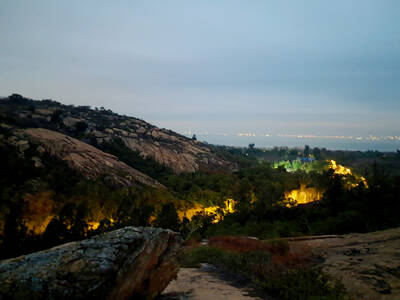
For the past five years, Sammy Jou (周祥敏) has climbed Kinmen’s highest peak, Taiwu Mountain (太武山) at 6am before heading to work. In the winter, it’s dark when he sets out but even at this hour, other climbers are already coming down the mountain. All of this is a big change from Jou’s childhood during the Martial Law period, when the military requisitioned the mountain for strategic purposes and most of it was off-limits. Back then, only two mountain trails were open, and they were open only during special occasions, such as for prayers to one’s ancestors during Lunar New Year.
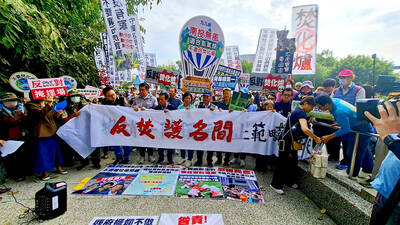
A key feature of Taiwan’s environmental impact assessments (EIA) is that they seldom stop projects, especially once the project has passed its second stage EIA review (the original Suhua Highway proposal, killed after passing the second stage review, seems to be the lone exception). Mingjian Township (名間鄉) in Nantou County has been the site of rising public anger over the proposed construction of a waste incinerator in an important agricultural area. The township is a key producer of tea (over 40 percent of the island’s production), ginger and turmeric. The incinerator project is currently in its second stage EIA. The incinerator

It sounded innocuous enough. On the morning of March 12, a group of Taichung political powerbrokers held a press conference in support of Deputy Legislative Speaker Johnny Chiang’s (江啟臣) bid to win the Chinese Nationalist Party (KMT) primary in the Taichung mayoral race. Big deal, right? It was a big deal, one with national impact and likely sent shivers down the spine of KMT Chairwoman Cheng Li-wun (鄭麗文). Who attended, who did not, the timing and the messaging were all very carefully calibrated for maximum impact — a masterclass in political messaging. In October last year, the Democratic Progressive Party (DPP)


 RSS
RSS