


Two dance programs in Taipei this weekend focus on questions of identity, experimentation and creation.
Taiwan Made (台灣製造) by dancer/choreographer Lin Juju’s (林祐如) is at the National Experimental Theater as the third installment in the National Theater Concert Hall’s (NTCH) Ideas Lab series, while at a performance space off Linsen N Road will be the site of White Dance Theater’s (白蹈場) NEWID Vol. 2.
Lin, a Taipei National University of the Arts (TNUA, 國立臺北藝術大學) alumnus and a great dancer herself, has over the past few years been building a portfolio of interesting, often quirky works as a freelance choreographer, both in Taiwan and abroad.
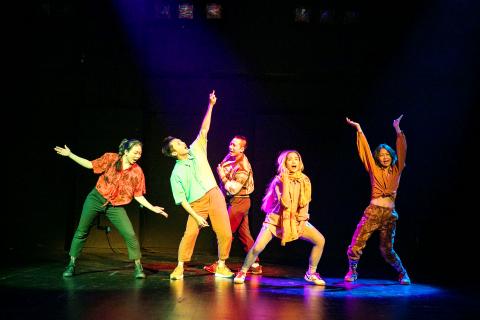
Photo courtesy of Chou Jia-hui
Her latest, which evolved during her stint as an NTCH artist-in-residence last year that included a trip to France to perform at the Rencontres choregraphiques internationales de Seine-Saint-Denis, looks to be just as intriguing.
Lin’s travels and experiences abroad as a performer, a creator and just an ordinary tourist led her to ponder the perceptions of identity, culture and connections: just what is meant by the name “Taiwan.”
Is it the name of an island, a nation, an identity of a people? Is it a collection of different ethnic groups, cultures and memories? What has enabled it to transform and to integrate different elements over the centuries?
Lin recruited five friends, who come from different backgrounds and work in different styles of dance, for the project: Huang Huai-te (黃懷德), Su Ping-wen (蘇品文), Hsiao Dong-yi (蕭東意), Lee Lu (李律) and Wang Chu-hua (王筑樺).
Given that they all have their own choreographic experience, she wanted the five to be more collaborators than just hired performers, mirroring how different elements have come together over the years to interact and influence the shape of Taiwan today, just as it has shaped their bodies and minds.
Lin drew on their ideas about life to create a show that seeks to explain “Taiwan in their eyes.”
RECREATING AN IDENTITY
The other program, the second installment of White Dance Theater’s NEWID sees four artists from different disciplines come together, each presenting a 15-minute solo work designed to challenge themselves and their audiences, who are to be included in the piece.
The question it poses is how does an artist recreate a new identity for themselves?
The idea behind the program was a quote attributed to US Pop art pioneer Andy Warhol that “in the future, everyone will be world-famous for 15 minutes.” It appeared in a brochure for a 1968 exhibition of his work at the Moderna Museet in Stockholm, Sweden, but in the decades since others have claimed to have coined it and Warhol reportedly said in 1980 that he had never actually said it.
Regardless, it is firmly attached to the Warhol brand, and fits neatly into today’s selfie and Instagram-obsessed culture.
The four artists are Chen Chiu-yen (陳秋燁), Shi Yu-che (施豫澤), Lu Yi-chieh (陸伊潔) and Palmer Mathews.
Audience members who purchase the NT$1,000 sponsor ticket will be able to participate in a physical introduction workshop with the artists before the show and also help lead the audience portions of each performance during the show.

This month the government ordered a one-year block of Xiaohongshu (小紅書) or Rednote, a Chinese social media platform with more than 3 million users in Taiwan. The government pointed to widespread fraud activity on the platform, along with cybersecurity failures. Officials said that they had reached out to the company and asked it to change. However, they received no response. The pro-China parties, the Chinese Nationalist Party (KMT) and Taiwan People’s Party (TPP), immediately swung into action, denouncing the ban as an attack on free speech. This “free speech” claim was then echoed by the People’s Republic of China (PRC),

Exceptions to the rule are sometimes revealing. For a brief few years, there was an emerging ideological split between the Democratic Progressive Party (DPP) and Chinese Nationalist Party (KMT) that appeared to be pushing the DPP in a direction that would be considered more liberal, and the KMT more conservative. In the previous column, “The KMT-DPP’s bureaucrat-led developmental state” (Dec. 11, page 12), we examined how Taiwan’s democratic system developed, and how both the two main parties largely accepted a similar consensus on how Taiwan should be run domestically and did not split along the left-right lines more familiar in
Many people in Taiwan first learned about universal basic income (UBI) — the idea that the government should provide regular, no-strings-attached payments to each citizen — in 2019. While seeking the Democratic nomination for the 2020 US presidential election, Andrew Yang, a politician of Taiwanese descent, said that, if elected, he’d institute a UBI of US$1,000 per month to “get the economic boot off of people’s throats, allowing them to lift their heads up, breathe, and get excited for the future.” His campaign petered out, but the concept of UBI hasn’t gone away. Throughout the industrialized world, there are fears that

Most heroes are remembered for the battles they fought. Taiwan’s Black Bat Squadron is remembered for flying into Chinese airspace 838 times between 1953 and 1967, and for the 148 men whose sacrifice bought the intelligence that kept Taiwan secure. Two-thirds of the squadron died carrying out missions most people wouldn’t learn about for another 40 years. The squadron lost 15 aircraft and 148 crew members over those 14 years, making it the deadliest unit in Taiwan’s military history by casualty rate. They flew at night, often at low altitudes, straight into some of the most heavily defended airspace in Asia.


 RSS
RSS