


Every culture has opportunities to form its own distinctive visual lexicon. In Taiwan, zhangbeitu (長輩圖) created by seniors are unexpectedly emerging as a camp aesthetic of the smartphone and social media age.
If you are on the Line messaging application and have contacts who are middle-aged or older, chances are high that you’re already familiar with zhangbeitu.
Named after the elderly users, or zhangbei (長輩), who are the main creators and senders of such graphics on Line, these rudimentary visual designs feature greetings and wise sayings in bright fonts set against backdrops of natural landscapes, serene figures of Buddha and flowery illustrations.
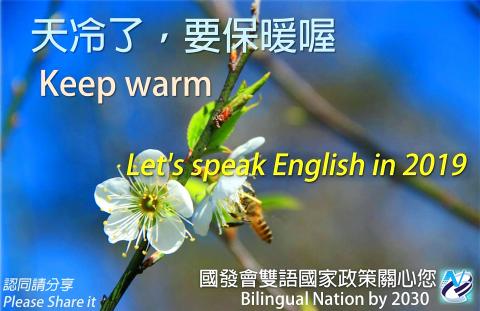
Photo courtesy of the National Development Council
A classic version could start with a portrait of a pink lotus flower in full bloom, overlaid with yellow words reading: “Good morning. Peace. Health. Fortune. Happiness.” Seniors send the zhangbeitu to wish loved ones a good day on ordinary mornings, and also to convey festive greetings on special occasions.
Despite the goodwill, many bulletin boards on Professional Technology Temple (PTT, the local equivalent of Reddit) are dedicated to ridiculing zhangbeitu. The phenomenon is derided by young digitals because of the rudimentary designs and perception that seniors send zhangbeitu indiscriminately, in spam-like blasts.
Users on PTT also describe feelings of bewilderment about how to respond when they receive zhangbeitu given the non sequitur nature of such messages, in which text, image and conversational context often have little to no relation.
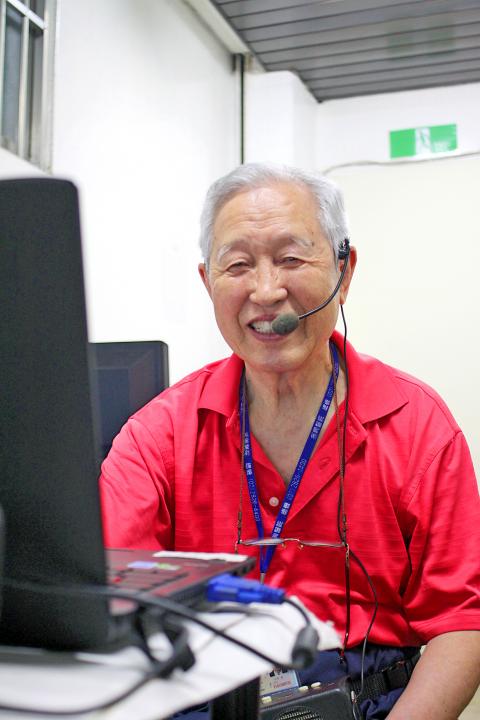
Photo: Davina Tham, Taipei Times
COMPUTER CLASS
When a zhangbeitu goes viral, it travels so far and wide that its point of origin seems impossible to locate. In fact, it’s usually closer than many realize. Many seniors make their first graphics in computer classes organized by neighborhood community centers and community colleges.
In a small classroom in the Xinzhong Borough (新忠) community center in Taipei’s Wanhua District (萬華), Chang Wang-hao (張望豪), 89, has led a weekly computer class for seniors for more than a decade.
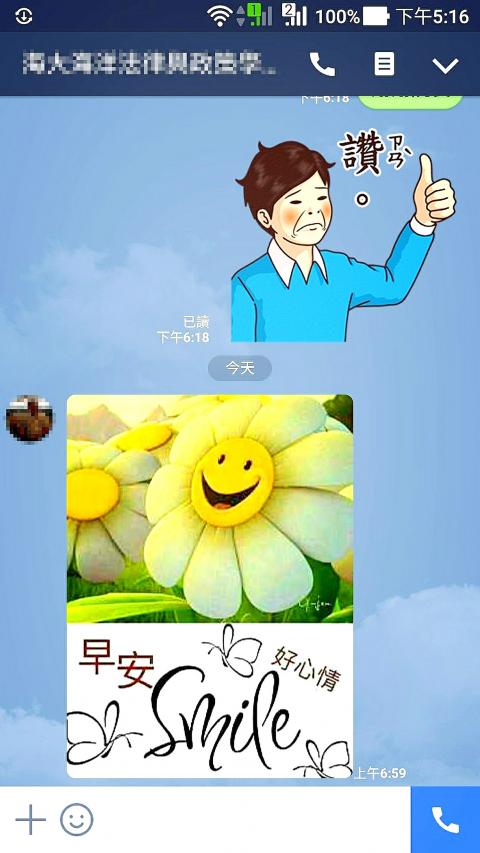
Photo: Wu Cheng-feng, Liberty Times
Chang dedicates an entire eight-week semester to teaching his students how to handle images on a computer. In his classroom, as in many others around the city, students learn the basics of downloading and saving images and editing photos by working on zhangbeitu, which combines several essential skills.
“Many Line stickers are made in our classroom,” Chang says, referring to the sticker function through which zhangbeitu are transmitted on Line. While unsure about why exactly zhangbeitu is so popular, he guesses that it might be because seniors find the image editing software easy to use.
A lesson outline for a course at the Taipei Xinyi Community College on creating Line stickers advertises the fact that producing zhangbeitu can also be a source of pocket money. Still and animated stickers can be sold for NT$30 and NT$60 respectively on the Line online shop.

Photo courtesy of Team Ear Music
An embodiment of lifelong learning, Chang himself picked up computer skills after retiring at the age of 65, and decided to put his newfound knowledge to use by sharing it with other seniors. He picked up smartphone usage by himself only two years ago, with a bit of assistance from family members.
According to statistics released by the National Development Council (NDC) last year, only 42.8 percent of Taiwanese aged 65 and above had used the Internet before, compared to 97.7 percent of citizens aged 12 to 49. The mobile penetration rate among senior citizens aged 60 and above was 20.2 percent.
In the results of another survey of senior citizens aged 60 and above in Yilan, Changhua, Yunlin, Chiayi, Pingtung and Penghu counties last year, the NDC pointed out that senior citizens active on the Internet reported better levels of health and satisfaction (76 percent and 73.7 percent respectively) than those who had never gone online before (48.2 percent and 54.3 percent respectively).
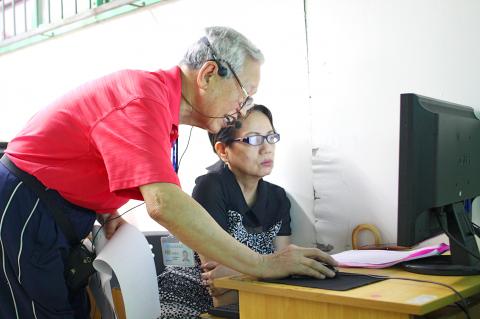
Photo: Davina Tham, Taipei Times
Chang says that his smartphone is most useful for making calls, rather than sending messages or viewing information online. He uses Line to send zhangbeitu to friends, family and colleagues, but when asked what kind of reply he hopes to receive from them, he is indeterminate.
In an office down the hall from the classroom, Ho Li-min (何麗民), an administrative assistant for Xinzhong Borough who is in her 40s, airs her own thoughts as a zhangbeitu recipient. Receiving zhangbeitu can be a little “perplexing,” Ho says, but she still finds the practice acceptable because the seniors make the graphics with sincerity.
“I think it’s quite impressive that they know how to make these and that they have the mindset that they want to learn” new skills says Ho, who usually replies to zhangbeitu with a sticker or greetings.
USES AND ABUSES
Despite being perplexed, younger generations have also been able to find ironic entertainment in zhangbeitu, even creating parodies. Meta versions of zhangbeitu push the medium into the realm of absurdist humor, such as a portrait of the same pink lotus flower that now simply reads: “This is a lotus flower.”
The tendency of zhangbeitu to spread virally among seniors, as well as the kitschy appeal it holds for younger generations, has not gone unnoticed. Government agencies, designers, celebrities and politicians are incorporating its visual language into their branding and public communications.
In February, the National Development Council released a series of zhangbeitu with English translations to promote its policy of Taiwan becoming a bilingual nation by 2030.
Singer-songwriter Crowd Lu (盧廣仲) enhances his grassroots, boy-next-door appeal by posting endearing screenshots of zhangbeitu exchanges with his grandfather on his Facebook fanpage.
Common features of zhangbeitu, such as pixelated landscapes and the phrase “if the message resonates, please share” (認同請分享), even became design elements in fashion designer Angus Chiang’s (江奕勳) spring/summer menswear collection this year.
All of these point to the fact that the camp aesthetic of zhangbeitu is gradually being integrated into mainstream visual culture. It’s an improbable development in the evolution of a visual language that has humble origins in cramped classrooms.
Chang himself continues to be a student, and is now moving on from still images to videos. His latest interest on the computer is downloading and watching videos of university speech and debate competitions that touch on social and political issues.
After initially considering retiring his computer classes last year, Chang decided to keep going as long as other senior citizens showed an interest in learning. He can still be found at the Xinzhong Borough community center every week, patiently instructing a classroom full of peers and juniors.
“Having learned so much about computers, I know I won’t be able to take this knowledge with me when I pass on,” Chang says, “so sharing it seems to me like a good idea.”

Ajay Verma, a consultant gastroenterologist at Kettering general hospital in Northamptonshire, says our gut is a “complex machine.” “It is constantly providing us with the nutrition we need, initially to grow and develop, and then for us to survive, thrive and repair from injury and illness.” How can we keep it functioning well? Put simply: “Make sure what you put into it is balanced, and that you clear out its waste products adequately,” Verma says. “In a general gastroenterology clinic, the most common conditions we see are irritable bowel syndrome (IBS), gastroesophageal reflux disease, inflammatory bowel disease and constipation,” says Nisha
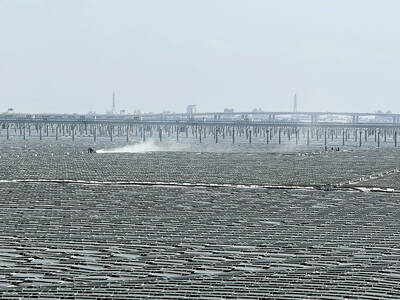
The arithmetic is straightforward and uncomfortable. By the end of 2025, Taiwan had committed itself to a 50-30-20 electricity mix — half natural gas, 30 per cent coal, 20 per cent renewables. The Ministry of Economic Affairs’s (MOEA) own monthly energy reports tell a different story. Natural gas reached 47.8 per cent of generation last year. Coal stood at 35.4 per cent, comfortably above its target ceiling. Renewables came in at 13.1 per cent, well short of the 20 per cent Taipei had pledged a decade earlier. Installed renewable capacity reached roughly half of the 12 gigawatts (GW) the government

There are shadowy cabals plotting to sell out Taiwan to be annexed by China, by invasion if necessary. Fortunately, they are buffoons. In 2019, former Bamboo Union gangster and founder of the China Unification Promotion Party (CUPP), Chang An-le (張安樂, colorfully known as “White Wolf”), led a protest at the Legislative Yuan against comments made by then-premier Su Tseng-chang (蘇貞昌) that in the event of an attack by China, he would never surrender, but would protect the nation by fighting to the end, even if he only had a broom. Chang had party members bring a wooden casket that they
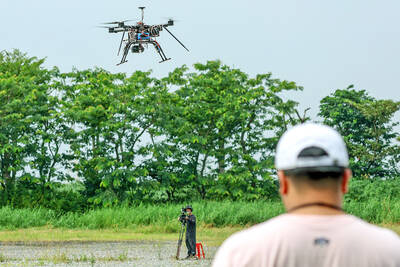
Taiwan’s drone exports are taking off, fuelled by the war in Ukraine, as Taiwanese companies seek a stake in the fast-growing global market for unmanned aerial vehicles (UAV). Low-cost drones used for reconnaissance and strikes are in high demand as governments around the world boost defense spending in the face of intensifying conflicts. A relative new player in the increasingly competitive industry, Taiwan’s pitch is to be an “Asian hub” for the production of UAVs and components free of Chinese materials, or “non-red.” That means its UAVs can be up to three times more expensive than their Chinese competitors, like the world’s biggest


 RSS
RSS