


Bubble tea, also called pearl tea (珍珠奶茶), is a quintessentially Taiwanese drink, but how old is the chewy tapioca ball-filled beverage, who invented it and how did it become to be so popular?
The origins of bubble tea are steeped in mystery and still hotly debated, but according to the orthodox version of events, the story begins in 1980s Taiwan.
At the time something called “bubble tea” — quite different from the drink we know today — was all the rage. Made with either black tea or green tea, brewed tea was sweetened with sugar syrup and then shaken through ice in a cocktail shaker to both chill the tea and produce a copious amount of bubbly froth at the top of the glass, similar to a “head” on a freshly poured pint of beer. The shaking was initially done by hand, but later machines were developed to automatically agitate the tea mixture.
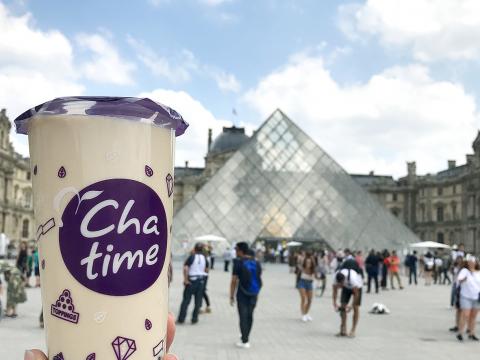
Photo: Yang Ya-min, Taipei Times
At some point, chewy tapioca balls (粉圓) were added to bubble tea, resulting in pearl milk tea, the familiar drink we know today. Two rival Taiwanese teahouse chains — Hanlin Tea Room (翰林茶館) in Tainan and Chun Shui Tang (春水堂人文茶館) in Taichung — lay claim to conceiving the bubbly beverage.
DISPUTE OVER ORIGINS
Hanlin Tea Room insists it came up with the idea in 1986 when its founder Tu Tsung-ho (?宗和) spotted white-colored tapioca balls on sale at Tainan’s Yamuliao market. Tu had a sudden flash of inspiration and bought some of the balls home, and after cooking them through, added them to some milk tea. He found the texture pleasing and soon christened the new beverage pearl milk tea on account of the pearly, semi-translucent white tapioca balls. To this day, customers at any branch of Hanlin Tea Room can choose between either the original white tapioca balls or the more common black variety, made with brown sugar.
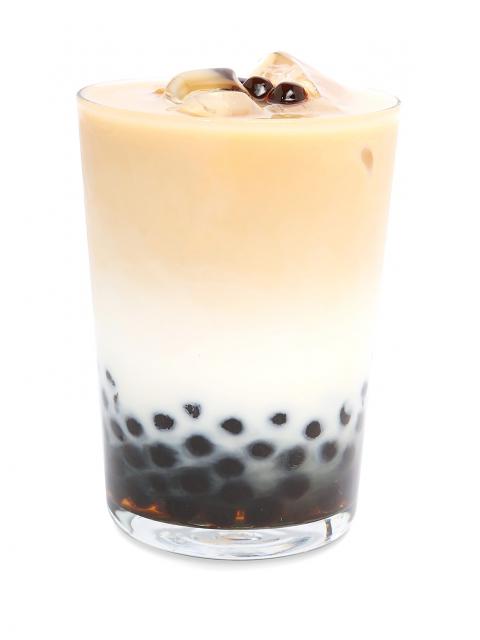
Photo Courtesy of Cha Cha The
However, Chun Shui Tang maintains it is the true inventor of the beverage, which it says was created by a then-20-year-old female employee, Lin Hsiu-hui (林秀慧), the following year in 1987. One day at the teahouse, Lin experimented by mixing her favorite childhood snack, tapioca balls, with iced milk tea and also lemon black tea to produce what the company claims was the world’s first cup of pearl milk tea.
The two companies became locked in a bitter dispute, filing lawsuits against each other and eventually going to court to settle the matter. However, since neither one was able to successfully patent or trademark their product, by the mid-1990s, pearl milk tea featured on the menus of Taiwan’s teahouses, which were popular hangouts for students and businessmen to relax and chew the cud in the days before the influx of coffee shops. With the introduction from abroad of machines that automatically seal the top of takeaway cups with a thin film of plastic, the modern takeaway version of the beverage was born.
ANOTHER THEORY
However, there is an intriguing alternative explanation: bubble tea’s earliest incarnation could in fact be traced back to the days of the British empire. In British Malaya (modern-day Singapore and Malaysia) an iced drink/desert, usually called cendol or chendol, began to be drunk to provide respite from the tropical heat.
Brightly-colored, worm-like gelatinous strands, usually made from rice flour or sago, are added to coconut milk which has been sweetened with sugar and combined with ice to make a refreshing drink or iced snack. It is thought that cendol may have been inspired by locals observing British expatriates adding milk to their tea and may have originated in port cities such as Malacca or Penang, where refrigeration technology from British ships would have provided the ice. Today, Cendol is a ubiquitous thirst-quencher drunk across South East Asia, including Thailand, Vietnam and Indonesia and when served in a tall glass, bears an uncanny resemblance to Taiwan’s bubble tea.
Meanwhile, chewy tapioca balls, called fenyuan in Chinese, somehow made their way to Taiwan from abroad — possibly via China, after being presented to Empress Dowager Cixi (慈禧太后) as tribute — and began to be used as an ingredient in sweet snacks at Taiwanese night markets. Contrary to the competing claims of the teahouses, perhaps the real origin of bubble tea is to be found in Taiwan’s night markets, possibly inspired by a Taiwanese night market vendor sipping on a glass of cendol during a trip to Singapore or Malaysia.
Whatever the true origin of bubble tea, today takeaway tea shops abound on almost every street corner and rival chains fiercely compete for business, continually innovating wacky new flavor combinations and textures to keep customers coming back for more. In recent years, Taiwan’s quasi-national beverage has successfully seen off the coffee juggernaut as well as multiple food safety scares and looks set to stay a permanent fixture of Taiwan’s culinary scene for many years to come.

Taiwan’s English education system is being pulled apart by three opposing forces. Bilingual Nation 2030 pulls students toward English and global communication. Artificial Intelligence (AI) readiness pulls them toward digital judgment, verification and AI-mediated work. But Taiwan’s old exam culture pulls them back toward memorization, grammar drills, timed reading and correct answers. If the education system keeps using old exams to define success, it risks producing graduates who are neither genuinely bilingual nor genuinely AI-ready, but trained for tasks machines can already perform. The first force is Bilingual Nation 2030. Launched in 2018, the policy aimed to “help Taiwan’s workforce connect
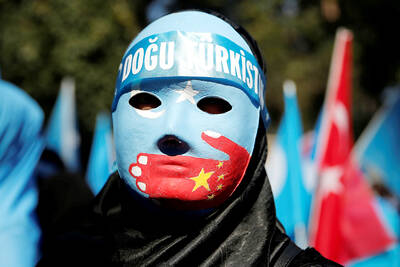
It seems every few days one bumps into one of those “real man” comments in which Taiwan is urged to “face reality” or similar, and “make a deal,” with the speaker implying that soon it will be too late. “Deal” advocates always present themselves as having a superior grip on reality, and the manly ability to make the “hard choice.” Their testosterone-laden language often echoes that of Taiwan sellout advocates. Note that such commentary always specifies a process (“make a deal, work with, make progress”), never the end state of what occupation by a violent authoritarian colonialist state will entail. In
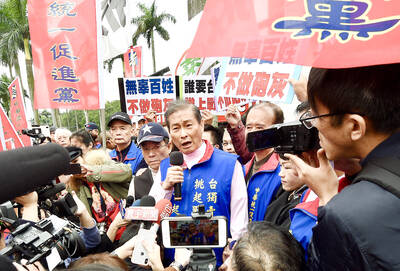
There are shadowy cabals plotting to sell out Taiwan to be annexed by China, by invasion if necessary. Fortunately, they are buffoons. In 2019, former Bamboo Union gangster and founder of the China Unification Promotion Party (CUPP), Chang An-le (張安樂, colorfully known as “White Wolf”), led a protest at the Legislative Yuan against comments made by then-premier Su Tseng-chang (蘇貞昌) that in the event of an attack by China, he would never surrender, but would protect the nation by fighting to the end, even if he only had a broom. Chang had party members bring a wooden casket that they
June 1 to June 7 "If all Taiwanese were as afraid of dying as you, then what would happen?” Physician Shih Chiang-nan (施江南) reportedly said this to his wife Chen Chiao-tung (陳焦桐) after she urged him to stop intervening on behalf of Taiwanese soldiers stranded overseas after serving in the Japanese Army during World War II. Shih had clashed with high-ranking officials over the issue, engaged in several heated arguments with Taiwan governor-general Chen Yi (陳儀) and allegedly shouted at general Ko Yuan-fen (柯遠芬), chief of staff of the Taiwan Garrison Command, over


 RSS
RSS