


Pingdengli (平等里, “flat village”) is a large, and, yes, relatively flat area of land, lying at about 400 meters above sea level in the southern foothills of Yangmingshan (陽明山). Thanks to the Datun Mountains (大屯山群), which loom above it to the north and west, the area is protected from the worst of the nasty weather that comes in from the ocean, and this is one of the most sheltered and sunniest spots in all Yangmingshan.
The area’s excellent microclimate, coupled with its rich volcanic soil, makes it perfect for growing things. Originally fruit and vegetables were the main crop farmed here, but as competition from farms in southern Taiwan increased, farmers started targeting local tourists by growing flowers, ornamental trees and pick-your-own fruit, such as strawberries.
This is a wonderful, yet often overlooked, corner of Yangmingshan National Park (陽明山國家公園). Even better, the weather in this area is often dry during the winter monsoon months, when more exposed parts of the mountains to the north and east are cold, wet and foggy. Equally, the shady woods, relatively gentle ascents of many trails and a chain of natural pools in the Neishuang Creek (內雙溪) make it a relatively comfortable choice for a summer hike.
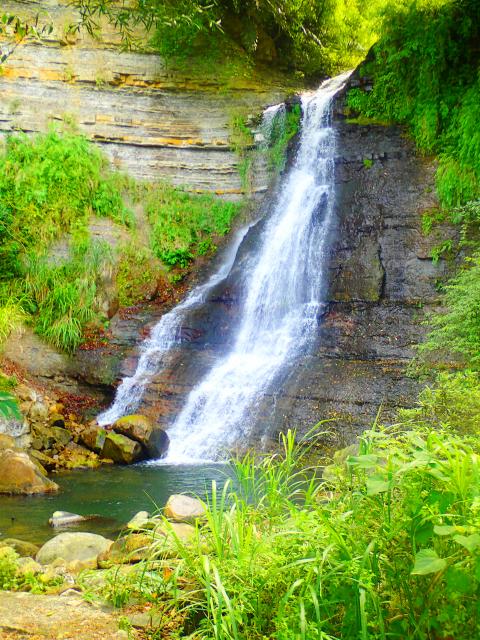
Photo: Richard Saunders
OLD TRAILS
The area has been farming land for over a century, and before the first roads were built up into the mountains, locals crossed the area by a network of old trails. At least 20 old trails in what is now Yangmingshan National Park can still be followed, and in Pingdengli alone, no less than four parallel old routes link old farming settlements with the ridges of Qingtiangang (擎天崗, better known to many expats as Buffalo Meadow) high above.
Of the four, Majiao Old Trail (瑪礁古道) and Zhugaoling Old Trail (竹篙嶺古道) keep to the high ground of two parallel ridges. For much of its length, Jiaokeng Old Trail (礁坑古道) keeps close to a wooded creek that flows through the valley between to the two. The fourth, longest and finest of the four routes, the Naishuangsi Old Trail (內雙溪古道), follows the headwaters of the Neishuang Creek, making a lovely, not too strenuous and (for most of its length) remarkably peaceful, solitary ramble.
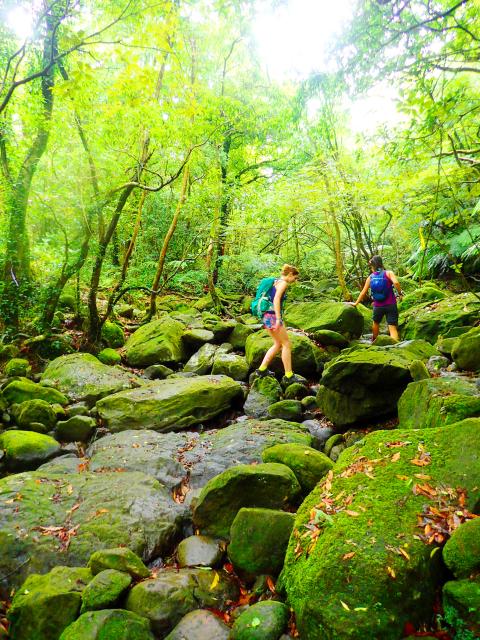
Photo: Richard Saunders
Even today, the trail is far from popular. Maybe the unsurfaced dirt path deters most people (there’s not one stretch of stone-slabbed path to be seen on the trail proper), or maybe it’s because the stream has to be forded six times (which would be difficult or dangerous after heavy rain).
In any event, it’s a quiet hiking choice for a busy weekend. Even the bus ride out there, along the Waishuang Creek valley past the National Palace Museum, is hassle-free, since it’s a far less busy route than any of the bus services running up onto Yangmingshan proper, which are packed to overflowing most weekend mornings, and often on weekdays too.
To get to the trailhead, take bus S18 from Jiantan MRT Station to the last stop, near Shenren Waterfall (聖人瀑布). This lovely 15-meter-high cascade is one of Yangmingshan’s loveliest and easily accessible falls, although (thankfully) it’s become far less popular with tourists since a typhoon knocked out the bridge below in 2004. Although not officially allowed, it’s easy to cross the rocky bed of the stream for a closer look if the water level is fairly low (but don’t attempt it after heavy rain).
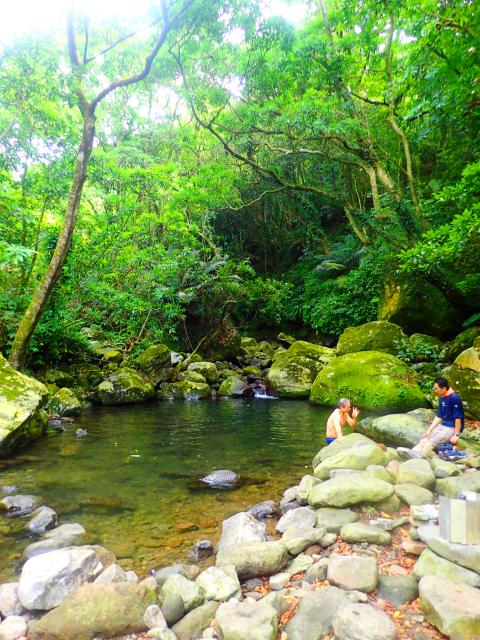
Photo: Richard Saunders
The waterfall is also perhaps the best place in Yangmingshan to see the original sedimentary rock of the Wuzhishan (五指山) range, which elsewhere hereabouts is covered by volcanic (igneous) rock, thick undergrowth or both. The cliffs to the left of the waterfall display some fine strata lines.
After getting off the bus, follow Zhishan Road (至善路) away from Taipei, past the Saint’s Waterfall approach road. When the main road doubles back to the left, continue ahead along a narrow lane uphill for about 10 minutes, and at the next hairpin bend, keep straight ahead on to a stone footpath which soon crosses the stream and climb the steps up the far side.
Keep left at the next junction, down steps, and recross the stream by another footbridge. Now follow the steps up the hillside opposite, crossing the first of three water channels which contour the wooded hillside, carrying water down to the farms of Pingdengli. The oldest is the uppermost, the three-kilometer-long Pingdengli Old Water Channel (平等里古圳) which was established in the 1830s. Turn right onto a dirt path beside this third water channel, and pass through an iron gate.
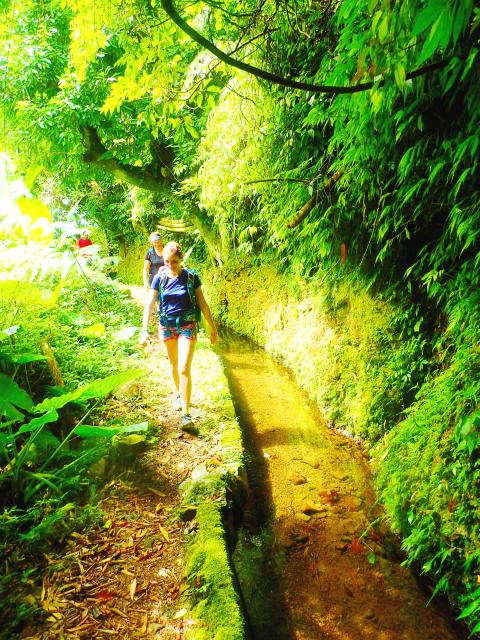
Photo: Richard Saunders
SWIMMING HOLE
If it’s a hot day, take a faint trail that veers right at the gate, descending to rejoin the Neishuang Creek below at a natural pool in the stream. It’s a smaller swimming hole than the sumptuous beauties you’ll find around Wulai (烏來) and Pinglin (坪林), but it’s one of the nicest I know of in Yangmingshan, and especially inviting after it’s been replenished by heavy rain.
Follow the channel upstream for another five minutes past the gate, and just before it joins the Neishuang Creek, take a dirt trail on the left, climbing high above the stream, then descending to cross it.
The dirt trail is easy to follow as it continues upstream, eventually crossing the creek a second time. After this, it climbs high above the stream once again. At a T-junction, take the wide trail on the right, and after another twenty minutes or so, it crosses the Neishuang Creek another four times in fairly quick succession.
Although it’s been a gentle climb for most of the way, the trail has now nearly gained the grassy, 800-meter heights of Qingtiangang. After the sixth and last stream crossing, the trail strikes left, following a smaller tributary stream, passing the remains of several stone buildings. Ruins like these lie scattered all over Yangmingshan, a reminder that a century ago, the landscape here would have looked very different, and that many areas on this part of the mountain were settled by farmers.
After 15 minutes or so the trail emerges from the woods into silver grass, and suddenly joins one of those familiar stone surfaced paths that crisscross Yangmingshan’s tourist-friendly corners. Turn left and follow the signposts (and an increasing number of fellow walkers), through the grassy folds of Qingtiangang’s miniature valleys and ridges to reach the road and visitor center.
Bus S15 offers a direct connection back to Jiantan Station, but if the tourist masses aren’t too overwhelming, hang around a little. Qingtiangang is one of the national park’s most popular attractions, yet on a fine day it’s magnificent.
Richard Saunders is a classical pianist and writer who has lived in Taiwan since 1993. He’s the founder of a local hiking group, Taipei Hikers, and is the author of six books about Taiwan, including Taiwan 101 and Taipei Escapes. Visit his Web site at www.taiwanoffthebeatentrack.com

Ajay Verma, a consultant gastroenterologist at Kettering general hospital in Northamptonshire, says our gut is a “complex machine.” “It is constantly providing us with the nutrition we need, initially to grow and develop, and then for us to survive, thrive and repair from injury and illness.” How can we keep it functioning well? Put simply: “Make sure what you put into it is balanced, and that you clear out its waste products adequately,” Verma says. “In a general gastroenterology clinic, the most common conditions we see are irritable bowel syndrome (IBS), gastroesophageal reflux disease, inflammatory bowel disease and constipation,” says Nisha
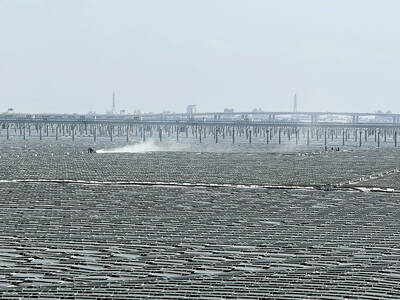
The arithmetic is straightforward and uncomfortable. By the end of 2025, Taiwan had committed itself to a 50-30-20 electricity mix — half natural gas, 30 per cent coal, 20 per cent renewables. The Ministry of Economic Affairs’s (MOEA) own monthly energy reports tell a different story. Natural gas reached 47.8 per cent of generation last year. Coal stood at 35.4 per cent, comfortably above its target ceiling. Renewables came in at 13.1 per cent, well short of the 20 per cent Taipei had pledged a decade earlier. Installed renewable capacity reached roughly half of the 12 gigawatts (GW) the government

Last week US President Donald Trump was asked by a reporter whether he would speak on the phone to the President of Taiwan. “l’ll speak to him. I speak to everybody. We have that situation very well in hand,” Trump said. This marked the second time in a couple of weeks he had said he would talk to the President of Taiwan. In 2016 he famously took a call from then-president Tsai Ing-wen (蔡英文), when he was president-elect. Despite warnings that the apocalypse was nigh because of a phone call, the world quickly forgot about the conversation between two democratically-elected presidents.
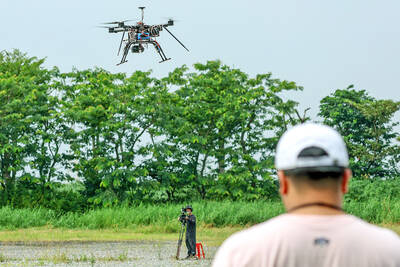
Taiwan’s drone exports are taking off, fuelled by the war in Ukraine, as Taiwanese companies seek a stake in the fast-growing global market for unmanned aerial vehicles (UAV). Low-cost drones used for reconnaissance and strikes are in high demand as governments around the world boost defense spending in the face of intensifying conflicts. A relative new player in the increasingly competitive industry, Taiwan’s pitch is to be an “Asian hub” for the production of UAVs and components free of Chinese materials, or “non-red.” That means its UAVs can be up to three times more expensive than their Chinese competitors, like the world’s biggest


 RSS
RSS