


US troops in a never-ending war. Students marching in the streets. Women demanding respect. Black athletes protesting for racial justice. Political upheaval.
Today’s headlines?
Yes.
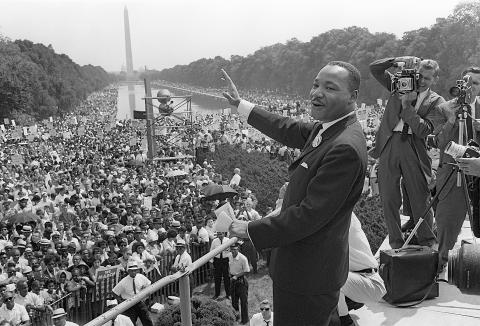
Photo: AFP
But they also could be from 50 years ago —1968 was a year so eventful that it’s become known as “The Year That Changed America.”
“Assassinations, riots, rebellions, protests, disorder and chaos —1968 was a year of really extraordinary shocks, shocks that I think still reverberate through today,” said David Farber, a history professor at the University of Kansas.
“The 1960s are this incredibly turbulent, tumultuous decade of politics and 1968 really sticks out,” said Amy Bass, a history professor at The College of New Rochelle.
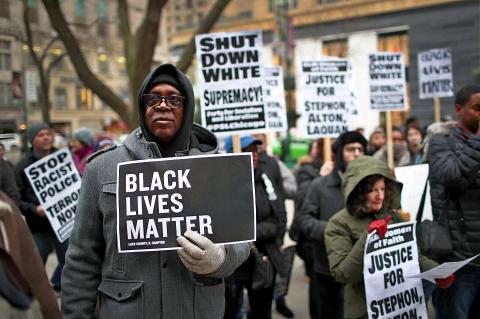
Photo: AFP
Some Americans are thinking “the people are rising and will have a voice,” said Bass, author of One Goal.
“And then there’s this other faction, (Richard Nixon’s) so-called ‘silent majority’ who sees the 1960s as America as coming apart at the seams.”
Rocking America in 1968 was the assassination on April 4 of civil rights leader Martin Luther King Jr and that of Democratic presidential hopeful Robert F. Kennedy just two months later.
By then, the country was already reeling. In January, North Vietnamese troops had launched the Tet Offensive, a blitz on South Vietnam that would eventually turn the US public against a war that was America’s longest until the 2001 invasion of Afghanistan.
US college campuses were gripped by anti-war protests and 700 students were injured in clashes with police at New York’s Columbia University in April 1968.
STUDENTS ON MARCH AGAIN
The war in Afghanistan has spawned no such protest movement despite entering its 17th year.
This can be explained in part because it stemmed from the Sept. 11, 2011 direct attacks on the US — but also because the military draft was eliminated in 1973, said Columbia University history professor Todd Gitlin.
“And the intensity of the war is far less,” said Gitlin, author of The Sixties: Years of Hope, Days of Rage.
“It’s off the screens for Americans and the body bags are few and far between, relatively speaking.” US students are on the march once again though — not to oppose an unpopular war, but to demand tougher gun laws.
“There’s a big difference, however,” Gitlin said. “The high school students are actually starting something.”
In the largest student protest in decades, hundreds of thousands took part on March 24 in the “March for Our Lives” organized by teenagers from a Florida high school where 17 people were shot dead in February.
“The political system again seems frozen for students today and they’re trying to find answers that don’t fit normal electoral politics,” Farber said.
Students were not the only ones protesting in the 1960s — the decade was marked by the civil rights movement led by King. King notably advocated non-violence but his assassination in Memphis, Tennessee sparked riots in several US cities.
Fifty years on, the banner for racial equality has been taken up by the Black Lives Matter movement and its protests against police misconduct and the use of force.
TREATMENT OF WOMEN
One of the iconic images of 1968 is that of Tommie Smith and John Carlos, winners of the gold and bronze medals in the 200-meter dash at the 1968 Olympic Games in Mexico City, raising black-gloved fists as the Star-Spangled Banner played.
Five decades later, a black athlete has once again become one of the most visible symbols of the struggle for racial equality.
Colin Kaepernick, the former quarterback of the San Francisco 49ers, has cited Smith and Carlos as an inspiration for his decision to kneel during the playing of the national anthem — a protest which has drawn sharp criticism from President Donald Trump.
Kaepernick and Black Lives Matter have been subjected to “vilification much like what we saw in response to the Black Power movement in the late 1960s,” said Susan Eckelmann Berghel, an assistant professor of history at the University of Tennessee Chattanooga.
The women’s movement in the US also took on a new dimension in 1968 with a protest by hundreds of women in Atlantic City against the Miss America beauty pageant.
“They tried to ask a very difficult question, which was ‘How should women be treated?’” said Farber. “Which is the kind of question we’re still asking.”
“That doesn’t get settled in a year or a decade,” Gitlin said.
In January of last year, hundreds of thousands of women took to the streets to protest Trump’s inauguration, he noted, and the #MeToo movement is “the next wave of a similar sentiment.”
Eckelmann Berghel said another echo in 2018 of 1968 could be what some see as the “shortcomings of the promises of a liberal presidency.”
President Lyndon Baines Johnson unveiled ambitious plans to abolish poverty and racial injustice under the banner of the Great Society.
But Johnson, wearied by the Vietnam War, shocked the nation in March 1968 by announcing he was not running for re-election.
That paved the way for the election of Nixon, a conservative Republican who promised Americans he would restore order to a chaotic decade.
And just as Johnson did not win the “War on Poverty,” the election of Barack Obama, America’s first black president, did not lead to a “post-racial society.”
Trump reached into Nixon’s 1968 playbook to win the White House, Farber said, creating his “new version of conservative populism.”
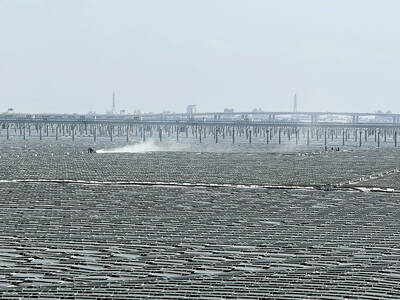
The arithmetic is straightforward and uncomfortable. By the end of 2025, Taiwan had committed itself to a 50-30-20 electricity mix — half natural gas, 30 per cent coal, 20 per cent renewables. The Ministry of Economic Affairs’s (MOEA) own monthly energy reports tell a different story. Natural gas reached 47.8 per cent of generation last year. Coal stood at 35.4 per cent, comfortably above its target ceiling. Renewables came in at 13.1 per cent, well short of the 20 per cent Taipei had pledged a decade earlier. Installed renewable capacity reached roughly half of the 12 gigawatts (GW) the government
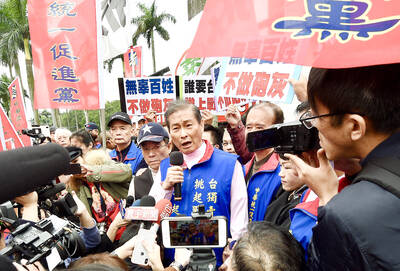
There are shadowy cabals plotting to sell out Taiwan to be annexed by China, by invasion if necessary. Fortunately, they are buffoons. In 2019, former Bamboo Union gangster and founder of the China Unification Promotion Party (CUPP), Chang An-le (張安樂, colorfully known as “White Wolf”), led a protest at the Legislative Yuan against comments made by then-premier Su Tseng-chang (蘇貞昌) that in the event of an attack by China, he would never surrender, but would protect the nation by fighting to the end, even if he only had a broom. Chang had party members bring a wooden casket that they
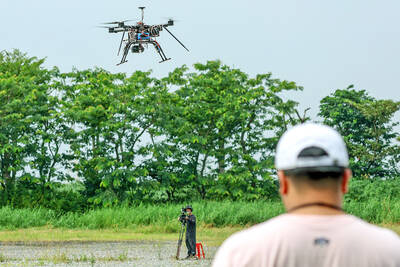
Taiwan’s drone exports are taking off, fuelled by the war in Ukraine, as Taiwanese companies seek a stake in the fast-growing global market for unmanned aerial vehicles (UAV). Low-cost drones used for reconnaissance and strikes are in high demand as governments around the world boost defense spending in the face of intensifying conflicts. A relative new player in the increasingly competitive industry, Taiwan’s pitch is to be an “Asian hub” for the production of UAVs and components free of Chinese materials, or “non-red.” That means its UAVs can be up to three times more expensive than their Chinese competitors, like the world’s biggest
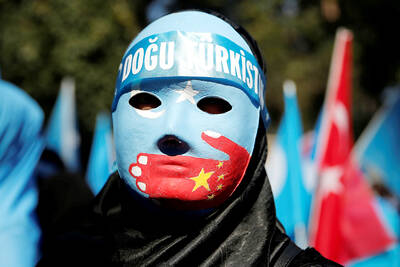
It seems every few days one bumps into one of those “real man” comments in which Taiwan is urged to “face reality” or similar, and “make a deal,” with the speaker implying that soon it will be too late. “Deal” advocates always present themselves as having a superior grip on reality, and the manly ability to make the “hard choice.” Their testosterone-laden language often echoes that of Taiwan sellout advocates. Note that such commentary always specifies a process (“make a deal, work with, make progress”), never the end state of what occupation by a violent authoritarian colonialist state will entail. In


 RSS
RSS